
Nursing practice questions with comprehensive rationales
NurseDive Free Nursing Practice Question
A client is wearing a Venturi mask to deliver oxygen and the dinner tray has arrived. What action by the nurse is best?
A. Assess the client’s oxygen saturation and, if normal, turn off the oxygen.
Assess the client’s oxygen saturation and, if normal, turn off the oxygen. This option is not ideal because turning off the oxygen completely can lead to a rapid drop in oxygen saturation levels, especially in patients who require continuous oxygen therapy. Monitoring oxygen saturation is crucial, but turning off the oxygen is not recommended unless specifically advised by a healthcare provider. Normal oxygen saturation levels typically range from 95% to 100%1. If the levels drop below 90%, it can lead to hypoxemia, which can cause serious complications.
B. Have the client lift the mask off the face when taking bites of food.
Have the client lift the mask off the face when taking bites of food. This option is also not ideal because it can be cumbersome for the client and may lead to inconsistent oxygen delivery. The Venturi mask is designed to provide a precise concentration of oxygen, and lifting it off repeatedly can disrupt this consistency. Additionally, it can be uncomfortable and impractical for the client to manage the mask while eating.
C. Turn the oxygen off while the client eats the meal and then restart it.
Turn the oxygen off while the client eats the meal and then restart it. This option is not recommended for similar reasons as Choice A. Turning off the oxygen can lead to a significant drop in oxygen saturation levels, which can be dangerous for the client. Continuous oxygen therapy is essential for maintaining adequate oxygen levels in patients who require it. Interrupting this therapy, even temporarily, can have adverse effects on the client’s health.
D. Determine if the client can switch to a nasal cannula during the meal
Determine if the client can switch to a nasal cannula during the meal. This is the best option because a nasal cannula allows the client to receive continuous oxygen while eating. The nasal cannula is less obtrusive and more comfortable for the client, enabling them to eat without significant interruption to their oxygen therapy. Nasal cannulas are commonly used for patients who need supplemental oxygen but also need to perform activities such as eating and talking. This approach ensures that the client maintains adequate oxygen levels while having their meal.
This question is an excerpt from Nurse Dive's nursing test bank - Final Med Surg Comprehensive Proctored Exam (Brooklyn University). Take the full exam now
Full Explanation
Choice A Reason:
Assess the client’s oxygen saturation and, if normal, turn off the oxygen. This option is not ideal because turning off the oxygen completely can lead to a rapid drop in oxygen saturation levels, especially in patients who require continuous oxygen therapy. Monitoring oxygen saturation is crucial, but turning off the oxygen is not recommended unless specifically advised by a healthcare provider. Normal oxygen saturation levels typically range from 95% to 100%1. If the levels drop below 90%, it can lead to hypoxemia, which can cause serious complications.
Choice B Reason:
Have the client lift the mask off the face when taking bites of food. This option is also not ideal because it can be cumbersome for the client and may lead to inconsistent oxygen delivery. The Venturi mask is designed to provide a precise concentration of oxygen, and lifting it off repeatedly can disrupt this consistency. Additionally, it can be uncomfortable and impractical for the client to manage the mask while eating.
Choice C Reason:
Turn the oxygen off while the client eats the meal and then restart it. This option is not recommended for similar reasons as Choice A. Turning off the oxygen can lead to a significant drop in oxygen saturation levels, which can be dangerous for the client. Continuous oxygen therapy is essential for maintaining adequate oxygen levels in patients who require it. Interrupting this therapy, even temporarily, can have adverse effects on the client’s health.
Choice D Reason:
Determine if the client can switch to a nasal cannula during the meal. This is the best option because a nasal cannula allows the client to receive continuous oxygen while eating. The nasal cannula is less obtrusive and more comfortable for the client, enabling them to eat without significant interruption to their oxygen therapy. Nasal cannulas are commonly used for patients who need supplemental oxygen but also need to perform activities such as eating and talking. This approach ensures that the client maintains adequate oxygen levels while having their meal.
Similar Questions
The nurse is taking care of a 60-year-old client with constant bubbling in the water seal chamber. The nurse knows that constant bubbling in the water seal of a chest drainage system indicates which problem?
A. Air leak
: Constant bubbling in the water seal chamber of a chest drainage system typically indicates an air leak. This can occur if there is a break in the system, allowing air to enter. The air leak could be from the chest tube insertion site, the tubing, or the drainage system itself. Identifying and correcting the source of the air leak is crucial to ensure the system functions properly and the patient’s condition does not worsen.
B. Tension pneumothorax
: A tension pneumothorax is a life-threatening condition where air accumulates in the pleural space and cannot escape, leading to increased pressure on the lungs and other thoracic structures. While a tension pneumothorax can cause significant respiratory distress, it is not typically indicated by constant bubbling in the water seal chamber. Instead, signs of tension pneumothorax include tracheal deviation, hypotension, and severe respiratory distress.
C. Kink in the tubing
: A kink in the tubing of a chest drainage system can obstruct the flow of air and fluid, but it does not cause constant bubbling in the water seal chamber. Instead, a kink would likely result in a lack of drainage or intermittent bubbling as the obstruction temporarily blocks and then allows passage of air or fluid.
D. Increased drainage
: Increased drainage in a chest tube system indicates that more fluid or air is being removed from the pleural space, but it does not cause constant bubbling in the water seal chamber. Increased drainage might be seen in cases of hemothorax or pleural effusion, where large amounts of fluid are present.
E. Tidaling
: Tidaling refers to the normal rise and fall of water in the water seal chamber with the patient’s respiratory cycle. It indicates that the chest tube is patent and functioning correctly. Absence of tidaling could suggest that the lung has fully re-expanded or that there is an obstruction in the system. However, tidaling itself does not cause constant bubbling.
Full Explanation
Choice A Reason:
Constant bubbling in the water seal chamber of a chest drainage system typically indicates an air leak. This can occur if there is a break in the system, allowing air to enter. The air leak could be from the chest tube insertion site, the tubing, or the drainage system itself. Identifying and correcting the source of the air leak is crucial to ensure the system functions properly and the patient’s condition does not worsen.
Choice B Reason:
A tension pneumothorax is a life-threatening condition where air accumulates in the pleural space and cannot escape, leading to increased pressure on the lungs and other thoracic structures. While a tension pneumothorax can cause significant respiratory distress, it is not typically indicated by constant bubbling in the water seal chamber. Instead, signs of tension pneumothorax include tracheal deviation, hypotension, and severe respiratory distress.
Choice C Reason:
A kink in the tubing of a chest drainage system can obstruct the flow of air and fluid, but it does not cause constant bubbling in the water seal chamber. Instead, a kink would likely result in a lack of drainage or intermittent bubbling as the obstruction temporarily blocks and then allows passage of air or fluid.
Choice D Reason:
Increased drainage in a chest tube system indicates that more fluid or air is being removed from the pleural space, but it does not cause constant bubbling in the water seal chamber. Increased drainage might be seen in cases of hemothorax or pleural effusion, where large amounts of fluid are present.
Choice E Reason:
Tidaling refers to the normal rise and fall of water in the water seal chamber with the patient’s respiratory cycle. It indicates that the chest tube is patent and functioning correctly. Absence of tidaling could suggest that the lung has fully re-expanded or that there is an obstruction in the system. However, tidaling itself does not cause constant bubbling.
The provider writes an order for a client to have a chest tube removed. Which of the following are appropriate reasons to discontinue a chest tube? Select all that apply.
A. Breath sounds diminished on auscultation.
Breath sounds diminished on auscultation indicate that there may still be fluid or air in the pleural space, suggesting that the chest tube is still needed to drain the pleural cavity. This is not an appropriate reason to discontinue a chest tube as it indicates ongoing issues that need to be resolved.
B. Improved respiratory status.
: Improved respiratory status is a key indicator that the chest tube has successfully resolved the underlying issue, such as a pneumothorax or pleural effusion. When the patient shows signs of stable and improved breathing, it suggests that the chest tube has served its purpose and can be safely removed.
C. Symmetrical rise and fall of the chest.
Symmetrical rise and fall of the chest during respiration indicate that both lungs are expanding and contracting normally. This symmetry is a sign that the pleural space is no longer compromised, making it an appropriate reason to remove the chest tube.
D. Oxygen saturation at least 90%.
Oxygen saturation at least 90% is a general indicator of adequate oxygenation but does not specifically address the condition of the pleural space. While important, it is not a direct reason to discontinue a chest tube without other supporting signs.
E. Continuous bubbling in water seal chamber.
Continuous bubbling in the water seal chamber indicates an ongoing air leak, which means that the chest tube is still necessary to evacuate air from the pleural space. This is not an appropriate reason to remove the chest tube.
F. Chest is asymmetrical on inspiration and expiration.
An asymmetrical chest on inspiration and expiration suggests that there is still an issue with lung expansion, possibly due to fluid or air in the pleural space. This condition requires the chest tube to remain in place until resolved.
G. Bilateral breath sounds clear on auscultation.
Bilateral breath sounds clear on auscultation indicate that both lungs are free of fluid and air, and are functioning normally. This is a strong indicator that the chest tube has achieved its purpose and can be safely removed.
Full Explanation
Choice A Reason:
Breath sounds diminished on auscultation indicate that there may still be fluid or air in the pleural space, suggesting that the chest tube is still needed to drain the pleural cavity. This is not an appropriate reason to discontinue a chest tube as it indicates ongoing issues that need to be resolved.
Choice B Reason:
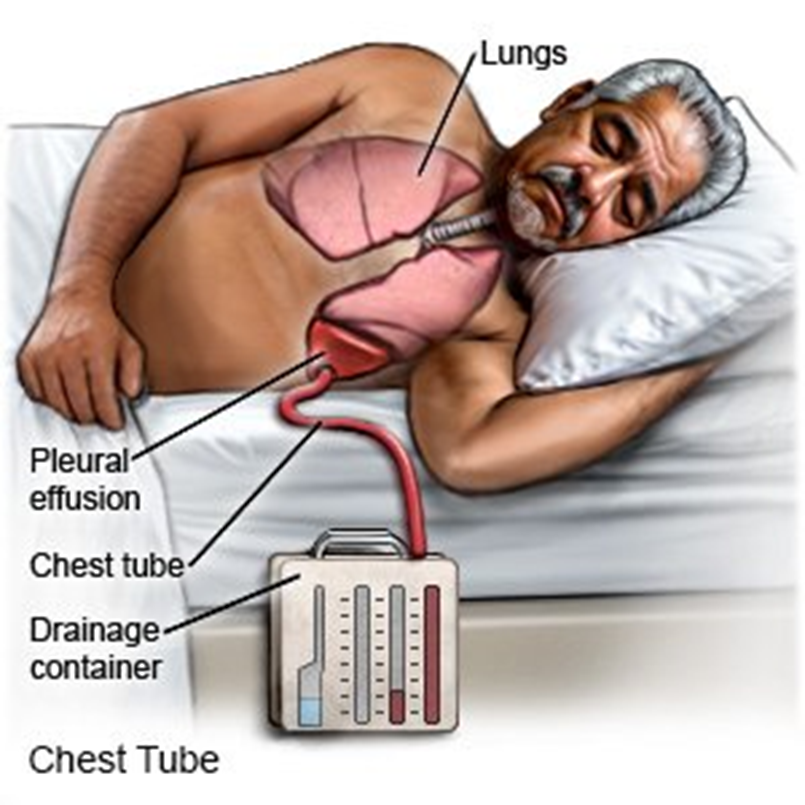
Improved respiratory status is a key indicator that the chest tube has successfully resolved the underlying issue, such as a pneumothorax or pleural effusion. When the patient shows signs of stable and improved breathing, it suggests that the chest tube has served its purpose and can be safely removed.
Choice C Reason:
Symmetrical rise and fall of the chest during respiration indicate that both lungs are expanding and contracting normally. This symmetry is a sign that the pleural space is no longer compromised, making it an appropriate reason to remove the chest tube.
Choice D Reason:
Oxygen saturation at least 90% is a general indicator of adequate oxygenation but does not specifically address the condition of the pleural space. While important, it is not a direct reason to discontinue a chest tube without other supporting signs.
Choice E Reason:
Continuous bubbling in the water seal chamber indicates an ongoing air leak, which means that the chest tube is still necessary to evacuate air from the pleural space. This is not an appropriate reason to remove the chest tube.
Choice F Reason:
An asymmetrical chest on inspiration and expiration suggests that there is still an issue with lung expansion, possibly due to fluid or air in the pleural space. This condition requires the chest tube to remain in place until resolved.
Choice G Reason:
Bilateral breath sounds clear on auscultation indicate that both lungs are free of fluid and air, and are functioning normally. This is a strong indicator that the chest tube has achieved its purpose and can be safely removed.
You retrieved regular insulin 100 units in 1 ml. How many ml should you administer?
Note
- Enter ONLY the number
- DO NOT enter the unit(s) of measurement
Full Explanation
Step 1: Calculate the total infusion time in minutes.
8 hours × 60 minutes/hour = 480 minutes
Result at each step = 480 minutes
Step 2: Calculate the total number of drops to be infused.
1,000 mL × 15 drops/mL = 15,000 drops
Result at each step = 15,000 drops
Step 3: Calculate the infusion rate in drops per minute.
15,000 drops ÷ 480 minutes = 31.25 drops/minute
Result at each step = 31.25 drops/minute
Step 4: Round to the nearest whole number if necessary.
31.25 drops/minute rounds to 31 drops/minute
Result at each step = 31 drops/minute
Therefore, the nurse should run the IV infusion at a rate of 31 drops per minute.