Nursing practice questions with comprehensive rationales
NurseDive Free Nursing Practice Question
A client with muscle spasticity receives a prescription for baclofen. Which information provided by the client requires additional instruction by the nurse?
A. Use stool softener as needed.
Option a, using stool softener as needed, is appropriate because baclofen can cause constipation as a side effect.
B. Avoid ingestion of alcohol.
Option b, avoiding ingestion of alcohol, is also appropriate because alcohol can increase the sedative effects of baclofen and cause drowsiness or dizziness.
C. Discontinue when spasms cease.
Option c, discontinuing the medication when spasms cease, is incorrect because muscle spasticity is a chronic condition, and baclofen is used to manage symptoms over a prolonged period. Discontinuing the medication abruptly can cause withdrawal symptoms and exacerbate the spasticity. Therefore, the nurse should educate the client to take the medication as prescribed by the healthcare provider and not discontinue it without medical advice.
D. Take medication with meals.
Option d, taking medication with meals, is recommended because it can help reduce stomach upset and nausea that may occur as a side effect of the medication.
This question is an excerpt from Nurse Dive's nursing test bank - HESI Pharmacology Proctored Exam. Take the full exam now
Full Explanation
Baclofen is a muscle relaxant medication used to treat muscle spasticity, which is a condition that causes muscles to become stiff and rigid. It works by reducing the activity of nerves in the brain and spinal cord that cause muscle spasms.
Option a, using stool softener as needed, is appropriate because baclofen can cause constipation as a side effect.
Option b, avoiding ingestion of alcohol, is also appropriate because alcohol can increase the sedative effects of baclofen and cause drowsiness or dizziness.
Option d, taking medication with meals, is recommended because it can help reduce stomach upset and nausea that may occur as a side effect of the medication.
Option c, discontinuing the medication when spasms cease, is incorrect because muscle spasticity is a chronic condition, and baclofen is used to manage symptoms over a prolonged period. Discontinuing the medication abruptly can cause withdrawal symptoms and exacerbate the spasticity. Therefore, the nurse should educate the client to take the medication as prescribed by the healthcare provider and not discontinue it without medical advice.

Similar Questions
A client with bipolar disorder admitted with severe depression and suicidal ideation receives a prescription for lithium carbonate, which instruction should the nurse provide to the client?
A. Eliminate use of nonsteroidal anti-inflammatory drugs. (NSAIDs)
Lithium carbonate is a mood stabilizer commonly used to treat bipolar disorder. However, it has a narrow therapeutic index and requires careful monitoring of serum levels to avoid toxicity. One of the major concerns with lithium therapy is the potential for drug interactions and toxicity. NSAIDs such as ibuprofen and naproxen can increase lithium levels by reducing its excretion and can lead to lithium toxicity. Therefore, it is essential to instruct the client to eliminate the use of NSAIDs while taking lithium.
B. Avoid consuming all foods that contain Iodine.
Option b) Avoid consuming all foods that contain iodine is incorrect because iodine is not contraindicated with lithium. However, excessive iodine intake can interfere with thyroid function, which can exacerbate mood instability.
C. Notify healthcare provider prior to dental procedures.
Option c) Notify healthcare provider prior to dental procedures is not specific to lithium therapy and is a general precaution that patients with bipolar disorder should follow before any medical or dental procedures.
D. Monitor blood glucose levels daily.
Option d) Monitor blood glucose levels daily is also not directly related to lithium therapy. While lithium can cause diabetes insipidus, which can lead to excessive thirst and urination, it does not typically affect blood glucose levels.
Full Explanation
Lithium carbonate is a mood stabilizer commonly used to treat bipolar disorder. However, it has a narrow therapeutic index and requires careful monitoring of serum levels to avoid toxicity. One of the major concerns with lithium therapy is the potential for drug interactions and toxicity. NSAIDs such as ibuprofen and naproxen can increase lithium levels by reducing its excretion and can lead to lithium toxicity. Therefore, it is essential to instruct the client to eliminate the use of NSAIDs while taking lithium.
Option b) Avoid consuming all foods that contain iodine is incorrect because iodine is not contraindicated with lithium. However, excessive iodine intake can interfere with thyroid function, which can exacerbate mood instability.
Option c) Notify healthcare provider prior to dental procedures is not specific to lithium therapy and is a general precaution that patients with bipolar disorder should follow before any medical or dental procedures.
Option d) Monitor blood glucose levels daily is also not directly related to lithium therapy. While lithium can cause diabetes insipidus, which can lead to excessive thirst and urination, it does not typically affect blood glucose levels.
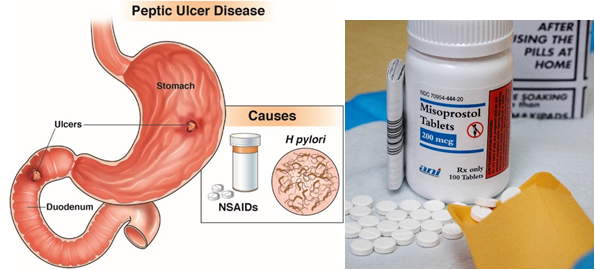
A female client with a history of peptic ulcer disease receives a prescription for misoprostol. Which information provided by the client indicates to the nurse a need for further teaching?
A. Begin therapy 1 week before the next normal menstrual cycle.
Misoprostol should not be used during pregnancy as it can cause harm to the fetus. Women of childbearing potential should use effective contraception while taking misoprostol. If there is a chance of conception, the healthcare provider should be contacted immediately. A negative pregnancy test is required before starting therapy with misoprostol .
B. Use condoms and a backup method of birth control.
C. Call the healthcare provider immediately if there is a chance of conception.
D. Ensure a negative pregnancy test two weeks before therapy.
Full Explanation
Misoprostol should not be used during pregnancy as it can cause harm to the fetus. Women of childbearing potential should use effective contraception while taking misoprostol. If there is a chance of conception, the healthcare provider should be contacted immediately. A negative pregnancy test is required before starting therapy with misoprostol .
A client with open-angle glaucoma asks the nurse how long the prescribed eye drops will need to be used. Which response made by the nurse is accurate?
A. Until a smaller angle can be restored.
Likewise, restoring a smaller angle or managing pain and swelling may be secondary goals but are not the primary purpose of using eye drops in open-angle glaucoma
B. For long-term control of normal eye pressure.
Open-angle glaucoma is a chronic eye condition that can cause irreversible damage to the optic nerve, leading to vision loss or blindness. The primary goal of treatment is to lower and control the intraocular pressure (IOP) to prevent further damage. Eye drops are often prescribed to reduce the IOP and are typically used for long-term control of normal eye pressure, even if the pressure has been reduced to a safe level. Options a, c, and d are incorrect because they do not reflect the long-term management of open-angle glaucoma.
C. Until the excess pressure is reduced.
While reducing excess pressure may be a goal of treatment, it is not a guarantee that the eye drops will be discontinued once the pressure is normalized.
D. For long-term control of pain and swelling.
Likewise, restoring a smaller angle or managing pain and swelling may be secondary goals but are not the primary purpose of using eye drops in open-angle glaucoma
Full Explanation
Open-angle glaucoma is a chronic eye condition that can cause irreversible damage to the optic nerve, leading to vision loss or blindness. The primary goal of treatment is to lower and control the intraocular pressure (IOP) to prevent further damage. Eye drops are often prescribed to reduce the IOP and are typically used for long-term control of normal eye pressure, even if the pressure has been reduced to a safe level.
Options a, c, and d are incorrect because they do not reflect the long-term management of open-angle glaucoma.
While reducing excess pressure may be a goal of treatment, it is not a guarantee that the eye drops will be discontinued once the pressure is normalized.
Likewise, restoring a smaller angle or managing pain and swelling may be secondary goals but are not the primary purpose of using eye drops in open-angle glaucoma