
Nursing practice questions with comprehensive rationales
NurseDive Free Nursing Practice Question
A newborn is jaundiced and receivesphototherapy via ultraviolet bank lights.
An appropriate nursing intervention when caring for an infant with hyperbilirubinemia and receiving phototherapy by this method would be to:
A. Apply an oil-based lotion to the newborn’s skin to prevent drying and cracking.
This is wrong because oil-based lotion can increase the absorption of heat and cause burns to the newborn’s skin.
B. Limit the newborn’s intake of milk to prevent nausea, vomiting, and diarrhea.
This is wrong because limiting the newborn’s intake of milk can cause dehydration and increase the risk of hyperbilirubinemia.
C. Place eye shields over the newborn’s closed eyes.
Placing eye shields over the newborn’s closed eyes. This is because phototherapy can cause eye damage and irritation to the newborn, so eye protection is essential.
D. Change the newborn’s position every 4 hours.
Thisis wrong because changing the newborn’s position every 4 hours is not frequent enough to prevent pressure ulcers and ensure even exposure to the light. Normal ranges for bilirubin levels in newborns are 1 to 12 mg/dL for term infants and 3 to 14 mg/dL for preterm infants. Phototherapy is usually indicated when the bilirubin level exceeds 15 mg/dL for term infants and 10 mg/dL for preterm infants.
This question is an excerpt from Nurse Dive's nursing test bank - OB Pediatric Cumulative Exam Test 4 V 1 2023 Proctored Exam. Take the full exam now
Full Explanation
Placing eye shields over the newborn’s closed eyes. This is because phototherapy can cause eye damage and irritation to the newborn, so eye protection is essential.
Choice A is wrong because oil-based lotion can increase the absorption of heat and cause burns to the newborn’s skin.
Choice B is wrong because limiting the newborn’s intake of milk can cause dehydration and increase the risk of hyperbilirubinemia.
Choice D is wrong because changing the newborn’s position every 4 hours is not frequent enough to prevent pressure ulcers and ensure even exposure to the light.
Normal ranges for bilirubin levels in newborns are 1 to 12 mg/dL for term infants and 3 to 14 mg/dL for preterm infants. Phototherapy is usually indicated when the bilirubin level exceeds 15 mg/dL for term infants and 10 mg/dL for preterm infants.
Similar Questions
Nurses can prevent evaporative heat loss in the newborn by:
A. Drying the baby after birth and wrapping the baby in a dry blanket.
This prevents evaporative heat loss, which occurs when water on the skin surface evaporates and cools the skin. Evaporative heat loss is especially significant in newborns because they are wet at birth and have a large surface area relative to their body mass.
B. Keeping the baby out of drafts and away from air conditioners.
This is wrong because it addresses convective heat loss, which occurs when air currents blow over the skin and carry away heat. Convective heat loss can be prevented by keeping the baby out of drafts and away from air conditioners.
C. Placing the baby away from the outside wall and the windows.
This is wrong because it addresses radiant heat loss, which occurs when heat radiates from the skin to cooler objects in the environment. Radiant heat loss can be prevented by placing the baby away from the outside wall and the windows.
D. Warming the stethoscope and the nurse’s hands before touching the baby.
This is wrong because it addresses conductive heat loss, which occurs when heat transfers from the skin to cooler objects in contact with the skin. Conductive heat loss can be prevented by warming the stethoscope and the nurse’s hands before touching the baby. Normal body temperature for a newborn is 36.5°C to 37.5°C (97.7°F to 99.5°F).
Full Explanation
Drying the baby after birth and wrapping the baby in a dry blanket
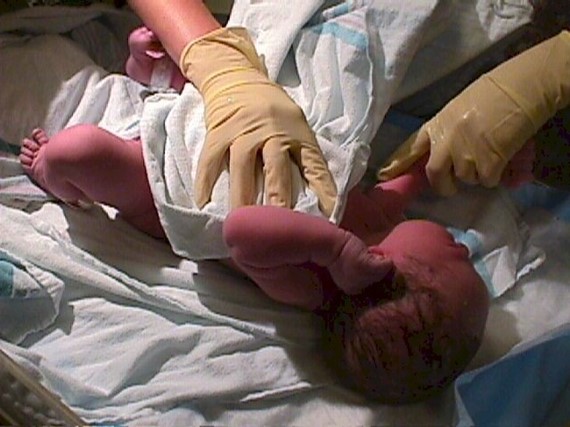
This prevents evaporative heat loss, which occurs when water on the skin surface evaporates and cools the skin. Evaporative heat loss is especially significant in newborns because they are wet at birth and have a large surface area relative to their body mass.
Choice B is wrong because it addresses convective heat loss, which occurs when air currents blow over the skin and carry away heat.
Convective heat loss can be prevented by keeping the baby out of drafts and away from air conditioners.
Choice C is wrong because it addresses radiant heat loss, which occurs when heat radiates from the skin to cooler objects in the environment.
Radiant heat loss can be prevented by placing the baby away from the outside wall and the windows.
Choice D is wrong because it addresses conductive heat loss, which occurs when heat transfers from the skin to cooler objects in contact with the skin.
Conductive heat loss can be prevented by warming the stethoscope and the nurse’s hands before touching the baby.
Normal body temperature for a newborn is 36.5°C to 37.5°C (97.7°F to 99.5°F).
The cheese-like, whitish substance that fuses with the epidermis and serves as a protective coating is called:
A. Vernix caseosa
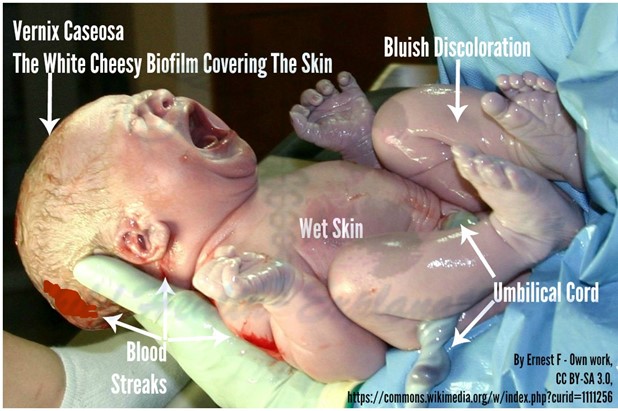
Vernix caseosa is a cheese-like, whitish substance that fuses with the epidermis and serves as a protective coating for the newborn.
B. Surfactant
Surfactant is a protein that lines the alveoli of the infant’s lungs and helps prevent them from collapsing.
C. Caput succedaneum
Caput succedaneum is a swelling of the tissue over the presenting part of the fetal head caused by pressure during delivery.
D. Acrocyanosis
Acrocyanosis is a bluish discoloration of the hands and feet due to reduced peripheral circulation. Normal ranges for vernix caseosa are not applicable as it varies depending on the gestational age and skin maturity of the newborn. However, it is usually more abundant in preterm infants than in term or post-term infants.
Full Explanation
Vernix caseosa is a cheese-like, whitish substance that fuses with the epidermis and serves as a protective coating for the newborn.
Some possible explanations for the other choices are:
- Choice B. Surfactant is a protein that lines the alveoli of the infant’s lungs and helps prevent them from collapsing.
- Choice C. Caput succedaneum is a swelling of the tissue over the presenting part of the fetal head caused by pressure during delivery.
- Choice D. Acrocyanosis is a bluish discoloration of the hands and feet due to reduced peripheral circulation.
Normal ranges for vernix caseosa are not applicable as it varies depending on the gestational age and skin maturity of the newborn. However, it is usually more abundant in preterm infants than in term or post-term infants.
As relates to rubella and Rh issues, nurses should be aware that:.
A. Breastfeeding mothers cannot be vaccinated with the live attenuated rubella virus.
This is wrong because breastfeeding mothers can be vaccinated with the live attenuated rubella virus. The vaccine virus is not harmful to the nursing infant.
B. Women should be warned that the rubella vaccination is teratogenic and that they must avoid pregnancy for 1 month after vaccination.
Women should be warned that the rubella vaccination is teratogenic and that they must avoid pregnancy for 1 month after vaccination. This is because rubella infection can cause serious birth defects in the developing baby, such as heart problems, hearing loss, intellectual disability, and liver or spleen damage. This condition is known as congenital rubella syndrome (CRS).
C. Rh immune globulin is safely administered intravenously because it cannot harm a nursing infant.
This is wrong because Rh immune globulin is not administered intravenously, but intramuscularly. It is given to prevent Rh sensitization in Rh-negative women who are exposed to Rh-positive blood, such as during pregnancy or delivery.
D. Rh immune globulin boosts the immune system and thereby enhances the effectiveness of vaccinations.
This is wrong because Rh immune globulin does not boost the immune system or enhance the effectiveness of vaccinations. It is a passive immunization that provides temporary protection against Rh antigens.
Full Explanation
The presence or absence of anxiety is a noninvasive assessment that the RN would perform to evaluate the patient’s psychological status and possible signs of hypovolemic shock.
Anxiety can indicate reduced cerebral perfusion due to blood loss and low blood pressure.
Choice A is wrong because pulse oximetry is a noninvasive assessment that the RN would perform to measure the oxygen saturation of the patient’s blood, not the circulatory status.
Choice B is wrong because heart sounds are a noninvasive assessment that the RN would perform to auscultate the cardiac rhythm and rate of the patient, not the circulatory status.
Choice C is wrong because arterial pulses are a noninvasive assessment that the RN would perform to palpate the strength and quality of the patient’s peripheral pulses, not the circulatory status.
Choice D is wrong because skin color, temperature, and turgor are noninvasive assessments that the RN would perform to observe the skin integrity and hydration of the patient, not the circulatory status.
Normal ranges for pulse oximetry are 95% to 100%, for heart rate, are 60 to 100 beats per minute, and for blood pressure are 120/80 mmHg.