
Nursing practice questions with comprehensive rationales
NurseDive Free Nursing Practice Question
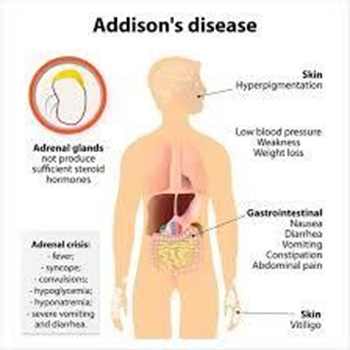
A nurse is assessing a client who is admitted for elective surgery and has a history of Addison's disease. Which of the following findings should the nurse expect?
A. Intention tremors
Intention tremors are not typically associated with Addison's disease.
B. Hyperpigmentation
Hyperpigmentation, particularly in sun-exposed areas and pressure points, is a characteristic finding in Addison's disease due to increased melanocyte-stimulating hormone (MSH) production.
C. Purple striations
Purple striations are typically associated with Cushing's syndrome, not Addison's disease.
D. Hirsutism
Hirsutism (excessive hair growth) is not a common manifestation of Addison's disease. It is more associated with Cushing’s disease.
This question is an excerpt from Nurse Dive's nursing test bank - Ati Med Surg Proctored Exam 8. Take the full exam now
Full Explanation
A. Intention tremors are not typically associated with Addison's disease.
B. Hyperpigmentation, particularly in sun-exposed areas and pressure points, is a characteristic finding in Addison's disease due to increased melanocyte-stimulating hormone (MSH) production.
C. Purple striations are typically associated with Cushing's syndrome, not Addison's disease.
D. Hirsutism (excessive hair growth) is not a common manifestation of Addison's disease. It is more associated with Cushing’s disease.
Similar Questions
A nurse is reviewing laboratory values for a client who has systemic lupus erythematosus (SLE).
Which of the following values should give the nurse the best indication of the client's renal function?
A. Blood urea nitrogen (BUN)
Blood urea nitrogen (BUN) can be affected by factors other than renal function, such as hydration status and protein intake.
B. Serum creatinine
Serum creatinine is a more specific indicator of renal function because it reflects the glomerular filtration rate (GFR). Elevated levels indicate impaired renal function.
C. Urine-specific gravity
Urine-specific gravity can provide some information about renal concentrating ability but is not as specific or sensitive as serum creatinine for assessing overall renal function.
D. Serum sodium
Serum sodium levels may be affected by various factors, including hydration status and medications, but they do not directly reflect renal function.
Full Explanation
A. Blood urea nitrogen (BUN) can be affected by factors other than renal function, such as hydration status and protein intake.
B. Serum creatinine is a more specific indicator of renal function because it reflects the glomerular filtration rate (GFR). Elevated levels indicate impaired renal function.
C. Urine-specific gravity can provide some information about renal concentrating ability but is not as specific or sensitive as serum creatinine for assessing overall renal function.
D. Serum sodium levels may be affected by various factors, including hydration status and medications, but they do not directly reflect renal function.
A nurse is caring for a client who has preeclampsia and is being treated with magnesium sulfate IV. The client's respiratory rate is 10/min and deep-tendon reflexes are absent. Which of the following actions should the nurse take?
A. Place the client in Trendelenburg position.
Placing the client in Trendelenburg position is not appropriate in this situation. It may worsen respiratory depression caused by magnesium sulfate.
B. Discontinue the medication infusion.
Absent deep-tendon reflexes and respiratory depression are signs of magnesium toxicity.Discontinuing the medication infusion is essential to prevent further toxicity.
C. Prepare for an emergency cesarean birth.
While preeclampsia can lead to complications necessitating emergency cesarean birth, the immediate concern here is addressing magnesium toxicity.
D. Assess maternal blood glucose.
Assessing maternal blood glucose is not relevant to the management of magnesium toxicity.
Full Explanation
A. Placing the client in Trendelenburg position is not appropriate in this situation. It may worsen respiratory depression caused by magnesium sulfate.
B. Absent deep-tendon reflexes and respiratory depression are signs of magnesium toxicity.
Discontinuing the medication infusion is essential to prevent further toxicity.
C. While preeclampsia can lead to complications necessitating emergency cesarean birth, the immediate concern here is addressing magnesium toxicity.
D. Assessing maternal blood glucose is not relevant to the management of magnesium toxicity.
A nurse is teaching a client who has acute kidney disease about fluid restrictions. Which of the following statements by the client should the nurse identify as understanding of the teaching?
A. “I will make a list of my favorite beverages"
Making a list of favorite beverages shows awareness but does not necessarily indicate an understanding of fluid restriction.
B. “I will put beverages in large containers to give the appearance of drinking a lot."
Putting beverages in large containers to deceive fluid intake is not a recommended or appropriate strategy for managing fluid restriction.
C. “I will not add ice cream to the amount of fluid intake."
Not adding fluid-rich foods like ice cream to the total fluid intake demonstrates an understanding of fluid restriction and adherence to the prescribed limit.
D. “I should consume most of the fluid during the evening."
Consuming most fluids during the evening is not an appropriate strategy for fluid restriction; fluid intake should be evenly distributed throughout the day.
Full Explanation
A. Making a list of favorite beverages shows awareness but does not necessarily indicate an understanding of fluid restriction.
B. Putting beverages in large containers to deceive fluid intake is not a recommended or appropriate strategy for managing fluid restriction.
C. Not adding fluid-rich foods like ice cream to the total fluid intake demonstrates an understanding of fluid restriction and adherence to the prescribed limit.
D. Consuming most fluids during the evening is not an appropriate strategy for fluid restriction; fluid intake should be evenly distributed throughout the day.