Nursing practice questions with comprehensive rationales
NurseDive Free Nursing Practice Question
A nurse is assessing a toddler at a well-child visit. At what point in the physical examination should the nurse examine the child's tympanic membrane?
A. At the beginning
It’s usually best to build trust and rapport first with non-invasive assessments. Starting with a potentially uncomfortable procedure like looking in the ears may cause distress and make the rest of the exam more difficult.
B. Before examining the head and neck
Examining the tympanic membrane before the head and neck might still be too early in the assessment and could cause the child to become uncooperative for subsequent steps. If the child becomes upset, it could complicate the rest of the physical exam, making it harder to complete.
C. At the end
Performing the ear examination at the end allows the nurse to build trust and rapport throughout the visit. The child is less likely to become distressed too early in the exam, which helps maintain cooperation for as long as possible. If the child does become upset, it is at the end of the visit, and the more critical assessments have already been completed.
D. Before auscultating the chest
If the ear exam causes distress, it may make the child uncooperative for important assessments like auscultating the heart and lungs.
This question is an excerpt from Nurse Dive's nursing test bank - Paediatrics ATI Proctored Exam. Take the full exam now
Full Explanation
A. It’s usually best to build trust and rapport first with non-invasive assessments. Starting with a potentially uncomfortable procedure like looking in the ears may cause distress and make the rest of the exam more difficult.
B. Examining the tympanic membrane before the head and neck might still be too early in the assessment and could cause the child to become uncooperative for subsequent steps. If the child becomes upset, it could complicate the rest of the physical exam, making it harder to complete.
C. Performing the ear examination at the end allows the nurse to build trust and rapport throughout the visit. The child is less likely to become distressed too early in the exam, which helps maintain cooperation for as long as possible. If the child does become upset, it is at the end of the visit, and the more critical assessments have already been completed.
D. If the ear exam causes distress, it may make the child uncooperative for important assessments like auscultating the heart and lungs.
Similar Questions
A nurse is caring for a 12-month-old toddler who is hospitalized and confined to a room with contact precautions in place. Which of the following toys should the nurse recommend in order to meet the developmental needs of the client?
A. Large building blocks
At this age, toddlers enjoy exploring objects and are developing their motor skills, so large building blocks would be an appropriate toy choice. Hanging crib toys may be too limiting in terms of exploration, and modeling clay may not be safe due to the risk of ingestion. Crayons and a coloring book may be appropriate for older children, but at 12 months, the child's fine motor skills are still developing.
B. Crayons and a coloring book
C. Hanging crib toys
D. Modeling clay
Full Explanation
At this age, toddlers enjoy exploring objects and are developing their motor skills, so large building blocks would be an appropriate toy choice. Hanging crib toys may be too limiting in terms of exploration, and modeling clay may not be safe due to the risk of ingestion. Crayons and a coloring book may be appropriate for older children, but at 12 months, the child's fine motor skills are still developing.
A nurse is caring for a 6-month-old infant. Which of the following findings indicates to the nurse that the infant may be experiencing pain?
A. Eyes wide open
B. Furrowed brow
Furrowing of the brow is often associated with discomfort or distress in infants. Other signs of pain in infants can include crying, irritability, increased heart rate, increased respiratory rate, and changes in sleep and feeding patterns. The eyes wide open, decreased muscle tone, and dry hands and feet are not specific indicators of pain and may have other explanations or may be within normal variations for an infant.
C. Decreased muscle tone
D. Dry hands and feet
Full Explanation
Furrowing of the brow is often associated with discomfort or distress in infants. Other signs of pain in infants can include crying, irritability, increased heart rate, increased respiratory rate, and changes in sleep and feeding patterns. The eyes wide open, decreased muscle tone, and dry hands and feet are not specific indicators of pain and may have other explanations or may be within normal variations for an infant.
A nurse is assessing a 15-month-old toddler. Which of the following findings should the nurse report to the provider?
A. The toddler cannot jump with both feet.
B. The toddler cannot build a tower of six to seven cubes
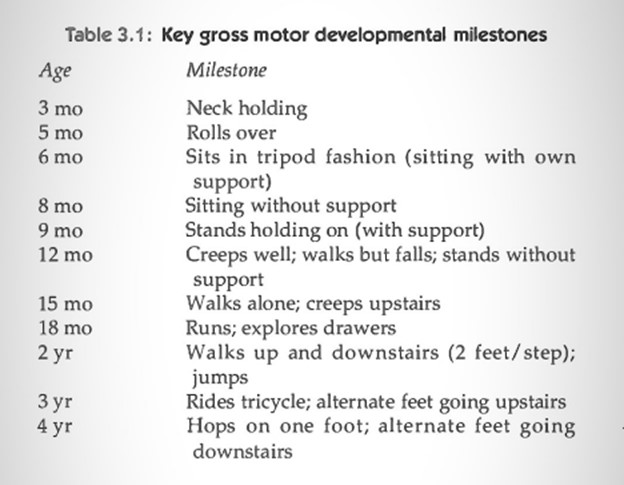
C. The toddler cannot stand upright without support
By 15 months of age, toddlers typically develop the ability to stand and maintain balance without support. This milestone is an important indicator of gross motor development. Not being able to stand upright without support at this age may suggest a delay or impairment in motor skills, and further evaluation may be needed to determine the underlying cause. The other findings mentioned—difficulty jumping with both feet, inability to build a tower of six to seven cubes, and inability to turn a doorknob—are within the expected range of development for a 15-month-old toddler. While some children may already demonstrate these skills, others may acquire them later in their developmental journey. It is important to consider individual variations in development, but the inability to stand without support should be further assessed.
D. The toddler cannot turn a doorknob
Full Explanation
By 15 months of age, toddlers typically develop the ability to stand and maintain balance without support. This milestone is an important indicator of gross motor development. Not being able to stand upright without support at this age may suggest a delay or impairment in motor skills, and further evaluation may be needed to determine the underlying cause.
The other findings mentioned—difficulty jumping with both feet, inability to build a tower of six to seven cubes, and inability to turn a doorknob—are within the expected range of development for a 15-month-old toddler. While some children may already demonstrate these skills, others may acquire them later in their developmental journey. It is important to consider individual variations in development, but the inability to stand without support should be further assessed.