
Nursing practice questions with comprehensive rationales
NurseDive Free Nursing Practice Question
A nurse is assigning care to an assistive personnel (AP). Which of the following tasks should the nurse delegate to the AP?
A. Educating a client on the use of a blood glucose monitor.
involves patient education, which is typically the responsibility of a licensed nurse.
B. Interpreting a client's vital signs.
involves assessing the client's health status, which is also typically the responsibility of a licensed nurse.
C. Performing a central line dressing change for a client.
is a complex task that requires specialized knowledge and skills.
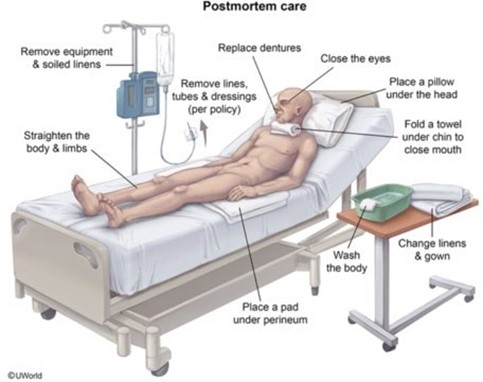
D. Providing postmortem care for a client who has died.
Assistive personnel (AP), also known as unlicensed assistive personnel (UAP), can perform tasks such as assisting with activities of daily living, hygiene, and nutrition, as well as those tasks that support professional nursing assessments ². Providing postmortem care for a client who has died [d] is a task that can be delegated to an AP.
This question is an excerpt from Nurse Dive's nursing test bank - ATI PN Medical Surgical Leadership Proctored Exam. Take the full exam now
Full Explanation
Assistive personnel (AP), also known as unlicensed assistive personnel (UAP), can perform tasks such as assisting with activities of daily living, hygiene, and nutrition, as well as those tasks that support professional nursing assessments ². Providing postmortem care for a client who has died [d] is a task that can be delegated to an AP.
The other options are not tasks that should be delegated to an AP. Educating a client on the use of a blood glucose monitor [a] involves patient education, which is typically the responsibility of a licensed nurse.
Interpreting a client's vital signs [b] involves assessing the client's health status, which is also typically the responsibility of a licensed nurse. Performing a central line dressing change for a client [c] is a complex task that requires specialized knowledge and skills.
Similar Questions
A nurse is working with two assistive personnel (AP). The nurse notes that one of the APs has been taking long breaks and making personal phone calls. Which of the following statements should the nurse make to resolve this conflict?
A. "Several staff members have commented that you don't do your fair share of the work."
B. "You have been very inconsiderate of others by not completing your share of the work."
C. "If you don't do your share of the work, I will have to inform the nurse manager."
D. "I need to talk to you about unit expectations regarding the timely completion of tasks."
The nurse should make the statement "I need to talk to you about unit expectations regarding timely completion of tasks" to resolve the conflict with the AP who has been taking long breaks and making personal phone calls. This statement is assertive and focuses on the issue at hand without blaming or attacking the AP. It also opens up a dialogue between the nurse and the AP to discuss the issue and find a resolution.
Full Explanation
The nurse should make the statement "I need to talk to you about unit expectations regarding timely completion of tasks" to resolve the conflict with the AP who has been taking long breaks and making personal phone calls. This statement is assertive and focuses on the issue at hand without blaming or attacking the AP. It also opens up a dialogue between the nurse and the AP to discuss the issue and find a resolution.
The other statements are not effective in resolving the conflict. Statements such as "Several staff members have commented that you don't do your fair share of the work" [a] and "You have been very inconsiderate of others by not completing your share of the work" [b] are accusatory and may make the AP defensive.
Threatening to inform the nurse manager [c] may also escalate the conflict and is not a constructive way to address the issue.
A nurse is caring for a client who has dementia and is scheduled for a procedure. Which of the following individuals should the nurse request to sign the client's informed consent?
A. The client's son, who has a durable power of attorney.
The nurse should request the client's son, who has a durable power of attorney, to sign the client's informed consent. A durable power of attorney is a legal document that allows an individual to appoint someone to make decisions on their behalf in the event that they become unable to do so. If the client has dementia and is unable to provide informed consent for the procedure, the individual with a durable power of attorney has the legal authority to make decisions on their behalf.
B. The client's sister, who assists with finances.
C. The client's daughter, who is the primary caregiver.
D. The client, who has advance directives.
Full Explanation
The nurse should request the client's son, who has a durable power of attorney, to sign the client's informed consent. A durable power of attorney is a legal document that allows an individual to appoint someone to make decisions on their behalf in the event that they become unable to do so. If the client has dementia and is unable to provide informed consent for the procedure, the individual with a durable power of attorney has the legal authority to make decisions on their behalf.
The other individuals are not the appropriate person to sign the client's informed consent. The client's sister [b] and daughter [c] may be involved in the client's care and decision-making, but they do not have the legal authority to provide informed consent on behalf of the client unless they have been designated as such in a legal document. Advance directives [d] are legal documents that allow individuals to communicate their wishes about medical treatment and end-of-life care, but they do not grant decision-making authority to another individual.
A nurse observes an unknown man in a laboratory coat making copies of a client's medical record. Which of the following actions should the nurse take?
A. Report the observation to the nurse caring for that client.
Option A, may not be the best initial action because it does not directly address the situation.
B. Notify hospital security and discuss the situation.
Option B may be premature without first gathering more information.
C. Ask other staff if they recognize the individual.
Option C, may also not be the best initial action because it does not directly address the situation.
D. Approach the man and ask why he is making copies.
The nurse should approach the man and ask why he is making copies of the client's medical records. This action allows the nurse to directly address the situation and gather more information before taking further steps.
Full Explanation
The nurse should approach the man and ask why he is making copies of the client's medical records. This action allows the nurse to directly address the situation and gather more information before taking further steps.
Option A, may not be the best initial action because it does not directly address the situation.
Option B may be premature without first gathering more information.
Option C, may also not be the best initial action because it does not directly address the situation.