
Nursing practice questions with comprehensive rationales
NurseDive Free Nursing Practice Question
A nurse is caring for a client who has a lower extremity fracture and a prescription for crutches.
Which of the following client statements indicates that the client is adapting to their role change?
A. "It's going to be difficult to tell my parents I can't take them to their appointments anymore.".
Choice A is incorrect because it indicates that the client is concerned about not being able to fulfill their responsibilities.
B. "I feel bad that I have to ask my partner to keep the house clean.".
Choice B is incorrect because it indicates that the client feels guilty about not being able to fulfill their responsibilities.
C. "These crutches will make it possible to care for my child.".
The statement “These crutches will make it possible to care for my child” indicates that the client is adapting to their role change by finding ways to continue fulfilling their responsibilities despite their injury.
D. "I will need to have my partner take over shopping for groceries and cooking the meals for us.".
Choice D is incorrect because it indicates that the client is relying on someone else to fulfill their responsibilities.
This question is an excerpt from Nurse Dive's nursing test bank - ATI Adult Medical Surgical 2019 Proctored Exam. Take the full exam now
Full Explanation
The statement “These crutches will make it possible to care for my child” indicates that the client is adapting to their role change by finding ways to continue fulfilling their responsibilities despite their injury.
Choice A is incorrect because it indicates that the client is concerned about not being able to fulfill their responsibilities.
Choice B is incorrect because it indicates that the client feels guilty about not being able to fulfill their responsibilities.
Choice D is incorrect because it indicates that the client is relying on someone else to fulfill their responsibilities.
Similar Questions
A nurse is caring for a client who is receiving chemotherapy and requests information about acupuncture to relieve some of the side effects. Which of the following findings should the nurse identify as a contraindication to receiving this alternative therapy?
A. Lymphedema.
Acupuncture is commonly used to treat a wide range of illnesses and ailments including pain management, control of nausea and vomiting, fatigue, hot flashes, xerostomia, neuropathy, anxiety, depression, and sleep disturbance in cancer patients. However, I could not find any information that suggests mouth sores (B), headaches, or urticaria (D) are contraindications for acupuncture. Lymphedema is a contraindication for acupuncture because it can increase the risk of infection in the affected area. It is important for the nurse to identify this as a contraindication to receiving acupuncture therapy.
B. Mouth sores.
C. Headaches.
D. Urticaria.
Full Explanation
Acupuncture is commonly used to treat a wide range of illnesses and ailments including pain management, control of nausea and vomiting, fatigue, hot flashes, xerostomia, neuropathy, anxiety, depression, and sleep disturbance in cancer patients.
However, I could not find any information that suggests mouth sores (B), headaches, or urticaria (D) are contraindications for acupuncture.
Lymphedema is a contraindication for acupuncture because it can increase the risk of infection in the affected area.
It is important for the nurse to identify this as a contraindication to receiving acupuncture therapy.
A nurse is assessing a client who has pericarditis.
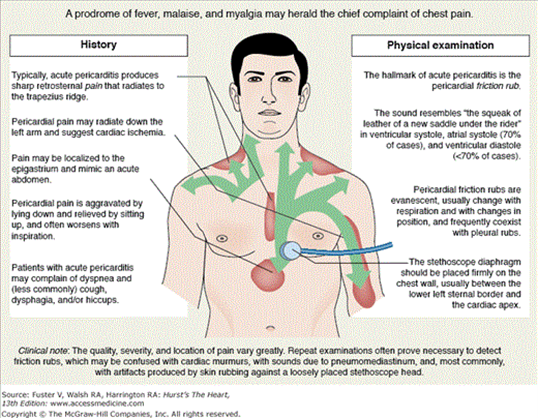
In which of the following areas of the client's chest should the nurse place the stethoscope to best hear a pericardial friction rub? (You will find hot spots to select in the artwork below.
Select only the hot spot that corresponds to your answer.).
A. A
is not the answer because it does not correspond to the left sternal border.
B. B
is not the answer because it does not correspond to the left sternal border.
C. C
A pericardial friction rub is highly specific for acute pericarditis and is generally heard over the left sternal border. It is often louder at inspiration but sometimes can be better heard on forced expiration while the patient bends forward.
D. D
is not the answer because it does not correspond to the left sternal border.
Full Explanation
A pericardial friction rub is highly specific for acute pericarditis and is generally heard over the left sternal border.
It is often louder at inspiration but sometimes can be better heard on forced expiration while the patient bends forward.
Choice A is not the answer because it does not correspond to the left sternal border.
Choice B is not the answer because it does not correspond to the left sternal border.
Choice D is not the answer because it does not correspond to the left sternal border.
A nurse is caring for a client who is receiving total parenteral nutrition (TPN).
The current infusion is almost complete and the new solution is not available, Which of the following actions should the nurse take?
A. Disconnect and flush the IV access line.
Choice A is incorrect because disconnecting and flushing the IV access line would interrupt the client’s nutrition and could lead to hypoglycemia.
B. Administer lactated Ringer through a peripheral IV site.
Choice B is incorrect because lactated Ringer’s solution does not provide the necessary glucose to prevent hypoglycemia.
C. Decrease the TPN infusion rate.
Choice C is incorrect because decreasing the TPN infusion rate would not provide the necessary glucose to prevent hypoglycemia.
D. Infuse dextrose 10% in water.
If the new TPN solution is not available, the nurse should infuse dextrose 10% in water to prevent hypoglycemia.
Full Explanation
If the new TPN solution is not available, the nurse should infuse dextrose 10% in water to prevent hypoglycemia.
Choice A is incorrect because disconnecting and flushing the IV access line would interrupt the client’s nutrition and could lead to hypoglycemia.
Choice B is incorrect because lactated Ringer’s solution does not provide the necessary glucose to prevent hypoglycemia.
Choice C is incorrect because decreasing the TPN infusion rate would not provide the necessary glucose to prevent hypoglycemia.