Nursing practice questions with comprehensive rationales
NurseDive Free Nursing Practice Question
A nurse is caring for a client who has an NG tube set to low intermittent suction. The nurse irrigates the NG tube twice with 30 mL of normal saline solution during his shift. At the end of the shift, the NG canister contains 475 mL. What amount of NG drainage should the nurse record? (Round the answer to the nearest whole number. Use a leading zero if it applies. Do not use a trailing zero.)
This question is an excerpt from Nurse Dive's nursing test bank - Ati Maternal Newborn 4 Proctored Exam. Take the full exam now
Full Explanation
To calculate the amount of NG drainage, the nurse should subtract the amount of irrigation fluid from the amount of fluid in the NG canister. The irrigation fluid is not part of the drainage, but rather a way to keep the NG tube patent and prevent clogging.
The amount of irrigation fluid is 30 mL x 2 = 60 mL.
The amount of fluid in the NG canister is 475 mL.
Therefore, the amount of NG drainage is 475 mL - 60 mL = 415 mL.
The answer should be rounded to the nearest whole number and use a leading zero if it applies. Do not use a trailing zero.
Therefore, the final answer is 415 mL.
Similar Questions
A nurse is preparing to administer chlordiazepoxide 50 mg PO every 8 hours to a client. The amount available is chlordiazepoxide 25 mg per capsule. How many capsules should the nurse administer per dose? (Round the answer to the nearest whole number. Use a leading zero if it applies. Do not use a trailing zero.)
Full Explanation
To calculate how many capsules to administer per dose, the nurse should divide the ordered dose by the available dose and round to the nearest whole number.
The ordered dose is 50 mg.
The available dose is 25 mg per capsule.
Therefore, the number of capsules to administer per dose is 50 mg / 25 mg = 2 capsules.
The answer should be rounded to the nearest whole number and use a leading zero if it applies. Do not use a trailing zero.
Therefore, the final answer is 2 capsules.
A provider prescribes quetiapine 50 mg PO divided equally every 12 hours for 3 days. Available is quetiapine 25 mg tablets. How many tablets should the nurse administer per dose on day 3? (Round the answer to the nearest whole number. Use a leading zero if it applies. Do not use a trailing zero.)
Full Explanation
Step 1: Determine the total daily dose of quetiapine.
- The provider prescribes 50 mg every 12 hours.
- Total daily dose = 50 mg × 2 = 100 mg.
Step 2: Calculate the total dose for 3 days.
- Total dose for 3 days = 100 mg × 3 = 300 mg.
Step 3: Determine the dose per administration.
- The total daily dose is divided into two doses (every 12 hours).
- Dose per administration = 100 mg ÷ 2 = 50 mg.
Step 4: Calculate the number of tablets needed per dose.
- Each tablet is 25 mg.
- Number of tablets per dose = 50 mg ÷ 25 mg = 2 tablets.
Step 5: Confirm the number of tablets to be administered per dose on day 3.
- The dose per administration remains the same each day.
- Therefore, the nurse should administer 2 tablets per dose on day 3.
So, the nurse should administer 2 tablets per dose on day 3.
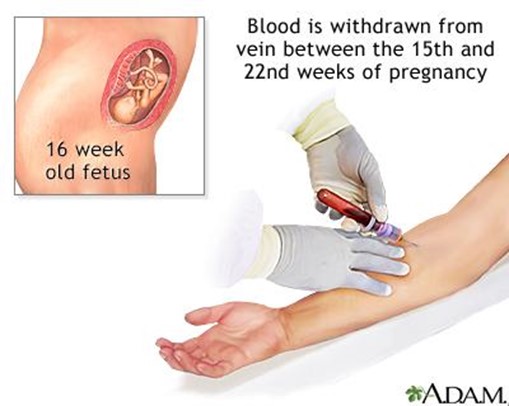
A pregnant woman undergoes a triple/quadruple screen at 16 to 18 weeks' gestation. What would the nurse suspect if the woman's alpha-fetoprotein (AFP) level is decreased?
A. Sickle-cell anemia
Reason: This is incorrect because sickle-cell anemia is a genetic disorder that affects the shape and function of red blood cells. It does not affect the AFP level, which is a protein produced by the fetus and placenta. Sickle-cell anemia can be detected by other prenatal tests, such as hemoglobin electrophoresis or DNA analysis.
B. Cardiac defects
Reason: This is incorrect because cardiac defects are structural abnormalities of the heart or blood vessels that affect the blood flow and oxygen delivery to the fetus. They may cause an increased AFP level, not a decreased one, as they can lead to fetal distress or edema. Cardiac defects can be detected by other prenatal tests, such as fetal echocardiography or ultrasound.
C. Down syndrome
Reason: This is correct because Down syndrome is a chromosomal disorder that results from an extra copy of chromosome 21. It causes various physical and mental developmental delays and defects in the fetus. It is associated with a decreased AFP level, as well as decreased levels of human chorionic gonadotropin (hCG) and unconjugated estriol (uE3). Down syndrome can be confirmed by other prenatal tests, such as amniocentesis or chorionic villus sampling (CVS).
D. Respiratory disorders
Reason: This is incorrect because respiratory disorders are problems that affect the breathing and gas exchange of the fetus. They may cause an increased AFP level, not a decreased one, as they can lead to fetal distress or edema. Respiratory disorders can be detected by other prenatal tests, such as fetal biophysical profile (BPP) or nonstress test (NST).
Full Explanation
Choice A Reason: This is incorrect because sickle-cell anemia is a genetic disorder that affects the shape and function of red blood cells. It does not affect the AFP level, which is a protein produced by the fetus and placenta. Sickle-cell anemia can be detected by other prenatal tests, such as hemoglobin electrophoresis or DNA analysis.
Choice B Reason: This is incorrect because cardiac defects are structural abnormalities of the heart or blood vessels that affect the blood flow and oxygen delivery to the fetus. They may cause an increased AFP level, not a decreased one, as they can lead to fetal distress or edema. Cardiac defects can be detected by other prenatal tests, such as fetal echocardiography or ultrasound.
Choice C Reason: This is correct because Down syndrome is a chromosomal disorder that results from an extra copy of chromosome 21. It causes various physical and mental developmental delays and defects in the fetus. It is associated with a decreased AFP level, as well as decreased levels of human chorionic gonadotropin (hCG) and unconjugated estriol (uE3). Down syndrome can be confirmed by other prenatal tests, such as amniocentesis or chorionic villus sampling (CVS).
Choice D Reason: This is incorrect because respiratory disorders are problems that affect the breathing and gas exchange of the fetus. They may cause an increased AFP level, not a decreased one, as they can lead to fetal distress or edema. Respiratory disorders can be detected by other prenatal tests, such as fetal biophysical profile (BPP) or nonstress test (NST).