
Nursing practice questions with comprehensive rationales
NurseDive Free Nursing Practice Question
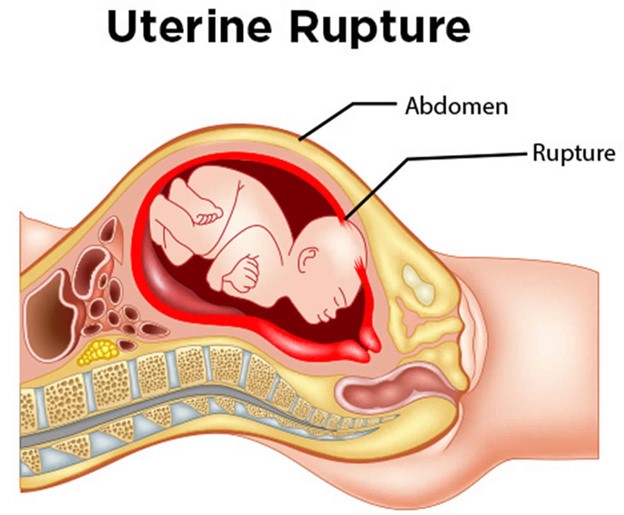
A nurse is caring for a client who is in active labor and reports sudden, severe lower abdominal pain. The nurse observes a drop in the client's blood pressure and notes cool skin and pallor. The fetal heart rate tracing shows prolonged bradycardia. Which of the following complications should the nurse suspect?
A. Amniotic fluid embolism
B. Umbilical cord prolapse
C. Uterine rupture
Uterine rupture. The sudden, severe lower abdominal pain, drop in blood pressure, and signs of shock such as cool skin and pallor all point to a potential intra-abdominal hemorrhage most likely due to Uterine rupture. Additionally, the prolonged bradycardia on the fetal heart rate tracing indicates that the baby may be experiencing fetal distress due to a compromised blood supply. Amniotic fluid embolism triggers an allergic reaction, causing a sudden onset of respiratory distress, hypotension, and cardiac arrest. Option D, placenta previa, occurs when the placenta implants in the lower uterine segment, partially or completely covering the cervical os. This can lead to painless vaginal bleeding but typically does not present with sudden, severe abdominal pain or signs of shock.
D. Placenta previa
which suggests that the nurse should assess the newborn's latch while breastfeeding. Sore nipples are a common concern among breastfeeding mothers, and the most common cause is an improper latch. The nurse should ensure that the baby is latching on correctly and not causing trauma to the mother's nipples. A proper latch involves the baby taking in a good portion of the areola and not just the nipple. Assessing the newborn's latch can help identify any issues with the baby's mouth or tongue that may be causing difficulty latching on. If the baby is not latching correctly, the nurse can provide education and support to help the mother correct the issue. Offering supplemental formula between feedings (choice A) is not recommended as it can decrease the frequency of breastfeeding and reduce the stimulation for milk production, leading to decreased milk supply. Instructing the client to wait 4 hours between daytime feedings (choice C) is not recommended as it can decrease milk production and lead to inadequate nutrition for the newborn.
This question is an excerpt from Nurse Dive's nursing test bank - ATI Maternal Newborn 2019 with NGN Proctored Exam. Take the full exam now
Full Explanation
Uterine rupture. The sudden, severe lower abdominal pain, drop in blood pressure, and signs of shock such as cool skin and pallor all point to a potential intra-abdominal hemorrhage most likely due to Uterine rupture. Additionally, the prolonged bradycardia on the fetal heart rate tracing indicates that the baby may be experiencing fetal distress due to a compromised blood supply. Amniotic fluid embolism triggers an allergic reaction, causing a sudden onset of respiratory distress, hypotension, and cardiac arrest. Option D, placenta previa, occurs when the placenta implants in the lower uterine segment, partially or completely covering the cervical os. This can lead to painless vaginal bleeding but typically does not present with sudden, severe abdominal pain or signs of shock.
Similar Questions
A nurse is caring for a client who is 1 day postpartum and breastfeeding her newborn. The client reports sore nipples. Which of the following actions should the nurse take?
A. offer supplemental formula between the newborn's feedings.
B. Have the client limit the length of breastfeeding to 5 min per breast.
C. Instruct the client to wait 4 hr between daytime feedings.
D. Assess the newborn's latch while breastfeeding.
This suggests that the nurse should assess the newborn's latch while breastfeeding. Sore nipples are a common concern among breastfeeding mothers, and the most common cause is an improper latch. The nurse should ensure that the baby is latching on correctly and not causing trauma to the mother's nipples. A proper latch involves the baby taking in a good portion of the areola and not just the nipple. Assessing the newborn's latch can help identify any issues with the baby's mouth or tongue that may be causing difficulty latching on. If the baby is not latching correctly, the nurse can provide education and support to help the mother correct the issue. Offering supplemental formula between feedings (choice A) is not recommended as it can decrease the frequency of breastfeeding and reduce the stimulation for milk production, leading to decreased milk supply. Instructing the client to wait 4 hours between daytime feedings (choice C) is not recommended as it can decrease milk production and lead to inadequate nutrition for the newborn.
Full Explanation
This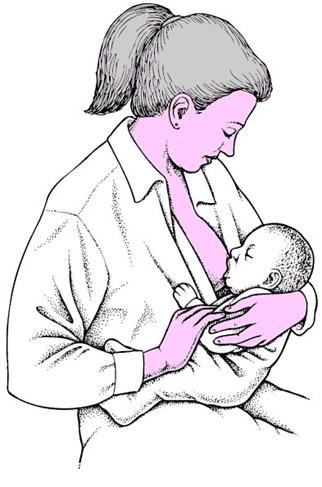 suggests that the nurse should assess the newborn's latch while breastfeeding. Sore nipples are a common concern among breastfeeding mothers, and the most common cause is an improper latch. The nurse should ensure that the baby is latching on correctly and not causing trauma to the mother's nipples. A proper latch involves the baby taking in a good portion of the areola and not just the nipple. Assessing the newborn's latch can help identify any issues with the baby's mouth or tongue that may be causing difficulty latching on. If the baby is not latching correctly, the nurse can provide education and support to help the mother correct the issue. Offering supplemental formula between feedings (choice A) is not recommended as it can decrease the frequency of breastfeeding and reduce the stimulation for milk production, leading to decreased milk supply. Instructing the client to wait 4 hours between daytime feedings (choice C) is not recommended as it can decrease milk production and lead to inadequate nutrition for the newborn.
A nurse is calculating the estimated date of delivery for a client who reports that the first day of her last menstrual period was August 10. Using Nägele's Rule, which of the following is the client's estimated date of delivery?
A. May 17
May 13. Nägele's Rule is used to calculate the estimated date of delivery (EDD) based on the first day of the last menstrual period (LMP). To use this rule, the nurse subtracts 3 months from the first day of the LMP and adds 7 days and 1 year. For this client, the first day of her LMP was August 10. Subtracting 3 months gives us May 10. Adding 7 days gives us May 17. Adding 1 year gives us May 17, 2022. Therefore, the estimated date of delivery is May 17, 2022. It is important to note that Nägele's Rule is an estimation, and not all pregnancies follow the typical 280-day gestational period. Other factors, such as irregular menstrual cycles, can affect the accuracy of the estimated date of delivery. The nurse should monitor the client's pregnancy and adjust the estimated date of delivery as needed based on ultrasound results and other clinical findings.
B. May 13
C. May 3
D. May 20
Full Explanation
May 13. Nägele's Rule is used to calculate the estimated date of delivery (EDD) based on the first day of the last menstrual period (LMP). To use this rule, the nurse subtracts 3 months from the first day of the LMP and adds 7 days and 1 year.
For this client, the first day of her LMP was August 10. Subtracting 3 months gives us May 10. Adding 7 days gives us May 17. Adding 1 year gives us May 17, 2022. Therefore, the estimated date of delivery is May 17, 2022.
It is important to note that Nägele's Rule is an estimation, and not all pregnancies follow the typical 280-day gestational period. Other factors, such as irregular menstrual cycles, can affect the accuracy of the estimated date of delivery. The nurse should monitor the client's pregnancy and adjust the estimated date of delivery as needed based on ultrasound results and other clinical findings.
A nurse is monitoring a client who is undergoing a nonstress test at 35 weeks of gestation. Which of the following findings requires intervention by the nurse?
A. Three uterine contractions within a 20-min period
Three uterine contractions within a 20-min period require intervention by the nurse during a nonstress test at 35 weeks of gestation. The nonstress test is used to assess fetal well-being by monitoring the fetal heart rate (FHR) response to fetal movement. The test is considered reactive if there are two or more accelerations of the FHR within a 20-min period, each lasting at least 15 seconds and peaking at least 15 beats above the baseline. In this scenario, the finding that requires intervention by the nurse is three uterine contractions within a 20-min period. This is because frequent or prolonged contractions can indicate preterm labor, which requires immediate intervention to prevent premature delivery. The nurse should assess the client for signs and symptoms of preterm labor, such as pelvic pressure, low back pain, vaginal bleeding or discharge, and abdominal cramping. The nurse should also notify the provider and prepare the client for further evaluation and possible interventions, such as tocolytic therapy to stop the contractions.
B. One acceleration of the FHR within a 20-min period
C. Uterine contractions lasting 20 to 30 seconds each
D. An FHR that peaks 20 beats above the baseline
Full Explanation
Three uterine contractions within a 20-min period require intervention by the nurse during a nonstress test at 35 weeks of gestation. The nonstress test is used to assess fetal well-being by monitoring the fetal heart rate (FHR) response to fetal movement. The test is considered reactive if there are two or more accelerations of the FHR within a 20-min period, each lasting at least 15 seconds and peaking at least 15 beats above the baseline. In this scenario, the finding that requires intervention by the nurse is three uterine contractions within a 20-min period. This is because frequent or prolonged contractions can indicate preterm labor, which requires immediate intervention
to prevent premature delivery. The nurse should assess the client for signs and symptoms of preterm labor, such as pelvic pressure, low back pain, vaginal bleeding or discharge, and abdominal cramping. The nurse should also notify the provider and prepare the client for further evaluation and possible interventions, such as tocolytic therapy to stop the contractions.