
Nursing practice questions with comprehensive rationales
NurseDive Free Nursing Practice Question
A. Turn the client onto her left side.
Turning the client onto her left side may be a comfort measure, but it is not specifically associated with the gate control theory of pain. It may help improve blood flow and relieve pressure but does not directly engage the gate control mechanism.
B. Massage the client's back.
Massage the client's back is consistent with the gate control theory of pain.According to the gate control theory, non-painful input (such as massage) can close the "gate" to painful input, reducing the perception of pain. Massage stimulates large-diameter nerve fibers, which can inhibit the transmission of painful signals.
C. Encourage the client to rest between contractions
Encouraging the client to rest between contractions is a general comfort measure but is not directly related to the gate control theory of pain.
D. Administer prescribed analgesic medication
Administering prescribed analgesic medication is a pharmacological approach to pain management and is not specifically associated with the gate control theory. Medications can act on pain receptors but do not engage the gate control mechanism.
This question is an excerpt from Nurse Dive's nursing test bank - Ati Rn Maternal Newborn Online Practice 2019 B With Ngn Proctored Exam. Take the full exam now
Full Explanation
The correct answer is B. Massage the client's back.
A. Turning the client onto her left side may be a comfort measure, but it is not specifically associated with the gate control theory of pain. It may help improve blood flow and relieve pressure but does not directly engage the gate control mechanism.
B. Massage the client's back is consistent with the gate control theory of pain.
According to the gate control theory, non-painful input (such as massage) can close the "gate" to painful input, reducing the perception of pain. Massage stimulates large-diameter nerve fibers, which can inhibit the transmission of painful signals.
C. Encouraging the client to rest between contractions is a general comfort measure but is not directly related to the gate control theory of pain.
D. Administering prescribed analgesic medication is a pharmacological approach to pain management and is not specifically associated with the gate control theory. Medications can act on pain receptors but do not engage the gate control mechanism.
Similar Questions
A nurse in the labor and delivery unit is caring for a client who is undergoing external fetal monitoring. The nurse observes that the fetal heart rate begins to slow after the start of a contraction and the lowest rate occurs after the peak of the contraction. Which of the following actions should the nurse take first?
A. Increase the rate of maintenance IV infusion.
Increasing the rate of maintenance IV infusion may be necessary, but the initial action should be to address potential aortocaval compression. Repositioning the client to the lateral position helps alleviate compression on the vena cava and improves blood flow to the uterus.
B. Place the client in the lateral position
Placing the client in the lateral position is the correct first action. Changing the client's position, particularly from a supine to a side-lying position, can relieve aortocaval compression and improve uteroplacental perfusion.
C. Elevate the client's legs
Elevating the client's legs is not the priority in this situation. Repositioning the client to the lateral position is more important to address potential aortocaval compression.
D. Administer oxygen using a nonrebreather mask
Administering oxygen using a nonrebreather mask may be indicated, but repositioning the client to the lateral position is the first action to address potential aortocaval compression. Oxygen administration can follow if necessary.
Full Explanation
The correct answer is B. Place the client in the lateral position.
A. Increasing the rate of maintenance IV infusion may be necessary, but the initial action should be to address potential aortocaval compression. Repositioning the client to the lateral position helps alleviate compression on the vena cava and improves blood flow to the uterus.
B. Placing the client in the lateral position is the correct first action. Changing the client's position, particularly from a supine to a side-lying position, can relieve aortocaval compression and improve uteroplacental perfusion.
C. Elevating the client's legs is not the priority in this situation. Repositioning the client to the lateral position is more important to address potential aortocaval compression.
D. Administering oxygen using a nonrebreather mask may be indicated, but repositioning the client to the lateral position is the first action to address potential aortocaval compression. Oxygen administration can follow if necessary.
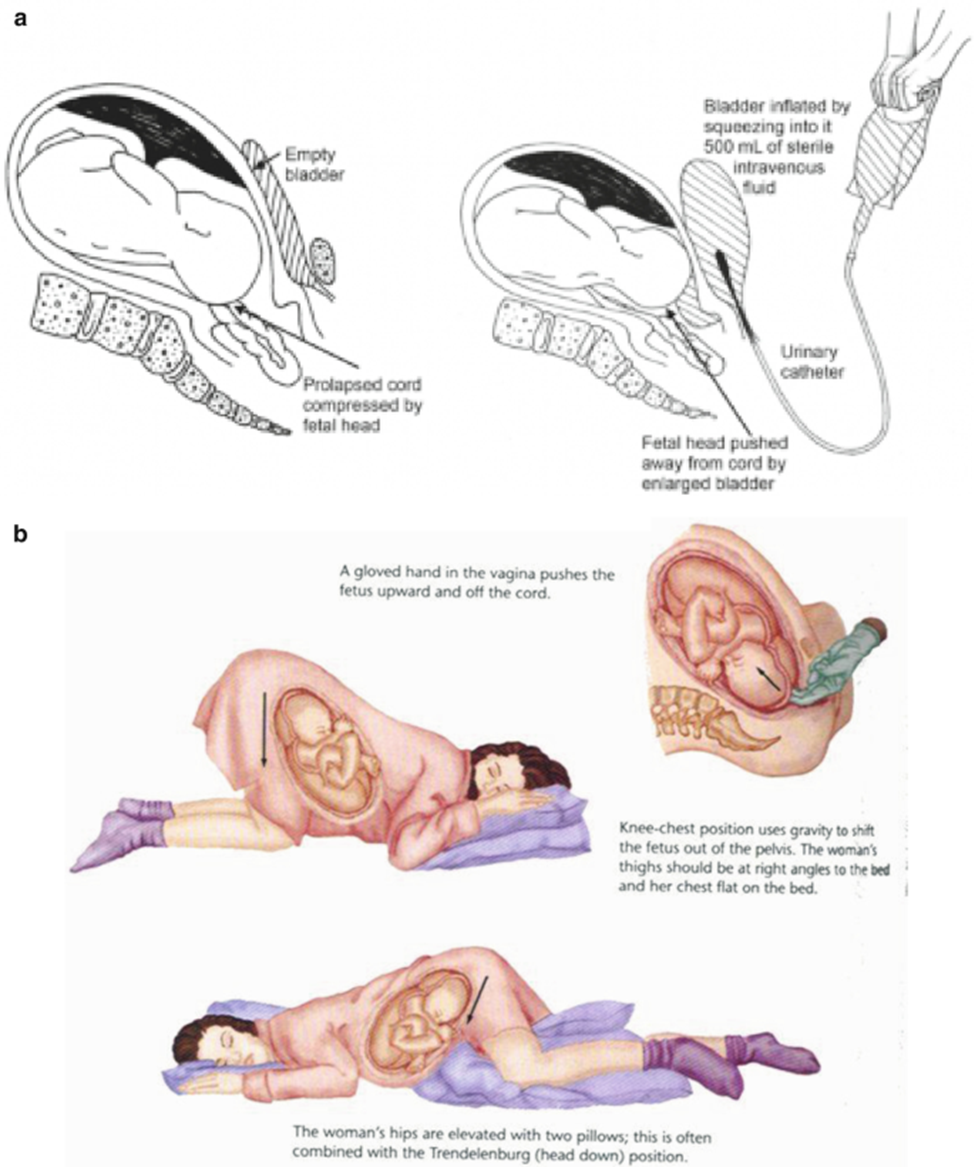
A nurse is caring for a client who is in the first stage of labor. The nurse observes the umbilical cord protruding from the vagina. Which of the following actions should the nurse perform first?
A. Cover the cord with a sterile, moist saline dressing
Covering the cord with a sterile, moist saline dressing is a potential action, but relieving pressure on the cord takes precedence. This can be done by manually elevating the presenting part of the fetus off the cord.
B. Place the client in knee-chest position
Placing the client in a knee-chest position may be recommended after taking the immediate action of relieving pressure on the cord. Elevating the hips may help reduce cord compression.
C. Insert a gloved hand into the vagina to relieve pressure on the cord
Inserting a gloved hand into the vagina to relieve pressure on the cord is the priority action.By manually lifting the presenting part off the cord, the nurse can help restore blood flow to the fetus and prevent umbilical cord compression.
D. Prepare the client for an immediate birth
Preparing the client for an immediate birth may be necessary, but the immediate action to relieve pressure on the cord should be performed first. The healthcare provider will determine the need for urgent delivery based on the clinical situation.
Full Explanation
The correct answer is C. Insert a gloved hand into the vagina to relieve pressure on the cord.
A. Covering the cord with a sterile, moist saline dressing is a potential action, but relieving pressure on the cord takes precedence. This can be done by manually elevating the presenting part of the fetus off the cord.
B. Placing the client in a knee-chest position may be recommended after taking the immediate action of relieving pressure on the cord. Elevating the hips may help reduce cord compression.
C. Inserting a gloved hand into the vagina to relieve pressure on the cord is the priority action.
By manually lifting the presenting part off the cord, the nurse can help restore blood flow to the fetus and prevent umbilical cord compression.
D. Preparing the client for an immediate birth may be necessary, but the immediate action to relieve pressure on the cord should be performed first. The healthcare provider will determine the need for urgent delivery based on the clinical situation.
A nurse is caring for a client who is at 40 weeks gestation and is in active labor. The client has 6 cm of cervical dilation and 100% cervical effacement. The nurse obtains the client's blood pressure reading as 82/52 mm Hg. Which of the following nursing interventions should the nurse perform?
A. Assist the client to turn onto her side.
Assisting the client to turn onto her side is the correct intervention. This is because the client's blood pressure is low, and turning onto the side helps improve blood flow to the uterus, reducing the risk of supine hypotension.
B. Assist the client to an upright position.
Assisting the client to an upright position is not the priority in this case. The client is at risk for supine hypotension, and a lateral position is more appropriate.
C. Prepare for a cesarean birth
Preparing for a cesarean birth is not indicated based solely on the blood pressure reading. Turning the client onto her side and monitoring the blood pressure response are appropriate initial actions.
D. Prepare for an immediate vaginal delivery.
Preparing for an immediate vaginal delivery is not indicated based solely on the blood pressure reading. The client's condition may improve with positional changes, and further assessment is needed.
Full Explanation
The correct answer is A. Assist the client to turn onto her side.
A. Assisting the client to turn onto her side is the correct intervention. This is because the client's blood pressure is low, and turning onto the side helps improve blood flow to the uterus, reducing the risk of supine hypotension.
B. Assisting the client to an upright position is not the priority in this case. The client is at risk for supine hypotension, and a lateral position is more appropriate.
C. Preparing for a cesarean birth is not indicated based solely on the blood pressure reading. Turning the client onto her side and monitoring the blood pressure response are appropriate initial actions.
D. Preparing for an immediate vaginal delivery is not indicated based solely on the blood pressure reading. The client's condition may improve with positional changes, and further assessment is needed.