
Nursing practice questions with comprehensive rationales
NurseDive Free Nursing Practice Question
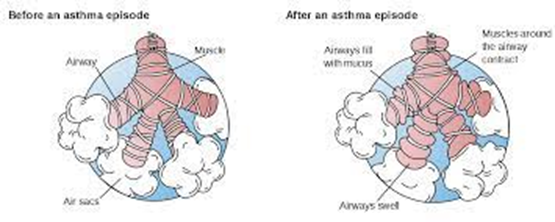
A nurse is caring for a client with asthma. Which of the following happens physiologically when bronchospasm occurs?
A. Decreased mucus production contributes to airway constriction.
Decreased mucus production contributes to airway constriction: This statement is incorrect. Bronchospasm does not decrease mucus production; instead, it primarily affects the smooth muscles surrounding the bronchioles, leading to their constriction and narrowing of the airways. Increased mucus production, often accompanied by inflammation, can contribute to airway obstruction in conditions like asthma.
B. Inflammation is reduced due to airway diameter.
Inflammation is reduced due to airway diameter: This statement is incorrect. Bronchospasm typically occurs in the setting of inflammation in conditions such as asthma. Constriction of the airways during bronchospasm exacerbates the inflammation and can further narrow the airways, leading to symptoms such as wheezing and dyspnea.
C. Bronchospasm occurs when there is Inflammation, edema, and excess mucus.
Bronchospasm occurs when there is inflammation, edema, and excess mucus: This statement is partially correct. Bronchospasm often occurs in the presence of inflammation, edema, and excess mucus production, as seen in conditions like asthma. These factors contribute to airway hyperresponsiveness, leading to bronchospasm and airway narrowing.
D. Airway obstruction occurs due to thinning mucus.
Airway obstruction occurs due to thinning mucus: This statement is incorrect. Airway obstruction in conditions like asthma is primarily due to bronchospasm, inflammation, and excessive mucus production, rather than thinning mucus. Thinning of mucus would not typically contribute to airway obstruction.
This question is an excerpt from Nurse Dive's nursing test bank - Ati Medical Surgical Proctored Exam 1. Take the full exam now
Full Explanation
Choice A Reason:
Decreased mucus production contributes to airway constriction: This statement is incorrect. Bronchospasm does not decrease mucus production; instead, it primarily affects the smooth muscles surrounding the bronchioles, leading to their constriction and narrowing of the airways. Increased mucus production, often accompanied by inflammation, can contribute to airway obstruction in conditions like asthma.
Choice B Reason:
Inflammation is reduced due to airway diameter: This statement is incorrect. Bronchospasm typically occurs in the setting of inflammation in conditions such as asthma. Constriction of the airways during bronchospasm exacerbates the inflammation and can further narrow the airways, leading to symptoms such as wheezing and dyspnea.
Choice C Reason:
Bronchospasm occurs when there is inflammation, edema, and excess mucus: This statement is partially correct. Bronchospasm often occurs in the presence of inflammation, edema, and excess mucus production, as seen in conditions like asthma. These factors contribute to airway hyperresponsiveness, leading to bronchospasm and airway narrowing.
Choice D Reason:
Airway obstruction occurs due to thinning mucus: This statement is incorrect. Airway obstruction in conditions like asthma is primarily due to bronchospasm, inflammation, and excessive mucus production, rather than thinning mucus. Thinning of mucus would not typically contribute to airway obstruction.
Similar Questions
A nurse is teaching a student about cerebral edema. The student nurse asks, "What type of cerebral edema is associated with a client who has a stroke?" Which of the following is the best response from the nurse?
A. Vasogenic cerebral edema
Vasogenic cerebral edema is appropriate response. Vasogenic cerebral edema occurs due to disruption of the blood-brain barrier (BBB), leading to leakage of fluid and proteins from the blood vessels into the brain parenchyma. This type of cerebral edema is commonly associated with conditions such as brain tumors, abscesses, and ischemic stroke.
B. Osmotic cerebral edema
Osmotic cerebral edema is inappropriate response. Osmotic cerebral edema occurs when there is an imbalance of osmotic forces across the blood-brain barrier, leading to the movement of water into the brain cells. This type of cerebral edema can result from conditions such as hyponatremia or the administration of hypertonic solutions.
C. Cellular cerebral edema
Cellular cerebral edema is inappropriate response. Cellular cerebral edema involves the swelling of brain cells (neurons and glial cells) due to various insults, such as ischemia, hypoxia, or metabolic disturbances. This type of cerebral edema can occur in conditions such as ischemic stroke or traumatic brain injury.
D. Interstitial cerebral edema
Interstitial cerebral edema is incorrect response. Interstitial cerebral edema involves the accumulation of fluid within the interstitial spaces of the brain tissue. This type of cerebral edema can occur in conditions such as hydrocephalus, where there is obstruction of cerebrospinal fluid (CSF) flow.
Full Explanation
Choice A Reason:
Vasogenic cerebral edema is appropriate response. Vasogenic cerebral edema occurs due to disruption of the blood-brain barrier (BBB), leading to leakage of fluid and proteins from the blood vessels into the brain parenchyma. This type of cerebral edema is commonly associated with conditions such as brain tumors, abscesses, and ischemic stroke.
Choice B Reason:
Osmotic cerebral edema is inappropriate response. Osmotic cerebral edema occurs when there is an imbalance of osmotic forces across the blood-brain barrier, leading to the movement of water into the brain cells. This type of cerebral edema can result from conditions such as hyponatremia or the administration of hypertonic solutions.
Choice C Reason:
Cellular cerebral edema is inappropriate response. Cellular cerebral edema involves the swelling of brain cells (neurons and glial cells) due to various insults, such as ischemia, hypoxia, or metabolic disturbances. This type of cerebral edema can occur in conditions such as ischemic stroke or traumatic brain injury.
Choice D Reason:
Interstitial cerebral edema is incorrect response. Interstitial cerebral edema involves the accumulation of fluid within the interstitial spaces of the brain tissue. This type of cerebral edema can occur in conditions such as hydrocephalus, where there is obstruction of cerebrospinal fluid (CSF) flow.
A nurse is teaching a client who has spinal stenosis about exercise. Which of the following statements by the client indicates they understand the teaching?
A. "I have signed up for an aerobics class three times a week."
"I have signed up for an aerobics class three times a week." This statement is incorrect. Participating in aerobics classes three times a week may not be suitable for someone with spinal stenosis, as certain movements and high-impact activities common in aerobics classes can exacerbate symptoms and increase the risk of injury to the spine.
B. "I ride my bicycle every day."
"I ride my bicycle every day." This statement is correct. Cycling is generally considered a low-impact exercise that can be beneficial for individuals with spinal stenosis, as it helps improve cardiovascular fitness without placing excessive stress on the spine. Riding a bicycle regularly may be a suitable exercise option for this client.
C. "I like to jog a half a mile every day."
"I like to jog a half a mile every day." This statement is incorrect. Jogging involves repetitive impact and can place significant stress on the spine, which may exacerbate symptoms of spinal stenosis. It is generally not recommended for individuals with spinal stenosis due to the high-impact nature of the activity.
D. "I enjoy doing circuit training once a week."
"I enjoy doing circuit training once a week.": Circuit training typically involves a combination of aerobic and strength-training exercises performed in rapid succession. While some components of circuit training, such as strength training, can be beneficial for individuals with spinal stenosis, the intensity and variety of exercises in circuit training may not be suitable for everyone with this condition.
Full Explanation
Choice A Reason:
"I have signed up for an aerobics class three times a week." This statement is incorrect. Participating in aerobics classes three times a week may not be suitable for someone with spinal stenosis, as certain movements and high-impact activities common in aerobics classes can exacerbate symptoms and increase the risk of injury to the spine.
Choice B Reason:
"I ride my bicycle every day." This statement is correct. Cycling is generally considered a low-impact exercise that can be beneficial for individuals with spinal stenosis, as it helps improve cardiovascular fitness without placing excessive stress on the spine. Riding a bicycle regularly may be a suitable exercise option for this client.
Choice C Reason:
"I like to jog a half a mile every day." This statement is incorrect. Jogging involves repetitive impact and can place significant stress on the spine, which may exacerbate symptoms of spinal stenosis. It is generally not recommended for individuals with spinal stenosis due to the high-impact nature of the activity.
Choice D Reason:
"I enjoy doing circuit training once a week.": Circuit training typically involves a combination of aerobic and strength-training exercises performed in rapid succession. While some components of circuit training, such as strength training, can be beneficial for individuals with spinal stenosis, the intensity and variety of exercises in circuit training may not be suitable for everyone with this condition.
A nurse is caring for a client who presents to the hospital with manifestations of a thoracic injury. Which of the following diagnostic tools would the nurse anticipate the health care provider to order? (Select all that apply.)
(Select All that Apply.)
A. Pleural cavity decompression via needle aspiration
Pleural cavity decompression via needle aspiration is inappropriate. Pleural cavity decompression via needle aspiration may be indicated in cases of tension pneumothorax, a potentially life-threatening condition in which air accumulates in the pleural space and compresses the lung. While it is an intervention rather than a diagnostic tool, it may be performed emergently if tension pneumothorax is suspected based on clinical findings.
B. Focused assessment with sonography in trauma (FAST)
Focused assessment with sonography in trauma (FAST) is appropriate. FAST is a bedside ultrasound examination commonly used in trauma settings to rapidly assess for the presence of free fluid in the pericardial, pleural, and peritoneal spaces. It can help identify hemopericardium, hemothorax, or intra-abdominal hemorrhage, which may be indicative of thoracic injury.
C. Chest x-ray
Chest x-ray is appropriate. Chest x-ray is a commonly used imaging modality for evaluating thoracic injuries. It can help visualize abnormalities such as rib fractures, pneumothorax, hemothorax, pulmonary contusions, or other traumatic injuries to the chest.
D. Thoracentesis
Thoracentesis is appropriate. Thoracentesis is a procedure used to sample fluid from the pleural space for diagnostic or therapeutic purposes. It may be indicated if there is a suspicion of pleural effusion or if fluid accumulation is seen on imaging studies such as chest x-ray or ultrasound.
E. Ultrasound
Ultrasound is appropriate. Ultrasound can be used to evaluate various aspects of thoracic injuries, including the presence of pneumothorax, hemothorax, or pleural effusion. It is often used as part of the FAST examination but can also be performed separately for more detailed assessment.
Full Explanation
Choice A Reason:
Pleural cavity decompression via needle aspiration is inappropriate. Pleural cavity decompression via needle aspiration may be indicated in cases of tension pneumothorax, a potentially life-threatening condition in which air accumulates in the pleural space and compresses the lung. While it is an intervention rather than a diagnostic tool, it may be performed emergently if tension pneumothorax is suspected based on clinical findings.
Choice B Reason:
Focused assessment with sonography in trauma (FAST) is appropriate. FAST is a bedside ultrasound examination commonly used in trauma settings to rapidly assess for the presence of free fluid in the pericardial, pleural, and peritoneal spaces. It can help identify hemopericardium, hemothorax, or intra-abdominal hemorrhage, which may be indicative of thoracic injury.
Choice C Reason:
Chest x-ray is appropriate. Chest x-ray is a commonly used imaging modality for evaluating thoracic injuries. It can help visualize abnormalities such as rib fractures, pneumothorax, hemothorax, pulmonary contusions, or other traumatic injuries to the chest.
Choice D Reason:
Thoracentesis is appropriate. Thoracentesis is a procedure used to sample fluid from the pleural space for diagnostic or therapeutic purposes. It may be indicated if there is a suspicion of pleural effusion or if fluid accumulation is seen on imaging studies such as chest x-ray or ultrasound.
Choice E Reason:
Ultrasound is appropriate. Ultrasound can be used to evaluate various aspects of thoracic injuries, including the presence of pneumothorax, hemothorax, or pleural effusion. It is often used as part of the FAST examination but can also be performed separately for more detailed assessment.