
Nursing practice questions with comprehensive rationales
NurseDive Free Nursing Practice Question
A nurse is collecting data from a client who is 14 hr postpartum.
The nurse notes: breasts soft; fundus firm, slightly deviated to the right; moderate lochia rubra; temperature 37.7° C (100° F); pulse rate 88/min; respiratory rate 18/min.
Which of the following actions should the nurse perform?
A. Report the client's temperature elevation.
Choice A is not correct because a temperature of 37.7° C (100° F) is within the normal range for a postpartum client.
B. Encourage the client to nurse more frequently so her milk will come in.
Choice B is not correct because the client’s milk production is not related to the findings noted by the nurse.
C. Ask the client to empty her bladder.
A full bladder can displace the uterus and cause it to deviate to one side.
D. Increase IV fluids.
Choice D is not correct because there is no indication that the client needs an increase in IV fluids.
This question is an excerpt from Nurse Dive's nursing test bank - ATI Custom- Wn23 NS122 Proctored Exam. Take the full exam now
Full Explanation
A full bladder can displace the uterus and cause it to deviate to one side.
Choice A is not correct because a temperature of 37.7° C (100° F) is within the normal range for a postpartum client.
Choice B is not correct because the client’s milk production is not related to the findings noted by the nurse.
Choice D is not correct because there is no indication that the client needs an increase in IV fluids.
Similar Questions
A nurse is collecting data from a 9-month-old infant.
Which of the following findings requires a nursing intervention?
A. Positive Moro reflex.
Choice A reason: Positive Moro reflex: This reflex should disappear by 6 months of age. Its presence at 9 months indicates potential neurological issues.
B. Negative Doll's eye reflex.
Choice B reason: Negative Doll’s eye reflex: This reflex, indicating brainstem function, should be positive in infants. A negative result suggests severe brainstem dysfunction
C. Positive Babinski reflex.
Choice C reason: Positive Babinski reflex: This reflex is normal up to 2 years of age. It indicates normal neurological development in infants.
D. Negative Crawl reflex.
Choice D reason: Negative Crawl reflex: Crawling typically develops between 6-10 months. A negative crawl reflex at 9 months could indicate developmental delays
Full Explanation
The correct answer is a. Positive Moro reflex.
Choice A reason:
Positive Moro reflex: This reflex should disappear by 6 months of age. Its presence at 9 months indicates potential neurological issues.
Choice B reason:
Negative Doll’s eye reflex: This reflex, indicating brainstem function, should be positive in infants. A negative result suggests severe brainstem dysfunction
Choice C reason:
Positive Babinski reflex: This reflex is normal up to 2 years of age. It indicates normal neurological development in infants.
Choice D reason:
Negative Crawl reflex: Crawling typically develops between 6-10 months. A negative crawl reflex at 9 months could indicate developmental delays
A nurse is caring for a client who has acute osteomyelitis.
The client asks the nurse to explain how she developed the infection.
The nurse should respond that which of the following organisms is the most common cause?
A. Staphylococcus aureus.
Staphylococcus aureus is the most common cause of acute osteomyelitis. Osteomyelitis is an infection of the bone that can be caused by a variety of microorganisms, including bacteria, fungi, and mycobacteria. Staphylococcus aureus is present in more than 50% of patients with osteomyelitis that results from contiguous spread from adjacent infected tissue or open wounds.
B. Pseudomonas aeruginosa.
Choice B is not an answer because Pseudomonas aeruginosa is a less common cause of osteomyelitis and is more commonly seen in injection drug users.
C. Streptococcus
Choice C is not an answer because Streptococcus B is not a common cause of osteomyelitis.
D. Escherichia coli.
Choice D is not an answer because Escherichia coli is not a common cause of osteomyelitis.
Full Explanation
Staphylococcus aureus is the most common cause of acute osteomyelitis.
Osteomyelitis is an infection of the bone that can be caused by a variety of microorganisms, including bacteria, fungi, and mycobacteria.
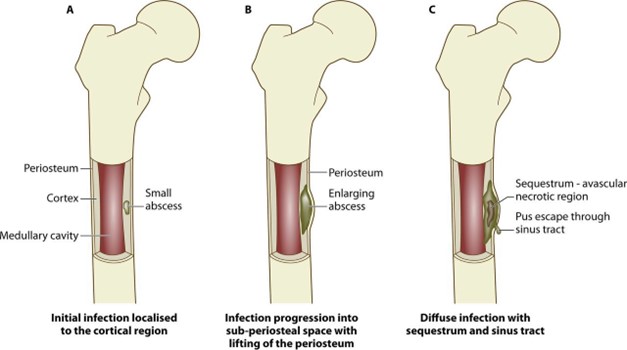
Staphylococcus aureus is present in more than 50% of patients with osteomyelitis that results from contiguous spread from adjacent infected tissue or open wounds.
Choice B is not an answer because Pseudomonas aeruginosa is a less common cause of osteomyelitis and is more commonly seen in injection drug users.
Choice C is not an answer because Streptococcus B is not a common cause of osteomyelitis.
Choice D is not an answer because Escherichia coli is not a common cause of osteomyelitis.
The nurse assesses the initial lochia post-delivery which is known as:
A. Rubra.
The initial lochia post-delivery is known as lochia rubra. Lochia is the vaginal discharge that occurs after childbirth and consists of blood, mucus, uterine tissue, and other materials from the uterus. There are three stages of lochia: lochia rubra, lochia serosa, and lochia alba. Lochia rubra is dark or bright red in color and lasts for about three to four days after delivery.
B. Fontanalis.
Choice B is not an answer because Fontanalis is not a term related to lochia.
C. Serosa.
Choice C is not an answer because lochia serosa is the second stage of lochia and occurs after lochia rubra.
D. Alba.
Choice D is not an answer because lochia alba is the last stage of lochia and occurs after lochia serosa.
Full Explanation
The initial lochia post-delivery is known as lochia rubra.
Lochia is the vaginal discharge that occurs after childbirth and consists of blood, mucus, uterine tissue, and other materials from the uterus.
There are three stages of lochia: lochia rubra, lochia serosa, and lochia alba.
Lochia rubra is dark or bright red in color and lasts for about three to four days after delivery.
Choice B is not an answer because Fontanalis is not a term related to lochia.
Choice C is not an answer because lochia serosa is the second stage of lochia and occurs after lochia rubra.
Choice D is not an answer because lochia alba is the last stage of lochia and occurs after lochia serosa.