
Nursing practice questions with comprehensive rationales
NurseDive Free Nursing Practice Question
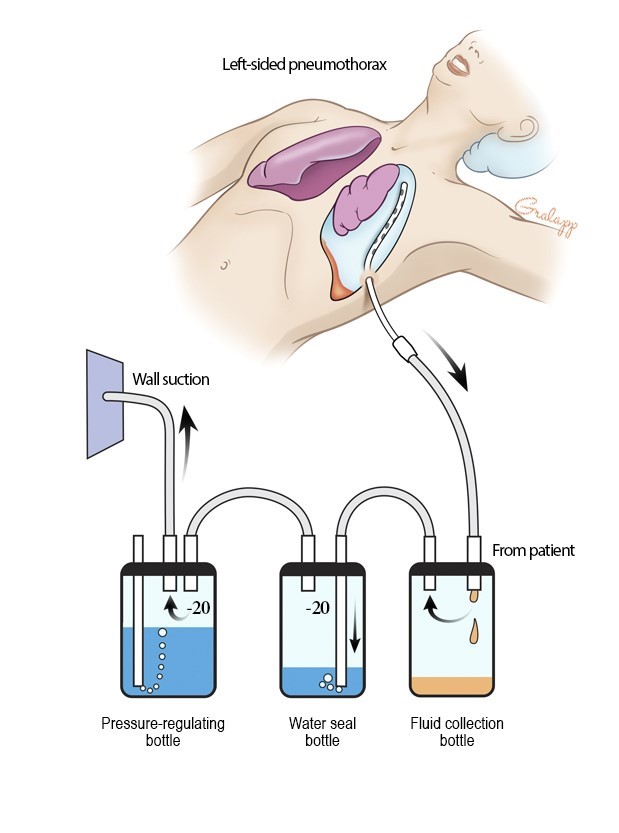
A nurse is contributing to the plan of care for a client who has a chest tube set to continuous suction to relieve a pneumothorax. Which of the following interventions should the nurse include?
A. Ensure the device is kept below the level of the client's chest.
Ensuring the device is kept below the level of the client's chest is important to ensure that the drainage system functions properly by allowing the fluid and air to flow downhill. Placing the device below the level of the chest helps facilitate gravity drainage.
B. Clamp the chest tube every 4 hr.
Continuous suction is required for proper functioning of the chest tube drainage system. Clamping the chest tube can disrupt the suction and impede the removal of air or fluid from the pleural space. Only in specific circumstances, such as when changing the drainage system or assessing for air leaks, may the healthcare provider request a temporary clamping of the chest tube.
C. Place the client in a supine position.
Positioning the client semi-Fowler's, with the head of the bed elevated, can help promote lung expansion and improve oxygenation. The specific positioning may vary depending on the client's condition and the healthcare provider's recommendations.
D. Empty the collection chamber every 8 hr.
The nurse should empty the collection chamber as per the facility's protocol, which typically includes monitoring the drainage and emptying it when it reaches a certain level. Regular emptying of the collection chamber helps maintain proper functioning of the chest tube system and allows for accurate measurement of drainage output.
This question is an excerpt from Nurse Dive's nursing test bank - ATI PN Comprehensive Predictor 2023 - Proctored Exam 1. Take the full exam now
Full Explanation
Ensuring the device is kept below the level of the client's chest is important to ensure that the drainage system functions properly by allowing the fluid and air to flow downhill. Placing the device below the level of the chest helps facilitate gravity drainage.
Continuous suction is required for proper functioning of the chest tube drainage system. Clamping the chest tube can disrupt the suction and impede the removal of air or fluid from the pleural space. Only in specific circumstances, such as when changing the drainage system or assessing for air leaks, may the healthcare provider request a temporary clamping of the chest tube.
Positioning the client semi-Fowler's, with the head of the bed elevated, can help promote lung expansion and improve oxygenation. The specific positioning may vary depending on the client's condition and the healthcare provider's recommendations.
The nurse should empty the collection chamber as per the facility's protocol, which typically includes monitoring the drainage and emptying it when it reaches a certain level. Regular emptying of the collection chamber helps maintain proper functioning of the chest tube system and allows for accurate measurement of drainage output.
Similar Questions
A nurse is collecting data from a client who has thrombocytopenia. The nurse should identify that which of the following findings increases the client's risk for injury?
A. Wears a face mask around others
Wearing a face mask does not increase the risk of injury. In fact, it helps protect the client from infections, especially if they have concurrent neutropenia, which is common in conditions affecting the bone marrow.
B. Increased intake of green, leafy vegetables
Green, leafy vegetables are rich in vitamin K, which plays a role in clotting. However, they do not directly increase the risk of injury in a client with thrombocytopenia. While vitamin K affects clotting factors, thrombocytopenia primarily involves a deficiency of platelets, which are necessary for clot formation.
C. Uses a firm-bristled toothbrush
Clients with thrombocytopenia have a low platelet count, which increases their risk of bleeding. Using a firm-bristled toothbrush can cause gum trauma and bleeding, leading to complications such as prolonged bleeding or infection. A soft-bristled toothbrush or an alternative oral hygiene method (such as an oral swab) is recommended to minimize injury.
D. Sleeps 8 to 10 hr per night
Adequate sleep does not increase the risk of injury. In fact, it may support overall health and immune function.
Full Explanation
A. Wearing a face mask does not increase the risk of injury. In fact, it helps protect the client from infections, especially if they have concurrent neutropenia, which is common in conditions affecting the bone marrow.
B. Green, leafy vegetables are rich in vitamin K, which plays a role in clotting. However, they do not directly increase the risk of injury in a client with thrombocytopenia. While vitamin K affects clotting factors, thrombocytopenia primarily involves a deficiency of platelets, which are necessary for clot formation.
C. Clients with thrombocytopenia have a low platelet count, which increases their risk of bleeding. Using a firm-bristled toothbrush can cause gum trauma and bleeding, leading to complications such as prolonged bleeding or infection. A soft-bristled toothbrush or an alternative oral hygiene method (such as an oral swab) is recommended to minimize injury.
D. Adequate sleep does not increase the risk of injury. In fact, it may support overall health and immune function.
A nurse in an assisted-living facility is reinforcing teaching with staff members about preparing for an external chemical disaster. Which of the following instructions should the nurse include?
A. "Turn on fans in the facility to circulate air."
Turning on fans in the facility to circulate air can actually worsen the situation by spreading the chemical and its fumes throughout the facility, potentially exposing more individuals.
B. "Cover the electrical outlets with wet towels."
Covering the electrical outlets with wet towels is not directly related to preparing for an external chemical disaster. It may be more relevant during a fire emergency to prevent the spread of flames, but not for chemical exposure.
C. "Move clients to a room above ground with few windows."
During an external chemical disaster, it is crucial to minimize the exposure of clients to the hazardous substance. Moving clients to a room above ground level with few windows can help reduce the risk of exposure to the chemical and its fumes. This is because many hazardous chemicals tend to be denser than air and may settle closer to the ground. Choosing a room above ground level and with fewer windows can provide a safer environment.
D. "Open the fireplace dampers in the day room."
Opening the fireplace dampers in the day room can allow the entry of outside air and potentially introduce more of the hazardous substance into the facility.
Full Explanation
During an external chemical disaster, it is crucial to minimize the exposure of clients to the hazardous substance. Moving clients to a room above ground level with few windows can help reduce the risk of exposure to the chemical and its fumes. This is because many hazardous chemicals tend to be denser than air and may settle closer to the ground. Choosing a room above ground level and with fewer windows can provide a safer environment.
Turning on fans in the facility to circulate air can actually worsen the situation by spreading the chemical and its fumes throughout the facility, potentially exposing more individuals.
Covering the electrical outlets with wet towels is not directly related to preparing for an external chemical disaster. It may be more relevant during a fire emergency to prevent the spread of flames, but not for chemical exposure.
Opening the fireplace dampers in the day room can allow the entry of outside air and potentially introduce more of the hazardous substance into the facility.
A nurse is collecting data from a client who is in renal failure. The nurse should identify that which of the following findings is a manifestation of hyperkalemia?
A. Dry mucous membranes
Dry mucous membranes are more commonly associated with dehydration or reduced fluid intake. Hyperkalemia does not directly cause dry mucous membranes.
B. Trousseau's sign
Trousseau's sign is a clinical manifestation of hypocalcemia, not hyperkalemia. It is characterized by carpal spasm induced by inflating a blood pressure cuff above the client's systolic blood pressure for a few minutes.
C. Hyperactive reflexes
Hyperactive reflexes are commonly seen in conditions such as hyperthyroidism or certain neurologic disorders. They are not directly related to hyperkalemia.
D. Irregular heart rate
Hyperkalemia refers to an elevated level of potassium in the blood. It can have various manifestations, and one of the critical effects of hyperkalemia is its impact on cardiac function. High levels of potassium can disrupt the normal electrical conduction in the heart, leading to arrhythmias or irregular heart rate. These arrhythmias can range from mild palpitations to more severe and life-threatening conditions like ventricular fibrillation.
Full Explanation
Hyperkalemia refers to an elevated level of potassium in the blood. It can have various manifestations, and one of the critical effects of hyperkalemia is its impact on cardiac function. High levels of potassium can disrupt the normal electrical conduction in the heart, leading to arrhythmias or irregular heart rate. These arrhythmias can range from mild palpitations to more severe and life-threatening conditions like ventricular fibrillation.
Dry mucous membranes are more commonly associated with dehydration or reduced fluid intake. Hyperkalemia does not directly cause dry mucous membranes.
Trousseau's sign is a clinical manifestation of hypocalcemia, not hyperkalemia. It is characterized by carpal spasm induced by inflating a blood pressure cuff above the client's systolic blood pressure for a few minutes.
Hyperactive reflexes are commonly seen in conditions such as hyperthyroidism or certain neurologic disorders. They are not directly related to hyperkalemia.