
Nursing practice questions with comprehensive rationales
NurseDive Free Nursing Practice Question
A nurse is discussing coping mechanisms with a parent of a 3-month-old infant. Which of the following therapeutic questions should the nurse ask the parent?
A. "Are you willing to take new parenting classes?"
Choice A is not a therapeutic question because it suggests a course of action rather than exploring the parent’s feelings and experiences.
B. "What do you do when your infant is fussy?"
This question allows the parent to discuss their coping mechanisms and gives the nurse an opportunity to provide guidance and support.
C. "Does parenting cause you stress?"
Choice Cis not a therapeutic questions because it isclosed-ended and does not encourage the parent to discuss their coping mechanisms.
D. "Is it overwhelming when your infant is having a bad day?".
ChoiceD is not a therapeutic questions because it isclosed-ended and does not encourage the parent to discuss their coping mechanisms.
This question is an excerpt from Nurse Dive's nursing test bank - ATI RN Nursing Care of Children 2019 Proctored Exam. Take the full exam now
Full Explanation
“What do you do when your infant is fussy?” This question allows the parent to discuss their coping mechanisms and gives the nurse an opportunity to provide guidance and support.
Choice A is not a therapeutic question because it suggests a course of action rather than exploring the parent’s feelings and experiences.
Choice C and D are not therapeutic questions because they are closed-ended and do not encourage the parent to discuss their coping mechanisms.
Similar Questions
A nurse in an urgent care clinic is prioritizing care for four children. Which of the following children should the nurse assess first?
A. A toddler who has nephrotic syndrome and facial edema.
Choice A, B and D are also important but not as urgent as choice C. A toddler with nephrotic syndrome and facial edema, an adolescent with Crohn’s disease and recent weight loss, and a school-age child with diabetes mellitus and a blood glucose of 200 mg/dL should be assessed after the preschool-age child with a muffled voice and no spontaneous cough.
B. An adolescent who has Crohn's disease and a recent weight loss of 5 kg (11 lb).
Choice A, B and D are also important but not as urgent as choice C. A toddler with nephrotic syndrome and facial edema, an adolescent with Crohn’s disease and recent weight loss, and a school-age child with diabetes mellitus and a blood glucose of 200 mg/dL should be assessed after the preschool-age child with a muffled voice and no spontaneous cough.
C. A preschool-age child who has a muffled voice and no spontaneous cough.
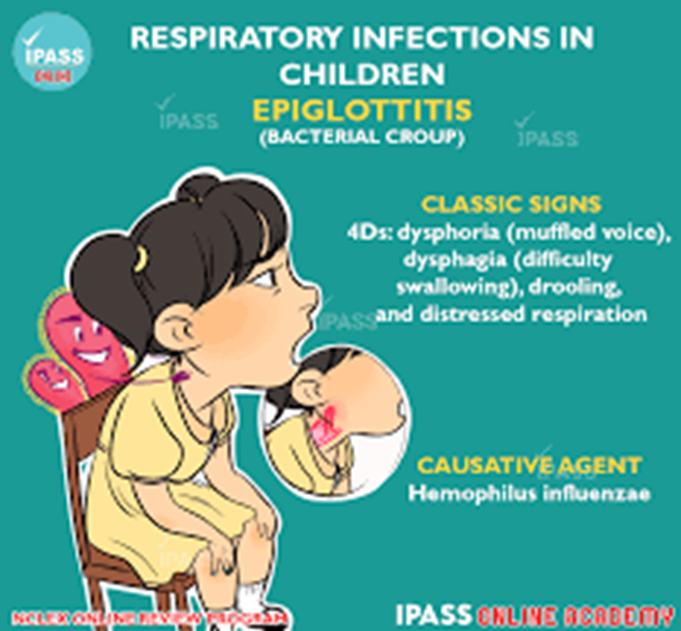
A preschool-age child who has a muffled voice and no spontaneous cough should be assessed first. These symptoms may indicate epiglottitis, which is a life-threatening condition that requires immediate medical attention.
D. A school-age child who has diabetes mellitus and a blood glucose of 200 mg/dL.
Choice A, B and D are also important but not as urgent as choice C. A toddler with nephrotic syndrome and facial edema, an adolescent with Crohn’s disease and recent weight loss, and a school-age child with diabetes mellitus and a blood glucose of 200 mg/dL should be assessed after the preschool-age child with a muffled voice and no spontaneous cough.
Full Explanation
A preschool-age child who has a muffled voice and no spontaneous cough should be assessed first.
These symptoms may indicate epiglottitis, which is a life-threatening condition that requires immediate medical attention.
Choice A, B and D are also important but not as urgent as choice C. A toddler with nephrotic syndrome and facial edema, an adolescent with Crohn’s disease and recent weight loss, and a school-age child with diabetes mellitus and a blood glucose of 200 mg/dL should be assessed after the preschool-age child with a muffled voice and no spontaneous cough.
A nurse is assessing an infant who has intussusception. Which of the following findings should the nurse expect?
A. Board-like abdomen.
Choice A is wrong because a board-like abdomen is not a symptom of intussusception.
B. Increased urinary output.
Choice B is wrong because increased urinary output is not a symptom of intussusception.
C. Sausage-shaped abdominal mass.
A sausage-shaped abdominal mass is a symptom of intussusception in infants. Intussusception is a serious condition where part of the intestine slides into an adjacent part of the intestine, often blocking food or fluid from passing through and cutting off the blood supply to the affected part of the intestine.
D. Constipation.
Choice D is wrong because constipation is not a symptom of intussusception.
Full Explanation
A sausage-shaped abdominal mass is a symptom of intussusception in infants.
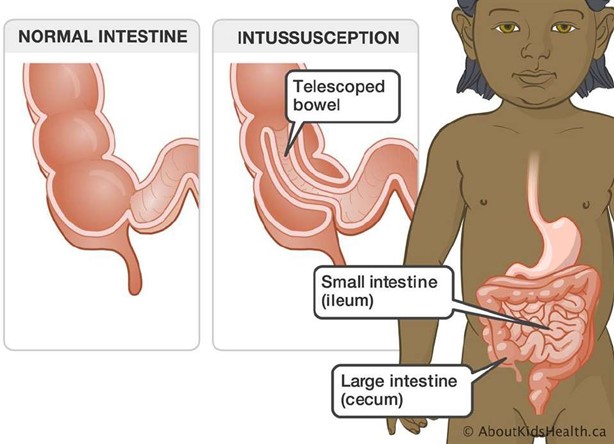
Intussusception is a serious condition where part of the intestine slides into an adjacent part of the intestine, often blocking food or fluid from passing through and cutting off the blood supply to the affected part of the intestine.
Choice A is wrong because a board-like abdomen is not a symptom of intussusception.
Choice B is wrong because increased urinary output is not a symptom of intussusception.
Choice D is wrong because constipation is not a symptom of intussusception.
A nurse is admitting a child who has acute epiglottitis. Which of the following actions should the nurse take?
A. Obtain a throat culture.
Choice A is wrong because obtaining a throat culture is not recommended when epiglottitis is suspected, as it can cause further obstruction of the airway.
B. Initiate droplet isolation precautions.
The nurse should initiate droplet isolation precautions when admitting a child who has acute epiglottitis. Epiglottitis is commonly caused by Haemophilus influenzae type B and can be transmitted through respiratory droplets.
C. Assist the child into a supine position.
Choice C is wrong because assisting the child into a supine position can worsen the airway obstruction. Children with epiglottitis prefer to sit upright with the chin extended and mouth open.
D. Check oxygen saturation every 4 hr.
Choice D is wrong because checking oxygen saturation every 4 hours may not be frequent enough for a child with acute epiglottitis who may require continuous monitoring of oxygen saturation.
Full Explanation
The nurse should initiate droplet isolation precautions when admitting a child who has acute epiglottitis.
Epiglottitis is commonly caused by Haemophilus influenzae type B and can be transmitted through respiratory droplets.
Choice A is wrong because obtaining a throat culture is not recommended when epiglottitis is suspected, as it can cause further obstruction of the airway.
Choice C is wrong because assisting the child into a supine position can worsen the airway obstruction.
Children with epiglottitis prefer to sit upright with the chin extended and mouth open.
Choice D is wrong because checking oxygen saturation every 4 hours may not be frequent enough for a child with acute epiglottitis who may require continuous monitoring of oxygen saturation.