
Nursing practice questions with comprehensive rationales
NurseDive Free Nursing Practice Question
A nurse is monitoring a client who was admited with a severe burn injury and is receiving IV fluid resuscitation therapy. The nurse should identify a decrease in which of the following findings as an indication of adequate fluid replacement?
A. Urine output
Reason: Urine output is not a finding that should decrease with adequate fluid replacement. On the contrary, urine output should increase as the fluid therapy restores the renal perfusion and function. The nurse should monitor the urine output and ensure that it is at least 0.5 mL/kg/hr for adults and 1 mL/kg/hr for children.
B. Heart rate
Reason: Heart rate is a finding that should decrease with adequate fluid replacement. A high heart rate is a sign of hypovolemia, which occurs when the burn injury causes fluid loss from the intravascular space. The nurse should monitor the heart rate and expect it to decrease as the fluid therapy replenishes the blood volume and improves the cardiac output.
C. Weight
Reason: Weight is not a finding that should decrease with adequate fluid replacement. On the contrary, weight may increase as the fluid therapy restores the hydration status and corrects the fluid deficit. The nurse should monitor the weight and compare it with the pre-burn weight to evaluate the fluid balance.
D. Blood pressure
Reason: Blood pressure is not a finding that should decrease with adequate fluid replacement. On the contrary, blood pressure may increase as the fluid therapy restores the vascular tone and improves the tissue perfusion. The nurse should monitor the blood pressure and expect it to increase as the fluid therapy compensates for the fluid loss.
This question is an excerpt from Nurse Dive's nursing test bank - ATI Med Surg Custom N235 Final Summer 2023 Proctored Exam. Take the full exam now
Full Explanation
Choice A Reason: Urine output is not a finding that should decrease with adequate fluid replacement. On the contrary, urine output should increase as the fluid therapy restores the renal perfusion and function. The nurse should monitor the urine output and ensure that it is at least 0.5 mL/kg/hr for adults and 1 mL/kg/hr for children.
Choice B Reason: Heart rate is a finding that should decrease with adequate fluid replacement. A high heart rate is a sign of hypovolemia, which occurs when the burn injury causes fluid loss from the intravascular space. The nurse should monitor the heart rate and expect it to decrease as the fluid therapy replenishes the blood volume and improves the cardiac output.
Choice C Reason: Weight is not a finding that should decrease with adequate fluid replacement. On the contrary, weight may increase as the fluid therapy restores the hydration status and corrects the fluid deficit. The nurse should monitor the weight and compare it with the pre-burn weight to evaluate the fluid balance.
Choice D Reason: Blood pressure is not a finding that should decrease with adequate fluid replacement. On the contrary, blood pressure may increase as the fluid therapy restores the vascular tone and improves the tissue perfusion. The nurse should monitor the blood pressure and expect it to increase as the fluid therapy compensates for the fluid loss.
Similar Questions
A nurse is caring for a client who has a traumatic head injury and is exhibiting signs of increasing intracranial pressure. Which of the following medications should the nurse plan to administer?
A. Dextran 70
Reason: Dextran 70 is not a medication that the nurse should plan to administer for a client who has a traumatic head injury and is exhibiting signs of increasing intracranial pressure. Dextran 70 is a plasma expander that increases the blood volume and viscosity, which can worsen the intracranial pressure by increasing the cerebral blood flow and edema.
B. Hydroxyethyl starch
Reason: Hydroxyethyl starch is not a medication that the nurse should plan to administer for a client who has a traumatic head injury and is exhibiting signs of increasing intracranial pressure. Hydroxyethyl starch is another plasma expander that has similar effects as dextran 70, and can also increase the risk of coagulopathy and renal failure.
C. Albumin 25%
Reason: Albumin 25% is not a medication that the nurse should plan to administer for a client who has a traumatic head injury and is exhibiting signs of increasing intracranial pressure. Albumin 25% is a colloid solution that increases the oncotic pressure and draws fluid from the interstitial space into the intravascular space, which can also worsen the intracranial pressure by increasing the cerebral blood flow and edema.
D. Mannitol 25%
Reason: Mannitol 25% is a medication that the nurse should plan to administer for a client who has a traumatic head injury and is exhibiting signs of increasing intracranial pressure. Mannitol 25% is an osmotic diuretic that reduces the intracranial pressure by creating an osmotic gradient and drawing fluid from the brain tissue into the blood vessels, which can then be excreted by the kidneys. The nurse should monitor the urine output, serum osmolality, and electrolytes when administering mannitol 25%.
Full Explanation
Choice A Reason: Dextran 70 is not a medication that the nurse should plan to administer for a client who has a traumatic head injury and is exhibiting signs of increasing intracranial pressure. Dextran 70 is a plasma expander that increases the blood volume and viscosity, which can worsen the intracranial pressure by increasing the cerebral blood flow and edema.
Choice B Reason: Hydroxyethyl starch is not a medication that the nurse should plan to administer for a client who has a traumatic head injury and is exhibiting signs of increasing intracranial pressure. Hydroxyethyl starch is another plasma expander that has similar effects as dextran 70, and can also increase the risk of coagulopathy and renal failure.
Choice C Reason: Albumin 25% is not a medication that the nurse should plan to administer for a client who has a traumatic head injury and is exhibiting signs of increasing intracranial pressure. Albumin 25% is a colloid solution that increases the oncotic pressure and draws fluid from the interstitial space into the intravascular space, which can also worsen the intracranial pressure by increasing the cerebral blood flow and edema.
Choice D Reason: Mannitol 25% is a medication that the nurse should plan to administer for a client who has a traumatic head injury and is exhibiting signs of increasing intracranial pressure. Mannitol 25% is an osmotic diuretic that reduces the intracranial pressure by creating an osmotic gradient and drawing fluid from the brain tissue into the blood vessels, which can then be excreted by the kidneys. The nurse should monitor the urine output, serum osmolality, and electrolytes when administering mannitol 25%.
A nurse is caring for a client who has a deep vein thrombosis and is prescribed heparin by continuous IV infusion at 1,200 units/hr. Available is heparin 25,000 units in 500 mL D5W. The nurse should set the IV pump to deliver how many mL/hr?
(Round the answer to the nearest tenth/whole number. Use a leading zero if it applies. Do not use a trailing zero.)
Full Explanation
- To find the concentration of heparin in the solution, divide the amount of heparin by the volume of D5W: 25,000 units / 500 mL = 50 units/mL
- To find the infusion rate, divide the prescribed dose by the concentration: 1,200 units/hr / 50 units/mL = 24 mL/hr
- Round the answer to the nearest tenth/whole number: 24 mL/hr
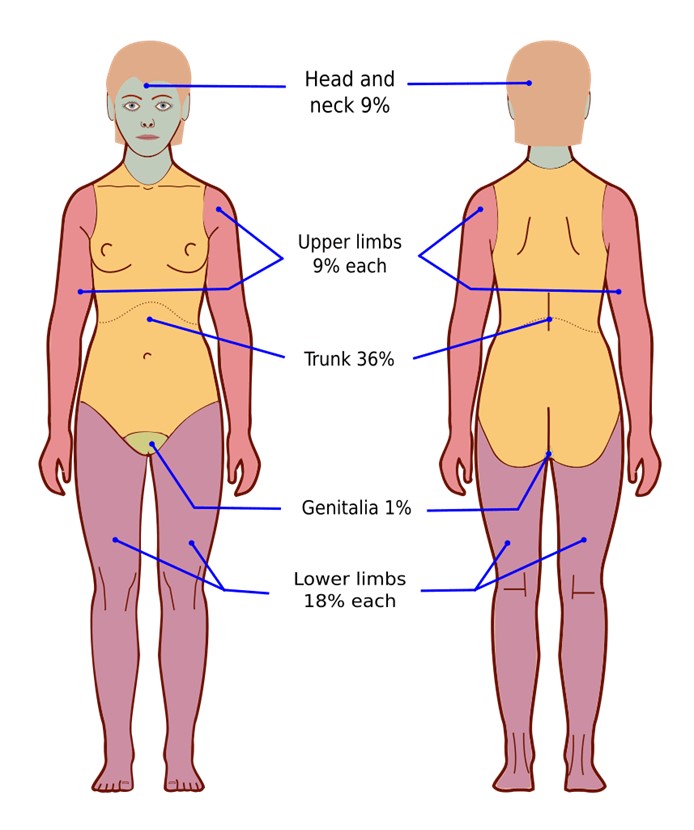
A nurse is assessing the depth and extent of injury on a client who has severe burns to the face, neck, and upper extremities. Which of the following factors is the nurse's priority when assessing the severity of the client's burns?
A. Cause of the burn
Reason: Cause of the burn is not the nurse's priority when assessing the severity of the client's burns. The cause of the burn may indicate the type and duration of exposure, such as thermal, chemical, electrical, or radiation, which can affect the depth and extent of injury. However, these factors are secondary to ensuring adequate oxygenation and ventilation.
B. Age of the client
Reason: Age of the client is not the nurse's priority when assessing the severity of the client's burns. The age of the client may influence the response to burn injury, such as healing time, infection risk, and fluid requirements. However, these factors are secondary to ensuring adequate oxygenation and ventilation.
C. Associated medical history
Reason: Associated medical history is not the nurse's priority when assessing the severity of the client's burns. The associated medical history may affect the outcome and prognosis of burn injury, such as pre-existing conditions, medications, or allergies. However, these factors are secondary to ensuring adequate oxygenation and ventilation.
D. Location of the burn
Reason: Location of the burn is the nurse's priority when assessing the severity of the client's burns. The location of the burn can indicate the potential for life-threatening complications, such as airway obstruction, inhalation injury, or impaired circulation. The nurse should assess for signs and symptoms of respiratory distress, such as stridor, wheezes, or cyanosis, and prepare for endotracheal intubation if needed. The nurse should also monitor for signs and symptoms of compartment syndrome, such as pain, pallor, paresthesia, pulselessness, or paralysis, and report any findings to the provider. The location of the burn can also affect the functional and cosmetic outcomes, such as vision loss, facial disfigurement, or joint contractures. The nurse should provide appropriate wound care, pain management, and rehabilitation as prescribed. Assessing for location of burn is essential to prevent further injury and preserve vital functions.
Full Explanation
Choice A Reason: Cause of the burn is not the nurse's priority when assessing the severity of the client's burns. The cause of the burn may indicate the type and duration of exposure, such as thermal, chemical, electrical, or radiation, which can affect the depth and extent of injury. However, these factors are secondary to ensuring adequate oxygenation and ventilation.
Choice B Reason: Age of the client is not the nurse's priority when assessing the severity of the client's burns. The age of the client may influence the response to burn injury, such as healing time, infection risk, and fluid requirements.
However, these factors are secondary to ensuring adequate oxygenation and ventilation.
Choice C Reason: Associated medical history is not the nurse's priority when assessing the severity of the client's burns. The associated medical history may affect the outcome and prognosis of burn injury, such as pre-existing conditions, medications, or allergies. However, these factors are secondary to ensuring adequate oxygenation and ventilation.
Choice D Reason: Location of the burn is the nurse's priority when assessing the severity of the client's burns. The location of the burn can indicate the potential for life-threatening complications, such as airway obstruction, inhalation injury, or impaired circulation. The nurse should assess for signs and symptoms of respiratory distress, such as stridor, wheezes, or cyanosis, and prepare for endotracheal intubation if needed. The nurse should also monitor for signs and symptoms of compartment syndrome, such as pain, pallor, paresthesia, pulselessness, or paralysis, and report any findings to the provider. The location of the burn can also affect the functional and cosmetic outcomes, such as vision loss, facial disfigurement, or joint contractures. The nurse should provide appropriate wound care, pain management, and rehabilitation as prescribed. Assessing for location of burn is essential to prevent further injury and preserve vital functions.