
Nursing practice questions with comprehensive rationales
NurseDive Free Nursing Practice Question
A nurse is monitoring an older adult client who has an exacerbation of chronic lymphocytic leukemia.
The nurse notes petechiae on the client's skin.
Which of the following actions should the nurse take?
A. Implement airborne precautions.
Choice A is incorrect because airborne precautions are used to prevent the spread of infectious diseases that are transmitted through the air, and are not necessary in this situation.
B. Determine the client's blood type.
Choice B is incorrect because determining the client’s blood type is not necessary in this situation.
C. Institute bleeding precautions.
The nurse should institute bleeding precautions for the client. Petechiae are small red or purple spots on the skin caused by broken capillaries, which can be a sign of low platelet count (thrombocytopenia) and an increased risk of bleeding. Bleeding precautions include measures such as using a soft-bristled toothbrush, avoiding injections, and avoiding activities that could result in injury.
D. Avoid administering IV pain medication.
Choice D is incorrect because avoiding IV pain medication is not necessary in this situation; however, the nurse should monitor the client for signs of bleeding and bruising.
This question is an excerpt from Nurse Dive's nursing test bank - ATI Adult Medical Surgical 2019 Proctored Exam. Take the full exam now
Full Explanation
The nurse should institute bleeding precautions for the client.
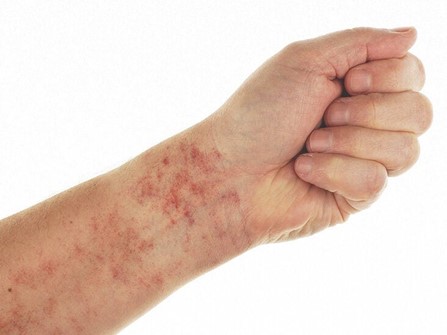
Petechiae are small red or purple spots on the skin caused by broken capillaries, which can be a sign of low platelet count (thrombocytopenia) and an increased risk of bleeding.
Bleeding precautions include measures such as using a soft-bristled toothbrush, avoiding injections, and avoiding activities that could result in injury.
Choice A is incorrect because airborne precautions are used to prevent the spread of infectious diseases that are transmitted through the air, and are not necessary in this situation.
Choice B is incorrect because determining the client’s blood type is not necessary in this situation.
Choice D is incorrect because avoiding IV pain medication is not necessary in this situation; however, the nurse should monitor the client for signs of bleeding and bruising.
Similar Questions
A nurse is preparing to perform ocular irrigation for a client following a chemical splash to the eye.
Which of the following actions should the nurse plan to take first?
A. Place a strip of pH paper onto the cul-de-sac of the affected eye.
Choice A is incorrect because airborne precautions are used to prevent the spread of infectious diseases that are transmitted through the air, and are not necessary in this situation.
B. Administer proparacaine eye drops into the affected eye.
Choice B is incorrect because administering proparacaine eye drops into the affected eye is not the first action the nurse should take. Proparacaine is a topical anesthetic that can be used to numb the eye before performing ocular irrigation, but it is not the first action the nurse should take.
C. Install 0.9% sodium chloride solution into the affected eye.
Choice C is incorrect because installing 0.9% sodium chloride solution into the affected eye is not the first action the nurse should take; the nurse should first collect information about the irritant that caused the injury before performing ocular irrigation.
D. Collect information about the irritant that caused the injury.
The first action the nurse should take is to collect information about the irritant that caused the injury. This information is important because it can help determine the appropriate treatment and irrigation solution to use.
Full Explanation
The first action the nurse should take is to collect information about the irritant that caused the injury.
This information is important because it can help determine the appropriate treatment and irrigation solution to use.
Choice A is incorrect because airborne precautions are used to prevent the spread of infectious diseases that are transmitted through the air, and are not necessary in this situation.
Choice B is incorrect because administering proparacaine eye drops into the affected eye is not the first action the nurse should take.
Proparacaine is a topical anesthetic that can be used to numb the eye before performing ocular irrigation, but it is not the first action the nurse should take.
Choice C is incorrect because installing 0.9% sodium chloride solution into the affected eye is not the first action the nurse should take; the nurse should first collect information about the irritant that caused the injury before performing ocular irrigation.
A nurse is caring for a client who has bladder cancer and a WBC count of 900/mm.
Which of the following actions should the nurse take?
A. Apply pressure to venipuncture sites for 10 min.
Choice A Applying pressure to venipuncture sites for 10 min is not necessary for a low WBC count.
B. Move the client to a negative pressure room.
Choice B Moving the client to a negative pressure room is not necessary for a low WBC count.
C. Instruct the client to avoid eating raw fruit.
Instruct the client to avoid eating raw fruit. A low white blood cell count can be caused by cancer or cancer treatment and can increase the risk of infection. One precaution that can be taken is to avoid all pre-cut fresh fruits and vegetables in delis, restaurants, and grocery stores.
D. Use contact isolation while providing care.
Choice D Contact isolation while providing care is not necessary for a low WBC count.
Full Explanation
Instruct the client to avoid eating raw fruit.
A low white blood cell count can be caused by cancer or cancer treatment and can increase the risk of infection.
One precaution that can be taken is to avoid all pre-cut fresh fruits and vegetables in delis, restaurants, and grocery stores.
Choice A Applying pressure to venipuncture sites for 10 min is not necessary for a low WBC count.
Choice B Moving the client to a negative pressure room is not necessary for a low WBC count.
Choice D Contact isolation while providing care is not necessary for a low WBC count.
A nurse in an emergency department is preparing a client for emergency surgery.
The client's blood alcohol level is 180 mg/dL.
Which of the following actions is the nurse's priority?
A. Insert an indwelling urinary catheter.
Inserting an indwelling urinary catheter may be necessary for monitoring urine output in some cases, but in this situation, the priority is to insert an NG tube. This will help prevent aspiration during surgery due to the client's high blood alcohol level, which increases the risk of vomiting.
B. Insert an NG tube.
Inserting an NG tube is the priority action for the nurse because a high blood alcohol level increases the risk of vomiting and aspiration during surgery. An NG tube can help reduce this risk by keeping the stomach empty and minimizing the chance of aspiration.
C. Obtain consent for surgery.
Obtaining consent for surgery is important, but in emergency situations, consent may be implied, or a designated surrogate decision-maker may provide consent. It is not the priority action for the nurse in this scenario.
D. Apply antiembolic stockings.
Applying antiembolic stockings is a preventive measure for deep vein thrombosis, but it is not the priority action in this case. Ensuring the client's safety during surgery, specifically by preventing aspiration, takes precedence due to the client's high blood alcohol level.
Full Explanation
The correct answer is choice B: Insert an NG tube.
Choice A rationale: Inserting an indwelling urinary catheter may be necessary for monitoring urine output in some cases, but in this situation, the priority is to insert an NG tube. This will help prevent aspiration during surgery due to the client's high blood alcohol level, which increases the risk of vomiting.
Choice B rationale: Inserting an NG tube is the priority action for the nurse because a high blood alcohol level increases the risk of vomiting and aspiration during surgery. An NG tube can help reduce this risk by keeping the stomach empty and minimizing the chance of aspiration.
Choice C rationale: Obtaining consent for surgery is important, but in emergency situations, consent may be implied, or a designated surrogate decision-maker may provide consent. It is not the priority action for the nurse in this scenario.
Choice D rationale: Applying antiembolic stockings is a preventive measure for deep vein thrombosis, but it is not the priority action in this case. Ensuring the client's safety during surgery, specifically by preventing aspiration, takes precedence due to the client's high blood alcohol level.