
Nursing practice questions with comprehensive rationales
NurseDive Free Nursing Practice Question
A nurse is performing a respiratory physical examination on a healthy patient. When performing the percussion physical assessment technique, the lung percussion note should be:
A. Resonance
Resonance is the expected percussion note when percussing over normal, healthy lung tissue. This sound is produced due to the presence of air in the lung parenchyma, which allows for the transmission of sound waves through the air-filled spaces. In a healthy individual, the resonance indicates that the lungs are free from any significant abnormalities that could alter the sound, such as fluid or solid masses.
B. Tympanic
Tympanic notes are typically heard over hollow, air-containing structures like the stomach. This sound is not expected in lung percussion unless there is a large, air-filled cavity within the lung tissue, which would be abnormal and indicative of a pathological condition such as a pneumothorax.
C. Flat
A flat percussion note is usually heard over dense tissues where air is not present, such as over the thigh muscles or areas of the chest where lung tissue has been replaced by something more solid, like in the case of a pleural effusion or a lung mass.
D. Dullness
Dullness on percussion usually indicates that the lung is not air-filled and may be suggestive of underlying conditions such as pneumonia, tumor, or atelectasis. It is a higher-pitched sound compared to flatness and is typically found in areas of the lung that are filled with fluid or solid tissue rather than air.
This question is an excerpt from Nurse Dive's nursing test bank - Ati Fundamentals Assessment Proctored Exam Midterm. Take the full exam now
Full Explanation
Choice a reason:
Resonance is the expected percussion note when percussing over normal, healthy lung tissue. This sound is produced due to the presence of air in the lung parenchyma, which allows for the transmission of sound waves through the air-filled spaces. In a healthy individual, the resonance indicates that the lungs are free from any significant abnormalities that could alter the sound, such as fluid or solid masses.
Choice b reason:
Tympanic notes are typically heard over hollow, air-containing structures like the stomach. This sound is not expected in lung percussion unless there is a large, air-filled cavity within the lung tissue, which would be abnormal and indicative of a pathological condition such as a pneumothorax.
Choice c reason:
A flat percussion note is usually heard over dense tissues where air is not present, such as over the thigh muscles or areas of the chest where lung tissue has been replaced by something more solid, like in the case of a pleural effusion or a lung mass.
Choice d reason:
Dullness on percussion usually indicates that the lung is not air-filled and may be suggestive of underlying conditions such as pneumonia, tumor, or atelectasis. It is a higher-pitched sound compared to flatness and is typically found in areas of the lung that are filled with fluid or solid tissue rather than air.
Similar Questions
A patient is diagnosed with left ear unilateral sensorineural hearing loss. During the performance of the Weber test, the nurse expects lateralization of the sound/vibration to the:
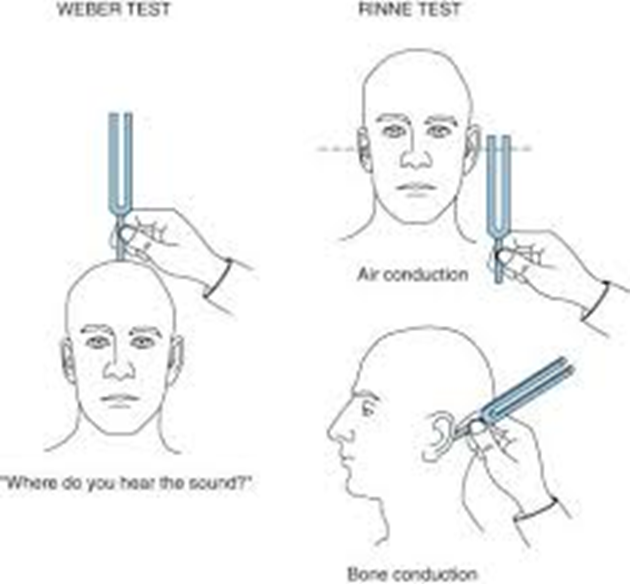
A. Left temporal bone
The left temporal bone would be the expected site of lateralization for sound in a Weber test if the patient had conductive hearing loss in the left ear. However, with unilateral sensorineural hearing loss, the sound typically lateralizes to the opposite ear, which is the ear with better hearing.
B. Both ears equally
Lateralization to both ears equally during the Weber test would suggest either normal hearing or symmetrical hearing loss. In the case of unilateral sensorineural hearing loss, the sound is not perceived as equal in both ears because the affected ear does not hear as well as the unaffected ear.
C. Right ear
In a patient with unilateral sensorineural hearing loss in the left ear, the Weber test will lateralize to the right ear, which is the ear with normal hearing. This occurs because the inner ear on the affected side is not able to transmit the sound as effectively as the unaffected side, making the sound seem louder in the ear with better hearing.
D. Left ear
Lateralization to the left ear in the Weber test would indicate conductive hearing loss in the left ear, not sensorineural hearing loss. In sensorineural hearing loss, the sound vibrates to the ear with better cochlear function, which would be the right ear in this case.
Full Explanation
Choice a reason:
The left temporal bone would be the expected site of lateralization for sound in a Weber test if the patient had conductive hearing loss in the left ear. However, with unilateral sensorineural hearing loss, the sound typically lateralizes to the opposite ear, which is the ear with better hearing.
Choice b reason:
Lateralization to both ears equally during the Weber test would suggest either normal hearing or symmetrical hearing loss. In the case of unilateral sensorineural hearing loss, the sound is not perceived as equal in both ears because the affected ear does not hear as well as the unaffected ear.
Choice c reason:
In a patient with unilateral sensorineural hearing loss in the left ear, the Weber test will lateralize to the right ear, which is the ear with normal hearing. This occurs because the inner ear on the affected side is not able to transmit the sound as effectively as the unaffected side, making the sound seem louder in the ear with better hearing.
Choice d reason:
Lateralization to the left ear in the Weber test would indicate conductive hearing loss in the left ear, not sensorineural hearing loss. In sensorineural hearing loss, the sound vibrates to the ear with better cochlear function, which would be the right ear in this case.
The nurse is planning to instruct a group of adolescents on ways to prevent traumatic brain injuries. What should be included in these instructions?
A. Wear nonslip shoes in the house.
Wearing nonslip shoes in the house is a preventive measure against falls, which are a leading cause of traumatic brain injuries (TBIs) in adolescents. Nonslip shoes provide better grip and stability, especially on potentially slippery surfaces like tiles or polished wood, reducing the risk of slips and falls that can lead to head injuries.
B. Use of guns should be supervised by an adult.
The supervised use of guns by an adult is critical in preventing accidental shootings, which can result in TBIs. Adolescents may lack the maturity and experience to handle firearms safely, and adult supervision ensures that proper safety protocols are followed, reducing the risk of accidental discharge and potential injury.
C. Always use seat belts.
The use of seat belts is one of the most effective ways to prevent TBIs in the event of a vehicle accident. Seat belts restrain the body and prevent individuals from being thrown around inside or ejected from the vehicle, significantly reducing the likelihood of head trauma.
D. Avoid risky activities such as snowboarding.
Avoiding risky activities such as snowboarding without proper safety equipment is essential in preventing sports-related TBIs. Snowboarding, like other high-speed sports, carries a risk of falls and collisions, which can cause head injuries. Wearing helmets and other protective gear, and engaging in these activities with caution, can mitigate this risk.
Full Explanation
Choice a reason:
Wearing nonslip shoes in the house is a preventive measure against falls, which are a leading cause of traumatic brain injuries (TBIs) in adolescents. Nonslip shoes provide better grip and stability, especially on potentially slippery surfaces like tiles or polished wood, reducing the risk of slips and falls that can lead to head injuries.
Choice b reason:
The supervised use of guns by an adult is critical in preventing accidental shootings, which can result in TBIs. Adolescents may lack the maturity and experience to handle firearms safely, and adult supervision ensures that proper safety protocols are followed, reducing the risk of accidental discharge and potential injury.
Choice c reason:
The use of seat belts is one of the most effective ways to prevent TBIs in the event of a vehicle accident. Seat belts restrain the body and prevent individuals from being thrown around inside or ejected from the vehicle, significantly reducing the likelihood of head trauma.
Choice d reason:
Avoiding risky activities such as snowboarding without proper safety equipment is essential in preventing sports-related TBIs. Snowboarding, like other high-speed sports, carries a risk of falls and collisions, which can cause head injuries. Wearing helmets and other protective gear, and engaging in these activities with caution, can mitigate this risk.
A nurse prepares an educational session on the importance of oral hygiene. Which teaching tip should be included in the section about preventing gingivitis?
A. A firm toothbrush is most effective in plaque removal.
A firm toothbrush is not recommended for plaque removal as it can damage the gums and tooth enamel. Soft-bristled toothbrushes are preferred because they are effective at removing plaque while being gentle on the gums and enamel.
B. Brushing more than twice per day irritates the gums.
Brushing more than twice per day does not necessarily irritate the gums unless done with improper technique or with a hard-bristled toothbrush. It is important to brush gently with a soft-bristled toothbrush and to use fluoride toothpaste to maintain oral hygiene and prevent gingivitis.
C. Ensure that dental restorations fit well.
Ensuring that dental restorations such as fillings and crowns fit well is crucial in preventing gingivitis. Poorly fitted restorations can trap food particles and bacteria, leading to plaque buildup and gum inflammation. Regular dental check-ups can help ensure that restorations remain intact and do not contribute to gingivitis.
D. Avoid flossing if there is bleeding at the gumline.
Flossing should not be avoided even if there is bleeding at the gumline. Bleeding can be a sign of gingivitis, and flossing can help remove the plaque and bacteria causing the inflammation. If bleeding persists, it is important to consult a dentist.
Full Explanation
Choice a reason:
A firm toothbrush is not recommended for plaque removal as it can damage the gums and tooth enamel. Soft-bristled toothbrushes are preferred because they are effective at removing plaque while being gentle on the gums and enamel.
Choice b reason:
Brushing more than twice per day does not necessarily irritate the gums unless done with improper technique or with a hard-bristled toothbrush. It is important to brush gently with a soft-bristled toothbrush and to use fluoride toothpaste to maintain oral hygiene and prevent gingivitis.
Choice c reason:
Ensuring that dental restorations such as fillings and crowns fit well is crucial in preventing gingivitis. Poorly fitted restorations can trap food particles and bacteria, leading to plaque buildup and gum inflammation. Regular dental check-ups can help ensure that restorations remain intact and do not contribute to gingivitis.
Choice d reason:
Flossing should not be avoided even if there is bleeding at the gumline. Bleeding can be a sign of gingivitis, and flossing can help remove the plaque and bacteria causing the inflammation. If bleeding persists, it is important to consult a dentist.