Nursing practice questions with comprehensive rationales
NurseDive Free Nursing Practice Question
A nurse is planning care for a client who has developed nephrotic syndrome. Which of the following dietary recommendations should the nurse include?
A. Decrease protein intake.
Decreasing protein intake is often recommended for clients with nephrotic syndrome to reduce proteinuria and slow the progression of kidney damage.
B. Decrease carbohydrate intake.
Decreasing carbohydrate intake is not typically a focus of dietary recommendations for nephrotic syndrome.
C. Increase potassium intake.
Increasing potassium intake may not be appropriate, as clients with nephrotic syndrome may be at risk of hyperkalemia due to impaired kidney function.
D. Increase phosphorus intake.
Increasing phosphorus intake is not typically indicated and may exacerbate complications associated with kidney dysfunction in nephrotic syndrome.
This question is an excerpt from Nurse Dive's nursing test bank - Ati Rn Adult Med Surg 2023 Proctored Exam. Take the full exam now
Full Explanation
A) Decreasing protein intake is often recommended for clients with nephrotic syndrome to reduce proteinuria and slow the progression of kidney damage.
B) Decreasing carbohydrate intake is not typically a focus of dietary recommendations for nephrotic syndrome.
C) Increasing potassium intake may not be appropriate, as clients with nephrotic syndrome may be at risk of hyperkalemia due to impaired kidney function.
D) Increasing phosphorus intake is not typically indicated and may exacerbate complications associated with kidney dysfunction in nephrotic syndrome.
Similar Questions
The nurse is reviewing the client's medical record.
The nurse is reviewing the client's medical record. Which of the following findings indicates the client's condition has improved?
Select all that apply.
A. Pain level
The client's pain level decreased from 7 to 5 after receiving nitroglycerin. This decrease indicates improvement in the client's condition.
B. Respiratory rate
The client’s respiratory rate decreased from 24/min to 22/min.
C. Heart rate
The client’s heart rate decreased from 120/min to 100/min.
D. Oxygenation saturation
Initially, the client's oxygen saturation was 93% on room air, which decreased to 89%. However, after receiving oxygen at 2 L/min via nasal cannula it improved to 92%.
E. Blood pressure
The blood pressure decreased from 176/82 to 110/62.
F. Echocardiogram results
Only one echocardiogram result showing myocardial infarction was provided.
G. Urinary output
Only one reading of I&O was provided showing an output of 32 mL, hence difficult to determine whether there was an improvement.
Full Explanation
A) The client's pain level decreased from 7 to 5 after receiving nitroglycerin. This decrease indicates improvement in the client's condition.
B) The client’s respiratory rate decreased from 24/min to 22/min.
C) The client’s heart rate decreased from 120/min to 100/min.
D) Initially, the client's oxygen saturation was 93% on room air, which decreased to 89%. However, after receiving oxygen at 2 L/min via nasal cannula it improved to 92%.
E) The blood pressure decreased from 176/82 to 110/62.
F) Only one echocardiogram result showing myocardial infarction was provided.
G) Only one reading of I&O was provided showing an output of 32 mL, hence difficult to determine whether there was an improvement.
A nurse is reviewing the client’s medical record
For each potential provider's prescription, click to specify if the potential prescription is anticipated, nonessential, or contraindicated for the client.
Potential Prescription: Anticipated Nonessential Contraindicated
A. Metoprolol 15 mg IV bolus
B. Oxygen at 2 L/min via nasal cannula
C. Draw electrolytes along with Hgb and Hct
D. Morphine 6 mg IV bolus every 3 hr as needed for pain
E. Nitroglycerin 0.5 mg SL now may repeat every 5 min up to 3 doses
F. Obtain daily weight
G. Atropine 0.5 mg IV bolus every 5 min up to 2 mg if heart rate drops below 60
Full Explanation
A) Metoprolol is a beta-blocker that can help reduce heart rate and blood pressure, which is beneficial in cases of chest pain and irregular tachycardia.
B) Oxygen at 2 L/min via nasal cannula is anticipated because the client's oxygen saturation is below normal, indicating they may benefit from supplemental oxygen.
C) Drawing electrolytes along with Hgb and Hct is anticipated as it is important to monitor these levels due to the client's symptoms and history of hypertension and diabetes.
D) Morphine is anticipated because the client reports pain, and morphine can provide pain relief and reduce the workload on the heart.
E) Nitroglycerin is a standard treatment for chest pain due to its vasodilating effects, which can improve blood flow to the heart.
F) Obtaining daily weight is nonessential at this moment because it does not directly address the acute symptoms the client is experiencing.
G) Atropine is contraindicated as the client's heart rate is tachycardic, not bradycardic, and atropine is used to increase heart rate.
A nurse is teaching a client who has a new prescription for warfarin about foods that affect the INR. The nurse should include in the teaching that which of the following foods interacts with this medication?
A. Beef stew
Beef stew do not contain significant amounts of vitamin K and thus have a lesser impact on INR levels.
B. Orange juice
Orange juice do not contain significant amounts of vitamin K and thus have a lesser impact on INR levels.
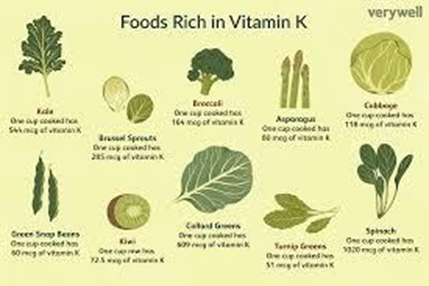
C. Kale
Warfarin's effectiveness can be influenced by vitamin K, which is found in high amounts in kale and other green leafy vegetables. Consistent intake of vitamin K is crucial as fluctuations can affect the International Normalized Ratio (INR), a measure of blood clotting.
D. Yogurt
Yogurt do not contain significant amounts of vitamin K and thus have a lesser impact on INR levels.
Full Explanation
A) Beef stew do not contain significant amounts of vitamin K and thus have a lesser impact on INR levels.
B) Orange juice do not contain significant amounts of vitamin K and thus have a lesser impact on INR levels.
C) Warfarin's effectiveness can be influenced by vitamin K, which is found in high amounts in kale and other green leafy vegetables. Consistent intake of vitamin K is crucial as fluctuations can affect the International Normalized Ratio (INR), a measure of blood clotting.
D) Yogurt do not contain significant amounts of vitamin K and thus have a lesser impact on INR levels.