
Nursing practice questions with comprehensive rationales
NurseDive Free Nursing Practice Question
A nurse is preparing to administer potassium chloride 10 mEq IV over 1 hr to a client. Available in potassium chloride 10 mEq in 100 mL of 0.9% sodium chloride. The nurse should set the infusion pump to deliver how many mL/hr? (Round the answer to the nearest whole number. Use a leading zero if it applies. Do not use a trailing zero.).
A. 10 mL/hr.
10 mL/hr would be the correct infusion rate if the client was receiving the entire 10 mEq of potassium chloride in a 100 mL solution over 1 hour. However, the question asks for the rate at which to administer 10 mEq over 1 hour, which means the total volume should be 100 mL/hr.
B. 50 mL/hr.
50 mL/hr would be the correct infusion rate if the client was receiving the entire 10 mEq of potassium chloride in a 100 mL solution over 2 hours. However, the question specifies 1 hour, so the rate should be higher.
C. 100 mL/hr.
This is the correct answer. To administer 10 mEq of potassium chloride in 100 mL over 1 hour, the infusion pump should be set to deliver 100 mL/hr.
D. 500 mL/hr.
500 mL/hr would be the correct infusion rate if the client was receiving the entire 10 mEq of potassium chloride in a 100 mL solution over 10 minutes (1/6th of an hour). However, the question specifies 1 hour, so the rate should be much lower.
This question is an excerpt from Nurse Dive's nursing test bank - ATI RN VATI Adult Medical Surgical S 2019 Proctored Exam. Take the full exam now
Full Explanation
Choice A rationale:
10 mL/hr would be the correct infusion rate if the client was receiving the entire 10 mEq of potassium chloride in a 100 mL solution over 1 hour. However, the question asks for the rate at which to administer 10 mEq over 1 hour, which means the total volume should be 100 mL/hr.
Choice B rationale:
50 mL/hr would be the correct infusion rate if the client was receiving the entire 10 mEq of potassium chloride in a 100 mL solution over 2 hours. However, the question specifies 1 hour, so the rate should be higher.
Choice C rationale:
This is the correct answer. To administer 10 mEq of potassium chloride in 100 mL over 1 hour, the infusion pump should be set to deliver 100 mL/hr.
Choice D rationale:
500 mL/hr would be the correct infusion rate if the client was receiving the entire 10 mEq of potassium chloride in a 100 mL solution over 10 minutes (1/6th of an hour). However, the question specifies 1 hour, so the rate should be much lower.
Similar Questions
A nurse is providing teaching for a client about testicular cancer. Which of the following manifestations should the nurse instruct the client to monitor for during self-examination?
A. A painless lump in the testicle.
Testicular cancer may present as a painless lump or swelling in the testicle. It's important for the client to monitor for any new or unusual lumps, as they could be indicative of cancer.
B. Decreased size of the testicle.
A decreased size of the testicle is not a typical manifestation of testicular cancer. It is more commonly associated with conditions like testicular atrophy due to other causes.
C. Left testicle descending lower than right testicle.
Asymmetry in the position of the testicles, with one testicle descending lower than the other, is a normal variation and not a sign of testicular cancer.
D. Dilated veins above the testicle.
Dilated veins above the testicle can be a sign of a varicocele, which is a separate condition from testicular cancer. It is caused by abnormal enlargement of veins in the scrotum and is generally not associated with cancer.
Full Explanation
Choice A rationale:
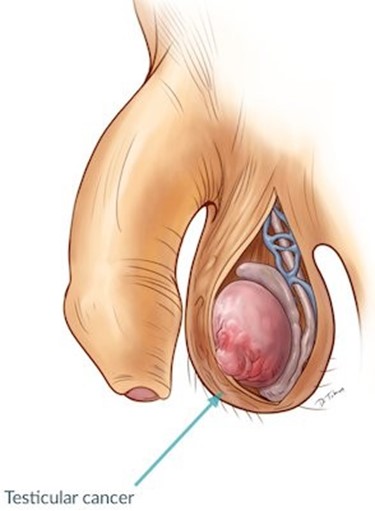
Testicular cancer may present as a painless lump or swelling in the testicle. It's important for the client to monitor for any new or unusual lumps, as they could be indicative of cancer.
Choice B rationale:
A decreased size of the testicle is not a typical manifestation of testicular cancer. It is more commonly associated with conditions like testicular atrophy due to other causes.
Choice C rationale:
Asymmetry in the position of the testicles, with one testicle descending lower than the other, is a normal variation and not a sign of testicular cancer.
Choice D rationale:
Dilated veins above the testicle can be a sign of a varicocele, which is a separate condition from testicular cancer. It is caused by abnormal enlargement of veins in the scrotum and is generally not associated with cancer.
A nurse is caring for a client who had a surgical repair of an abdominal aortic aneurysm 3 days ago. The client's vital signs are temperature 38.3°C (100.9°F), heart rate 80/min, respirations 16/min, and blood pressure 128/76 mm Hg. Which of the following actions is the nurse's priority?
A. Notify the surgeon of the temperature elevation.
Notifying the surgeon of the temperature elevation is important, but it is not the nurse's priority. A temperature elevation after abdominal surgery could be a sign of infection, but the immediate action should be to assess the surgical incision for any signs of infection.
B. Encourage the client to drink more fluids.
Encouraging the client to drink more fluids is a good practice to maintain hydration and promote recovery after surgery. However, it is not the nurse's priority in this situation. The elevated temperature and potential infection take precedence over increasing fluid intake.
C. Assess the surgical incision for signs of infection.
This is the correct answer because the nurse's priority is to assess the surgical incision for signs of infection. An elevated temperature is a significant finding after surgery, and it may indicate a surgical site infection, which requires prompt assessment and intervention.
D. Monitor vital signs every 4 hr.
Monitoring vital signs every 4 hours is an essential nursing intervention after surgery, but it is not the priority when the client has an elevated temperature and a recent surgical incision. The nurse must first assess for signs of infection before proceeding with routine vital sign monitoring.
Full Explanation
Choice A rationale:
Notifying the surgeon of the temperature elevation is important, but it is not the nurse's priority. A temperature elevation after abdominal surgery could be a sign of infection, but the immediate action should be to assess the surgical incision for any signs of infection.
Choice B rationale:
Encouraging the client to drink more fluids is a good practice to maintain hydration and promote recovery after surgery. However, it is not the nurse's priority in this situation. The elevated temperature and potential infection take precedence over increasing fluid intake.
Choice C rationale:
This is the correct answer because the nurse's priority is to assess the surgical incision for signs of infection. An elevated temperature is a significant finding after surgery, and it may indicate a surgical site infection, which requires prompt assessment and intervention.
Choice D rationale:
Monitoring vital signs every 4 hours is an essential nursing intervention after surgery, but it is not the priority when the client has an elevated temperature and a recent surgical incision.
The nurse must first assess for signs of infection before proceeding with routine vital sign monitoring.
A nurse is caring for a client who has multiple sclerosis. Which of the following manifestations should the nurse expect?
A. Diplopia.
A) Diplopia: Diplopia, or double vision, is a common symptom in multiple sclerosis (MS) due to demyelination of nerves in the brainstem, affecting eye movement coordination. This visual disturbance is frequently seen in MS clients and may worsen during flare-ups.
B. Masklike expression.
B) Masklike expression: A masklike expression is more commonly associated with Parkinson’s disease rather than multiple sclerosis. This characteristic facial appearance is due to muscle rigidity, which is not typically a manifestation of MS.
C. Twitching of the face.
C) Twitching of the face: Facial twitching, or fasciculations, is not typically a primary symptom of multiple sclerosis. While muscle weakness and spasticity are common in MS, twitching is more commonly seen in conditions such as amyotrophic lateral sclerosis (ALS).
D. Agitation.
D) Agitation: Agitation is not a primary symptom of MS. While MS can lead to cognitive changes or mood disturbances, such as depression, severe agitation is more commonly linked with other neurological or psychiatric conditions.
Full Explanation
Answer: A. Diplopia.
Rationale:
A) Diplopia: Diplopia, or double vision, is a common symptom in multiple sclerosis (MS) due to demyelination of nerves in the brainstem, affecting eye movement coordination. This visual disturbance is frequently seen in MS clients and may worsen during flare-ups.
B) Masklike expression: A masklike expression is more commonly associated with Parkinson’s disease rather than multiple sclerosis. This characteristic facial appearance is due to muscle rigidity, which is not typically a manifestation of MS.
C) Twitching of the face: Facial twitching, or fasciculations, is not typically a primary symptom of multiple sclerosis. While muscle weakness and spasticity are common in MS, twitching is more commonly seen in conditions such as amyotrophic lateral sclerosis (ALS).
D) Agitation: Agitation is not a primary symptom of MS. While MS can lead to cognitive changes or mood disturbances, such as depression, severe agitation is more commonly linked with other neurological or psychiatric conditions.