
Nursing practice questions with comprehensive rationales
NurseDive Free Nursing Practice Question
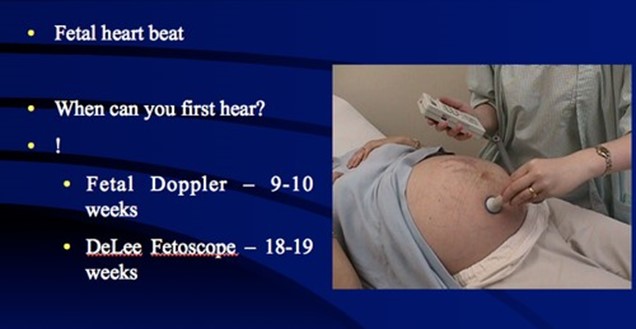
A nurse is preparing to assess fetal heart tones for a client who is at 12 weeks of gestation.
Which of the following actions should the nurse take?
A. Position the ultrasound stethoscope above the symphysis pubis to assess the fetal heart rate.
This is because at 12 weeks of gestation, the uterus is still low in the pelvis and the fetal heart tones are best audible through the fetal back, which is usually located just above the symphysis pubis. The fetal heart rate at this stage is normally between 120 and 180 beats per minute.
B. Measure the fundal height to determine the placement of the ultrasound stethoscope.
because measuring the fundal height is not necessary to determine the placement of the ultrasound stethoscope at 12 weeks of gestation. The fundal height is usually measured from 20 weeks of gestation onwards to assess fetal growth and estimate gestational age.
C. Place the client in a side-lying position prior to assessing the fetal heart rate.
wrong because placing the client in a side-lying position prior to assessing the fetal heart rate is not required at 12 weeks of gestation. This position may be helpful later in pregnancy to improve maternal blood flow and oxygen delivery to the fetus, especially if there are signs of fetal distress or hypoxia.
D. Perform Leopold maneuvers prior to auscultating the fetal heart rate.
because performing Leopold maneuvers prior to auscultating the fetal heart rate is not appropriate at 12 weeks of gestation. Leopold maneuvers are a series of four steps to palpate the abdomen and determine the fetal position, presentation, lie, and engagement. They are usually performed after 24 weeks of gestation when the fetus is large enough to be felt through the abdominal wall.
This question is an excerpt from Nurse Dive's nursing test bank - ATI Comprehensive Predictor 2023 Exit Proctored Exam A. Take the full exam now
Full Explanation
Similar Questions
A nurse is caring for a child who is postoperative following a tonsillectomy.
Which of the following findings indicates that the child may be experiencing hemorrhage?
A. Elevated pain level.
because elevated pain level is not a specific sign of hemorrhage. Pain is expected after a tonsillectomy and can be managed with medication and fluids.
B. Increased drowsiness.
because increased drowsiness is not a specific sign of hemorrhage. Drowsiness can be caused by anesthesia, medication, or dehydration.
C. Frequent swallowing.
This indicates that the child may be experiencing hemorrhage because they are trying to clear the blood from their throat. Frequent swallowing is one of the initial signs of bleeding immediately after tonsillectomy.
D. Diminished breath sounds.
because diminished breath sounds are not a specific sign of hemorrhage. Diminished breath sounds can be caused by respiratory infection, asthma, or bronchospasm. Normal ranges for hemoglobin and hematocrit are 11.5 to 15.5 g/dL and 34 to 45% for children, respectively. Normal ranges for platelet count are 150,000 to 450,000/mm3 for both children and adults. Normal ranges for plasma clotting variables depend on the specific test and method used.
Full Explanation
The correct answer is choice C, frequent swallowing.
This indicates that the child may be experiencing hemorrhage because they are trying to clear the blood from their throat. Frequent swallowing is one of the initial signs of bleeding immediately after tonsillectomy.
Choice A is wrong because elevated pain level is not a specific sign of hemorrhage.
Pain is expected after a tonsillectomy and can be managed with medication and fluids.
Choice B is wrong because increased drowsiness is not a specific sign of hemorrhage.
Drowsiness can be caused by anesthesia, medication, or dehydration.
Choice D is wrong because diminished breath sounds are not a specific sign of hemorrhage.
Diminished breath sounds can be caused by respiratory infection, asthma, or bronchospasm.
Normal ranges for hemoglobin and hematocrit are 11.5 to 15.5 g/dL and 34 to 45% for children, respectively.
Normal ranges for platelet count are 150,000 to 450,000/mm3 for both children and adults.
Normal ranges for plasma clotting variables depend on the specific test and method used.
A nurse is assessing a client who is taking haloperidol and is experiencing pseudoparkinsonism.
Which of the following findings should the nurse document as a manifestation of pseudoparkinsonism?
A. Nonreactive pupils.
Nonreactive pupils is wrong because this is not a typical feature of pseudoparkinsonism or Parkinson’s disease. Nonreactive pupils can be caused by other conditions, such as brain injury, drugs, or eye diseases.
B. Serpentine limb movement.
.Serpentine limb movement is wrong because this is a characteristic of tardive dyskinesia, another drug-induced movement disorder that can result from long-term use of dopamine receptor blocking agents. Tardive dyskinesia causes involuntary movements of the face, tongue, and limbs that are often writhing or twisting
C. Smacking lips.
Smacking lips is wrong because this is also a sign of tardive dyskinesia, not pseudoparkinsonism. Smacking lips is one of the orofacial movements that can occur in tardive dyskinesia due to abnormal muscle contractions.
D. Shuffling gait.
This is because shuffling gait is a common manifestation of pseudoparkinsonism, which is a condition that mimics the symptoms of Parkinson’s disease due to the use of certain medications that block dopamine receptors, such as haloperidol. Pseudoparkinsonism can cause slowed movements, muscle stiffness, tremor, and postural instability.
Full Explanation
The correct answer is choice D. Shuffling gait. This is because shuffling gait is a common manifestation of pseudoparkinsonism, which is a condition that mimics the symptoms of Parkinson’s disease due to the use of certain medications that block dopamine receptors, such as haloperidol. Pseudoparkinsonism can cause slowed movements, muscle stiffness, tremor, and postural instability.
Choice A. Nonreactive pupils is wrong because this is not a typical feature of pseudoparkinsonism or Parkinson’s disease.
Nonreactive pupils can be caused by other conditions, such as brain injury, drugs, or eye diseases.
Choice B. Serpentine limb movement is wrong because this is a characteristic of tardive dyskinesia, another drug-induced movement disorder that can result from long-term use of dopamine receptor blocking agents. Tardive dyskinesia causes involuntary movements of the face, tongue, and limbs that are often writhing or twisting.
Choice C. Smacking lips is wrong because this is also a sign of tardive dyskinesia, not pseudoparkinsonism. Smacking lips is one of the orofacial movements that can occur in tardive dyskinesia due to abnormal muscle contractions.
A nurse is planning care for a client who has a prescription for a bowel-training program following a spinal cord injury.
Which of the following actions should the nurse include in the plan of care?
A. Encourage a maximum fluid intake of 1,500 mL per day.
wrong because encouraging a maximum fluid intake of 1,500 mL per day is not enough to prevent constipation and promote bowel health. A fluid intake of at least 2,000 mL per day is recommended for most adults.
B. Increase the amount of refined grains in the client’s diet.
is wrong because increasing the amount of refined grains in the client’s diet can worsen constipation and reduce stool bulk. Refined grains are low in fiber, which is essential for normal bowel function. A high-fiber diet of at least 20 to 35 grams per day is advised for clients with spinal cord injury.
C. Provide the client with a cold drink prior to defecation.
wrong because providing the client with a cold drink prior to defecation can have the opposite effect of stimulating the bowel. Cold drinks can slow down the digestive process and reduce peristalsis, which is the movement of food through the intestines. Warm or hot drinks can help stimulate the bowel and increase peristalsis.
D. Administer a cathartic suppository 30 min prior to scheduled defecation times.
defecation times. This is because a cathartic suppository stimulates the nerve endings in the rectum, causing a contraction of the bowel and facilitating defecation. This is especially helpful for clients who have an upper motor neuron or reflexic bowel, which means they have lost the ability to feel when the rectum is full and have a tight anal sphincter muscle. A bowel program is a way of controlling or moving the bowels after a spinal cord injury, which may affect normal bowel function depending on the spinal level involved. A bowel program aims to achieve regular bowel movements, prevent constipation or impaction, and avoid accidents.
Full Explanation
The correct answer is choice D. Administer a cathartic suppository 30 min prior to scheduled defecation times. This is because a cathartic suppository stimulates the nerve endings in the rectum, causing a contraction of the bowel and facilitating defecation. This is especially helpful for clients who have an upper motor neuron or reflexic bowel, which means they have lost the ability to feel when the rectum is full and have a tight anal sphincter muscle. A
bowel program is a way of controlling or moving the bowels after a spinal cord injury, which may affect normal bowel function depending on the spinal level involved. A bowel program aims to achieve regular bowel movements, prevent constipation or impaction, and avoid accidents.
Choice A is wrong because encouraging a maximum fluid intake of 1,500 mL per day is not enough to prevent constipation and promote bowel health. A fluid intake of at least 2,000 mL per day is recommended for most adults.
Choice B is wrong because increasing the amount of refined grains in the client’s diet can worsen constipation and reduce stool bulk.
Refined grains are low in fiber, which is essential for normal bowel function. A high-fiber diet of at least 20 to 35 grams per day is advised for clients with spinal cord injury.
Choice C is wrong because providing the client with a cold drink prior to defecation can have the opposite effect of stimulating the bowel.
Cold drinks can slow down the digestive process and reduce peristalsis, which is the movement of food through the intestines. Warm or hot drinks can help stimulate the bowel and increase peristalsis.