
Nursing practice questions with comprehensive rationales
NurseDive Free Nursing Practice Question
A nurse is preparing to examine a post-term newborn immediately following delivery. Which of the following findings should she expect to observe? (Select all that apply.).
A. Moro reflex.
The Moro reflex is a normal finding in newborns, including those born post-term. It is a primitive reflex that should be present and indicates a healthy neurological system.
B. Vernix in the folds and creases.
Vernix, a protective white substance that coats the skin in utero, is typically absent or minimal in post-term newborns due to its decreased production as gestation progresses. Therefore, it would not be expected in a post-term infant.
C. Abundant lanugo.
Lanugo, the fine hair covering a newborn's body, is usually present in greater amounts in preterm infants. By the time a newborn is post-term, lanugo is typically sparse or absent, making it an unlikely finding.
D. Heel to ear maneuverability.
This maneuver assesses the flexibility of the newborn's joints. Post-term infants tend to have reduced flexibility and increased muscle tone, making this maneuver more difficult or restricted in this population.
This question is an excerpt from Nurse Dive's nursing test bank - ATI Custom Maternity Newborncare Proctored Exam. Take the full exam now
Full Explanation
Choice A rationale:
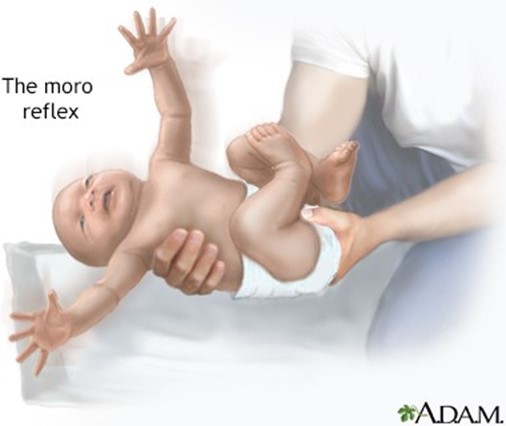
The Moro reflex is a normal finding in newborns, including those born post-term. It is a primitive reflex that should be present and indicates a healthy neurological system.
Choice B rationale:
Vernix, a protective white substance that coats the skin in utero, is typically absent or minimal in post-term newborns due to its decreased production as gestation progresses. Therefore, it would not be expected in a post-term infant.
Choice C rationale:
Lanugo, the fine hair covering a newborn's body, is usually present in greater amounts in preterm infants. By the time a newborn is post-term, lanugo is typically sparse or absent, making it an unlikely finding.
Choice D rationale:
This maneuver assesses the flexibility of the newborn's joints. Post-term infants tend to have reduced flexibility and increased muscle tone, making this maneuver more difficult or restricted in this population.
Similar Questions
A nurse is collecting data about reflexes from a newborn. Which of the following actions should the nurse take to elicit the newborn's Moro reflex?
A. Perform a sharp hand clap near the infant.
The Moro reflex, also known as the startle reflex, is a normal reflex observed in newborns. To elicit this reflex, the nurse should perform a sharp hand clap or make a loud noise near the infant. This reflex is characterized by the baby's arms and legs extending outward, followed by a quick flexion, resembling a startle response. It is an important reflex to assess the newborn's neurological and motor development.
B. Turn the newborn's head quickly to one side.
Turning the newborn's head quickly to one side does not elicit the Moro reflex. This action may stimulate other reflexes, such as the tonic neck reflex, but it is not the appropriate method to assess the Moro reflex.
C. Place a finger at the base of the newborn's toes.
Placing a finger at the base of the newborn's toes does not elicit the Moro reflex. This action is more related to testing the Babinski reflex, which involves the fanning and curling of the toes when the sole of the foot is stimulated.
D. Hold the newborn vertically, allowing one foot to touch the crib surface.
Holding the newborn vertically and allowing one foot to touch the crib surface does not elicit the Moro reflex. This action might elicit the stepping reflex, where the baby shows stepping movements as if walking when held in an upright position with their feet touching a surface.
Full Explanation
Choice A rationale:
The Moro reflex, also known as the startle reflex, is a normal reflex observed in newborns. To elicit this reflex, the nurse should perform a sharp hand clap or make a loud noise near the infant. This reflex is characterized by the baby's arms and legs extending outward, followed by a quick flexion, resembling a startle response. It is an important reflex to assess the newborn's neurological and motor development.
Choice B rationale:
Turning the newborn's head quickly to one side does not elicit the Moro reflex. This action may stimulate other reflexes, such as the tonic neck reflex, but it is not the appropriate method to assess the Moro reflex.
Choice C rationale:
Placing a finger at the base of the newborn's toes does not elicit the Moro reflex. This action is more related to testing the Babinski reflex, which involves the fanning and curling of the toes when the sole of the foot is stimulated.
Choice D rationale:
Holding the newborn vertically and allowing one foot to touch the crib surface does not elicit the Moro reflex. This action might elicit the stepping reflex, where the baby shows stepping movements as if walking when held in an upright position with their feet touching a surface.
A nurse is caring for a newborn who is formula-fed. The newborn takes 0.5 oz of formula at 0800, 1 oz at 1100, 0.5 oz at 1300, 0.5 oz at 1600, and 0.5 oz at 1830. How many mL of formula should the nurse record as the client's intake for the shift?
A. 15 mL.
15 mL is not the correct choice because it only considers the first two feedings and does not account for the intake during the entire shift.
B. 30 mL.
30 mL is not the correct choice because it only considers the first three feedings and does not account for the intake during the entire shift.
C. 45 mL.
45 mL is not the correct choice because it only considers the first four feedings and does not account for the intake during the entire shift.
D. 90 mL.
The nurse should record 60 mL of formula as the newborn's intake for the shift. To calculate the total intake, you add the amounts from each feeding: 0.5 oz + 1 oz + 0.5 oz + 0.5 oz + 0.5 oz = 3 oz. Remember that 1 fluid ounce (oz) is approximately equal to 30 mL. So 3 oz= 3 x 30 = 90mL
Full Explanation
Choice A rationale:
15 mL is not the correct choice because it only considers the first two feedings and does not account for the intake during the entire shift.
Choice B rationale:
30 mL is not the correct choice because it only considers the first three feedings and does not account for the intake during the entire shift.
Choice C rationale:
45 mL is not the correct choice because it only considers the first four feedings and does not account for the intake during the entire shift.
Choice D rationale:
The nurse should record 60 mL of formula as the newborn's intake for the shift. To calculate the total intake, you add the amounts from each feeding: 0.5 oz + 1 oz + 0.5 oz + 0.5 oz + 0.5 oz = 3 oz. Remember that 1 fluid ounce (oz) is approximately equal to 30 mL. So 3 oz= 3 x 30 = 90mL
A mother asks, "Why does my infant have blue hands?".
A. He is just cold.
"He is just cold”. is not the correct choice. While newborns can have cold hands and feet due to their immature thermoregulation, it would not explain persistent blue hands.
B. He may have been born with a heart problem.
"He may have been born with a heart problem”. is not the correct choice as it suggests a congenital heart defect. While cyanosis (bluish discoloration) can be associated with some heart problems, the hands alone being blue is less likely to be solely related to a heart issue.
C. The hands are always blue in a newborn.
"The hands are always blue in a newborn”. is not the correct choice. While newborns may have bluish extremities (acrocyanosis) during the first few days after birth due to their developing circulatory system, persistent blue hands beyond this period would require further assessment.
D. The circulation in his hands is not fully developed.
The correct choice is that "The circulation in his hands is not fully developed.”. Newborns have a developing circulatory system, and sometimes, their peripheral circulation takes some time to mature, leading to transient blue hands. However, if the blue color persists or worsens, it's essential to evaluate for any underlying issues.
Full Explanation
Choice A rationale:
"He is just cold”. is not the correct choice. While newborns can have cold hands and feet due to their immature thermoregulation, it would not explain persistent blue hands.
Choice B rationale:
"He may have been born with a heart problem”. is not the correct choice as it suggests a congenital heart defect. While cyanosis (bluish discoloration) can be associated with some heart problems, the hands alone being blue is less likely to be solely related to a heart issue.
Choice C rationale:
"The hands are always blue in a newborn”. is not the correct choice. While newborns may have bluish extremities (acrocyanosis) during the first few days after birth due to their developing circulatory system, persistent blue hands beyond this period would require further assessment.
Choice D rationale:
The correct choice is that "The circulation in his hands is not fully developed.”. Newborns have a developing circulatory system, and sometimes, their peripheral circulation takes some time to mature, leading to transient blue hands. However, if the blue color persists or worsens, it's essential to evaluate for any underlying issues.