
Nursing practice questions with comprehensive rationales
NurseDive Free Nursing Practice Question
A nurse is providing anticipatory guidance about child development to the parents of a preschooler. Which of the following developmental tasks should the nurse include as being expected of a preschooler?
A. Participates in imaginary play
Preschoolers, typically between the ages of 3 and 5 years, engage in imaginative and pretend play. They often create scenarios, role-play, and use their imagination to create fictional situations and characters. This type of play is important for their cognitive, social, and emotional development. Building a section of cards and controlling impulsive feelings are not specific developmental tasks typically associated with preschoolers. While building with blocks or other construction toys can enhance fine motor skills and problem-solving abilities, building a section of cards is not a common developmental milestone. Controlling impulsive feelings is an ongoing process that develops over time and requires guidance and support from parents and caregivers, but it is not solely expected of preschoolers.
B. Builds a section of cards
C. Controls impulsive feelings
This question is an excerpt from Nurse Dive's nursing test bank - Paediatrics ATI Proctored Exam. Take the full exam now
Full Explanation
Preschoolers, typically between the ages of 3 and 5 years, engage in imaginative and pretend play. They often create scenarios, role-play, and use their imagination to create fictional situations and characters. This type of play is important for their cognitive, social, and emotional development.
Building a section of cards and controlling impulsive feelings are not specific developmental tasks typically associated with preschoolers. While building with blocks or other construction toys can enhance fine motor skills and problem-solving abilities, building a section of cards is not a common developmental milestone. Controlling impulsive feelings is an ongoing process that develops over time and requires guidance and support from parents and caregivers, but it is not solely expected of preschoolers.
Similar Questions
A nurse is planning care for a 2-month-old infant following a surgical procedure. Which of the following pain rating scales should the nurse plan to use to determine the infant's level of pain?
A. PANAD scale
B. OUCHER scale
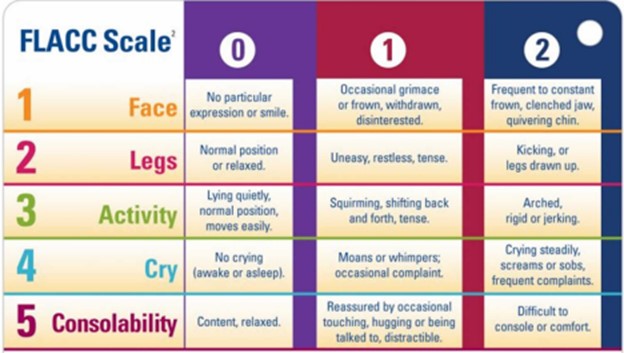
C. FLACC scale
The appropriate pain rating scale to use for a 2-month-old infant is the FLACC (Face, Legs, Activity, Cry, Consolability) scale. The FLACC scale is commonly used for infants and young children who are unable to self-report their pain. It assesses facial expression, leg movement, activity level, cry, and ability to be consoled. Each category is scored on a scale of 0 to 2, and the total score provides an indication of the infant's pain level. The PANAD scale and OUCHER scale are more commonly used for older children, while the FACE scale is specific to assessing pain in individuals with cognitive impairments.
D. FACE Scale
Full Explanation
The appropriate pain rating scale to use for a 2-month-old infant is the FLACC (Face, Legs, Activity, Cry, Consolability) scale. The FLACC scale is commonly used for infants and young children who are unable to self-report their pain. It assesses facial expression, leg movement, activity level, cry, and ability to be consoled. Each category is scored on a scale of 0 to 2, and the total score provides an indication of the infant's pain level.
The PANAD scale and OUCHER scale are more commonly used for older children, while the FACE scale is specific to assessing pain in individuals with cognitive impairments.
A nurse is providing care to a child who has an allergy to eggs. The nurse should question the prescription for which of the following immunizations?
A. inactivated poliovirus (PV)
B. influenza live attenuated (LAV)
The influenza LAV is typically produced using egg-based methods, which may pose a risk for individuals with an allergy to eggs. Although the risk of a severe allergic reaction to the influenza vaccine is low, it is recommended to avoid the influenza LAV in individuals with a known severe allergy to eggs. Inactivated poliovirus (PV), Haemophilus influenza type b (Hib), and Hepatitis (Hepi) vaccines do not contain egg proteins and can generally be safely administered to individuals with an egg allergy.
C. Haemophilus influenza type b (Hib)
D. Hepatitis (Hepi)
Full Explanation
The influenza LAV is typically produced using egg-based methods, which may pose a risk for individuals with an allergy to eggs. Although the risk of a severe allergic reaction to the influenza vaccine is low, it is recommended to avoid the influenza LAV in individuals with a known severe allergy to eggs. Inactivated poliovirus (PV), Haemophilus influenza type b (Hib), and Hepatitis (Hepi) vaccines do not contain egg proteins and can generally be safely administered to individuals with an egg allergy.
A nurse is caring for a 6-month-old infant. Which of the following findings should indicate to the nurse that the client is experiencing pain following a procedure?
A. Increased formula consumption
B. Increased crying episodes
Crying is a common behavioral response to pain in infants, and it serves as an important indicator of discomfort. Infants may cry more intensely, have a high-pitched cry, or exhibit inconsolable crying when they are in pain. It is important for the nurse to assess the infant's pain level and provide appropriate interventions to alleviate the discomfort.
C. Decreased respiratory rate
D. Decreased heart rate
Full Explanation
Crying is a common behavioral response to pain in infants, and it serves as an important indicator of discomfort. Infants may cry more intensely, have a high-pitched cry, or exhibit inconsolable crying when they are in pain. It is important for the nurse to assess the infant's pain level and provide appropriate interventions to alleviate the discomfort.