
Nursing practice questions with comprehensive rationales
NurseDive Free Nursing Practice Question
A nurse is providing teaching about increasing dietary fiber to an antepartum client who reports constipation. Which of the following food selections has the highest fiber content per cup?
A. Lentils
Lentils. Lentils have the highest fiber content per cup compared to the other options. One cup of cooked lentils provides approximately 15.6 grams of fiber. Oatmeal provides approximately 4 grams of fiber per cup, asparagus provides approximately 3.6 grams of fiber per cup, and cabbage provides approximately 2.6 grams of fiber per cup. Increasing dietary fiber is an effective way to manage constipation during pregnancy, as it can promote bowel regularity and prevent complications such as hemorrhoids. The nurse can provide additional education on other high-fiber food options, the importance of drinking adequate fluids, and the need to increase physical activity to help manage constipation.
B. Oatmeal
C. Cabbage
D. Asparagus
This question is an excerpt from Nurse Dive's nursing test bank - ATI Maternal Newborn 2019 with NGN Proctored Exam. Take the full exam now
Full Explanation
Lentils. Lentils have the highest fiber content per cup compared to the other options. One cup of cooked lentils provides approximately 15.6 grams of fiber. Oatmeal provides approximately 4 grams of fiber per cup, asparagus provides approximately 3.6 grams of fiber per cup, and cabbage provides approximately 2.6 grams of fiber per cup. Increasing dietary fiber is an effective way to manage constipation during pregnancy, as it can promote bowel regularity and prevent complications such as hemorrhoids. The nurse can provide additional education on other high-fiber food options, the importance of drinking adequate fluids, and the need to increase physical activity to help manage constipation. 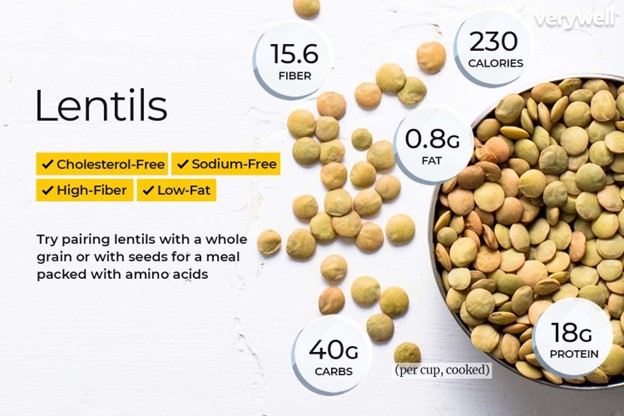
Similar Questions
A nurse is teaching a newly licensed nurse about the uses of ultrasonography in the first trimester of pregnancy. Which of the following statements by the newly licensed nurse indicates an understanding of the teaching?
A. "Ultrasound is used to observe for placental maturity in the first trimester."
B. "Ultrasound is used to perform a biophysical profile in the first trimester."
C. "Ultrasound is used to determine gestational age in the first trimester."
The correct answer is choice C. Ultrasonography is a diagnostic tool used during pregnancy to visualize the fetus and the maternal reproductive organs. In the first trimester of pregnancy, it is primarily used to determine gestational age, confirm the presence of an intrauterine pregnancy, and assess for fetal viability. It can also be used to identify multiple gestations, evaluate for ectopic pregnancy, and detect certain fetal anomalies. Ultrasound is not typically used to observe for placental maturity or to perform a biophysical profile in the first trimester. Intrauterine growth restriction is typically assessed later in pregnancy using serial ultrasound measurements.
D. "Ultrasound is used to detect intrauterine growth restriction in the first trimester."
Full Explanation
The correct answer is choice C. Ultrasonography is a diagnostic tool used during pregnancy to visualize the fetus and the maternal reproductive organs. In the first trimester of pregnancy, it is primarily used to determine gestational age, confirm the presence of an intrauterine pregnancy, and assess for fetal viability. It can also be used to identify multiple gestations, evaluate for ectopic pregnancy, and detect certain fetal anomalies. Ultrasound is not typically used to observe for placental maturity or to perform a biophysical profile in the first trimester. Intrauterine growth restriction is typically assessed later in pregnancy using serial ultrasound measurements.
A nurse is admitting a client to the birthing unit who reports her contractions started 1 hr ago. The nurse determines the client is 80% effaced and 8 cm dilated. The nurse realizes that the client is at risk for which of the following conditions?
A. Ectopic pregnancy
B. Postpartum hemorrhage
The client's cervical dilation and effacement indicate that she is in active labor and progressing rapidly. Because the client is already 8 cm dilated and has been in labor for only 1 hour, the nurse should recognize that the client is at risk for a rapid delivery, which can increase the risk of postpartum hemorrhage. The other options listed are not associated with cervical dilation and effacement during active labor.
C. Incompetent cervix
D. Hyperemesis gravidarum
Full Explanation
The client's cervical dilation and effacement indicate that she is in active labor and progressing rapidly. Because the client is already 8 cm dilated and has been in labor for only 1 hour, the nurse should recognize that the client is at risk for a rapid delivery, which can increase the risk of postpartum hemorrhage. The other options listed are not associated with cervical dilation and effacement during active labor.
A nurse is assessing a full-term newborn. Which of the following findings should the nurse report to the provider?
A. Respiratory rate 55/min
A respiratory rate of 55 breaths per minute is within the normal range for a full-term newborn, which is generally between 30 and 60 breaths per minute.
B. Heart rate 72/min
A heart rate of 72 beats per minute is significantly lower than the normal range for a newborn. Normal heart rates for newborns typically range from 120 to 160 beats per minute. A heart rate this low could indicate bradycardia, which requires immediate assessment and intervention.
C. Temperature 36.5° C (97.7° F)
A temperature 36.5° C (97.7° F) is slightly below the normal range for newborns, which is typically between 36.6°C to 37.2°C (97.9°F to 99.0°F). However, it may not be immediately concerning unless it is part of a pattern or accompanied by other symptoms.
D. Blood pressure 80/50 mm Hg
A blood pressure reading of 80/50 mm Hg is within the expected range for a full-term newborn, where typical values are approximately 60-80 mm Hg for systolic and 40-50 mm Hg for diastolic.
Full Explanation
A. A respiratory rate of 55 breaths per minute is within the normal range for a full-term newborn, which is generally between 30 and 60 breaths per minute.
B. A heart rate of 72 beats per minute is significantly lower than the normal range for a newborn. Normal heart rates for newborns typically range from 120 to 160 beats per minute. A heart rate this low could indicate bradycardia, which requires immediate assessment and intervention.
C. A temperature 36.5° C (97.7° F) is slightly below the normal range for newborns, which is typically between 36.6°C to 37.2°C (97.9°F to 99.0°F). However, it may not be immediately concerning unless it is part of a pattern or accompanied by other symptoms.
D. A blood pressure reading of 80/50 mm Hg is within the expected range for a full-term newborn, where typical values are approximately 60-80 mm Hg for systolic and 40-50 mm Hg for diastolic.