
Nursing practice questions with comprehensive rationales
NurseDive Free Nursing Practice Question
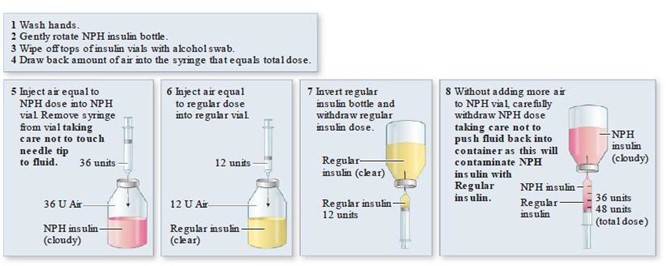
A nurse is reinforcing teaching with a client who is to self-administer regular insulin and NPH insulin from the same syringe.
Which of the following instructions should the nurse provide?
A. Inject air into the regular insulin first.
“Inject air into the regular insulin first.” When mixing regular insulin and NPH insulin in the same syringe, the nurse should instruct the client to inject air into the NPH insulin vial first, then inject air into the regular insulin vial. After that, the client should draw up the regular insulin into the syringe first, followed by the NPH insulin.
B. Shake the NPH insulin until it is well mixed.
Choice B is not correct because NPH insulin should not be shaken vigorously as it can damage the insulin molecules.
C. Draw up the NPH insulin into the syringe first.
Choice C is not correct because the regular insulin should be drawn up into the syringe first.
D. Discard regular insulin if it appears cloudy.
Choice D is not correct because regular insulin is a clear solution and should not appear cloudy.
This question is an excerpt from Nurse Dive's nursing test bank - ATI Pharmacology Endocrine and Hematology Proctored Exam. Take the full exam now
Full Explanation
“Inject air into the regular insulin first.” When mixing regular insulin and NPH insulin in the same syringe, the nurse should instruct the client to inject air into the NPH insulin vial first, then inject air into the regular insulin vial.
After that, the client should draw up the regular insulin into the syringe first, followed by the NPH insulin.
Choice B is not correct because NPH insulin should not be shaken vigorously as it can damage the insulin molecules.
Choice C is not correct because the regular insulin should be drawn up into the syringe first.
Choice D is not correct because regular insulin is a clear solution and should not appear cloudy.
Similar Questions
A nurse is reviewing laboratory data from a client who has a pulmonary embolism and is receiving IV heparin.
Which of the following findings should the nurse report to the provider?
A. Patient's platelets 100,000.
“Patient’s platelets 100,000.” A nurse should report a low platelet count to the provider because it may indicate heparin-induced thrombocytopenia (HIT), a serious complication of heparin therapy.
B. Prothrombin time (PT) 12 seconds.
Choice B is not correct because a Prothrombin time (PT) of 12 seconds is within the normal range and does not need to be reported.
C. Thrombin time (TT) 55 seconds.
Choice C is not correct because Thrombin time (TT) is not typically used to monitor heparin therapy.
D. Hematocrit 35%.
Choice D is not correct because a Hematocrit of 35% is within the normal range and does not need to be reported.
Full Explanation
“Patient’s platelets 100,000.” A nurse should report a low platelet count to the provider because it may indicate heparin-induced thrombocytopenia (HIT), a serious complication of heparin therapy.
Choice B is not correct because a Prothrombin time (PT) of 12 seconds is within the normal range and does not need to be reported.
Choice C is not correct because Thrombin time (TT) is not typically used to monitor heparin therapy.
Choice D is not correct because a Hematocrit of 35% is within the normal range and does not need to be reported.
A nurse is reinforcing discharge instructions for a client who has asthma and is about to start taking theophylline.
The nurse should instruct the client to monitor which of the following findings is an adverse effect of the medication.
A. Drowsiness.
Choice A is not correct because drowsiness is not a common side effect of theophylline.
B. Constipation.
Choice B is not correct because constipation is not a common side effect of theophylline.
C. Tachycardia.
“Tachycardia.” Theophylline can cause a number of side effects, including tachycardia (fast heart rate) 1. The nurse should instruct the client to monitor for this adverse effect and report it to their healthcare provider if it occurs.
D. None of the above.
Choice D is not correct because tachycardia is a known adverse effect of theophylline.
Full Explanation
“Tachycardia.” Theophylline can cause a number of side effects, including tachycardia (fast heart rate) 1.
The nurse should instruct the client to monitor for this adverse effect and report it to their healthcare provider if it occurs.
Choice A is not correct because drowsiness is not a common side effect of theophylline.
Choice B is not correct because constipation is not a common side effect of theophylline.
Choice D is not correct because tachycardia is a known adverse effect of theophylline.

A nurse is preparing to administer heparin subcutaneously to a client.
Which of the following is an appropriate action by the nurse?
A. Use a 1-inch needle to inject the medication.
Choice A is not correct because a 1-inch needle may be too long for subcutaneous injection. A shorter needle, such as a 3/8 to 5/8 inch needle, is typically used for subcutaneous injections.
B. Use a 22-gauge needle to inject the medication.
Choice B is not correct because a 22-gauge needle may be too large for subcutaneous injection. A smaller gauge needle, such as a 25- or 27-gauge needle, is typically used for subcutaneous injections.
C. Massage the injection site after administration of the medication.
Choice C is not correct because massaging the injection site after administering heparin can increase the risk of bruising and should be avoided.
D. Inject the medication into the abdomen above the level of the iliac crest.
“Inject the medication into the abdomen above the level of the iliac crest.” When administering heparin subcutaneously, it is appropriate to inject the medication into the abdomen above the level of the iliac crest 1.
Full Explanation
“Inject the medication into the abdomen above the level of the iliac crest.” When administering heparin subcutaneously, it is appropriate to inject the medication into the abdomen above the level of the iliac crest 1.
Choice A is not correct because a 1-inch needle may be too long for subcutaneous injection.
A shorter needle, such as a 3/8 to 5/8 inch needle, is typically used for subcutaneous injections.
Choice B is not correct because a 22-gauge needle may be too large for subcutaneous injection.
A smaller gauge needle, such as a 25- or 27-gauge needle, is typically used for subcutaneous injections.
Choice C is not correct because massaging the injection site after administering heparin can increase the risk of bruising and should be avoided.