
Nursing practice questions with comprehensive rationales
NurseDive Free Nursing Practice Question
A nurse is reinforcing teaching with a postpartum client about bathing her newborn.
Which of the following statements should the nurse include?
A. Wash your newborn's head under a stream of running water.
A) "Wash your newborn's head under a stream of running water": Washing the newborn's head under a stream of running water is not safe due to the risk of startling the baby or causing discomfort. Instead, the head should be gently washed using a damp cloth or sponge.
B. Bathe your newborn within 30 minutes after a feeding.
B) "Bathe your newborn within 30 minutes after a feeding": Bathing a newborn within 30 minutes after feeding is not advisable as it may cause discomfort or spitting up due to the baby's full stomach. It is better to wait for some time after feeding before bathing the baby.
C. Start the bath by washing the newborn's diaper area first.
C) "Start the bath by washing the newborn's diaper area first": Starting the bath by washing the newborn's diaper area first is not recommended. The face and head should be washed first to avoid spreading bacteria from the diaper area to other parts of the body.
D. The bath water should be 100 to 103 degrees Fahrenheit.
D) "The bath water should be 100 to 103 degrees Fahrenheit": This is the correct temperature range for a newborn's bath water. It is essential to ensure that the water is warm enough to be comfortable but not too hot, to avoid burns or discomfort. The temperature should be checked with a thermometer or the elbow to ensure it is safe for the baby.
This question is an excerpt from Nurse Dive's nursing test bank - VATI PN Comprehensive Predictor 2020 Proctored Exam. Take the full exam now
Full Explanation
Answer: D
Rationale:
A) "Wash your newborn's head under a stream of running water": Washing the newborn's head under a stream of running water is not safe due to the risk of startling the baby or causing discomfort. Instead, the head should be gently washed using a damp cloth or sponge.
B) "Bathe your newborn within 30 minutes after a feeding": Bathing a newborn within 30 minutes after feeding is not advisable as it may cause discomfort or spitting up due to the baby's full stomach. It is better to wait for some time after feeding before bathing the baby.
C) "Start the bath by washing the newborn's diaper area first": Starting the bath by washing the newborn's diaper area first is not recommended. The face and head should be washed first to avoid spreading bacteria from the diaper area to other parts of the body.
D) "The bath water should be 100 to 103 degrees Fahrenheit": This is the correct temperature range for a newborn's bath water. It is essential to ensure that the water is warm enough to be comfortable but not too hot, to avoid burns or discomfort. The temperature should be checked with a thermometer or the elbow to ensure it is safe for the baby.
Similar Questions
A nurse is assisting with an admission interview for a client who has schizophrenia. He tells the nurse that he is receiving special audible messages from the Central Intelligence Agency that no one else is able to hear. The nurse should identify that the client is having which of the following alterations in perception?
A. Derealization
Derealization (option a) refers to a subjective feeling of unreality or detachment from the environment. It involves a perception that the external world is strange, distorted, or unreal. This is not the primary alteration in perception described in the scenario.
B. Illusion
Illusion (option b) is a misinterpretation or misperception of a real sensory stimulus. It occurs when a person's perception of an actual stimulus is distorted or misunderstood. There is no indication of a misperception of a real stimulus in the scenario.
C. Hallucination
In the scenario described, the client's experience of receiving special audible messages from the Central Intelligence Agency that no one else can hear indicates a hallucination. Hallucinations are perceptual disturbances in which a person experiences sensory perceptions without any external stimuli. They can occur in any sensory modality, such as hearing (auditory hallucinations), seeing (visual hallucinations), smelling (olfactory hallucinations), tasting (gustatory hallucinations), or feeling (tactile hallucinations). In this case, the client is experiencing auditory hallucinations, as he is perceiving auditory stimuli (audible messages) that are not present in the external environment. Auditory hallucinations are most commonly associated with schizophrenia, although they can occur in other psychiatric disorders as well.
D. Depersonalization
Full Explanation
c. Hallucination
In the scenario described, the client's experience of receiving special audible messages from the Central Intelligence Agency that no one else can hear indicates a hallucination. Hallucinations are perceptual disturbances in which a person experiences sensory perceptions without any external stimuli. They can occur in any sensory modality, such as hearing (auditory hallucinations), seeing (visual hallucinations), smelling (olfactory hallucinations), tasting (gustatory hallucinations), or feeling (tactile hallucinations).
In this case, the client is experiencing auditory hallucinations, as he is perceiving auditory stimuli (audible messages) that are not present in the external environment. Auditory hallucinations are most commonly associated with schizophrenia, although they can occur in other psychiatric disorders as well.
Derealization (option a) refers to a subjective feeling of unreality or detachment from the environment. It involves a perception that the external world is strange, distorted, or unreal. This is not the primary alteration in perception described in the scenario.
Illusion (option b) is a misinterpretation or misperception of a real sensory stimulus. It occurs when a person's perception of an actual stimulus is distorted or misunderstood. There is no indication of a misperception of a real stimulus in the scenario.
Depersonalization (option d) is a subjective experience of being detached from one's own body, thoughts, or emotions. It involves a feeling of being outside of oneself or observing oneself from a distance. This is not the primary alteration in perception described in the scenario.
Therefore, the correct answer is c. Hallucination, as the client's experience of receiving special audible messages that no one else can hear represents an auditory hallucination.
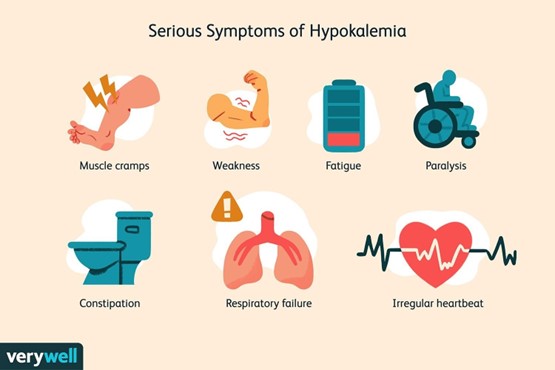
A nurse in an urgent care clinic is collecting data from a client who reports having diarrhea for the past 3 days. Which of the following findings indicates hypokalemia?
A. Pitting edema
Pitting edema is not a typical symptom of hypokalemia
B. Diplopia
Diplopiais not a typical symptom of hypokalemia.
C. Muscle weakness
A nurse collecting data from a client who reports having diarrhea for the past 3 days should identify that muscle weakness is a symptom of hypokalemia. Hypokalemia is a condition in which the blood potassium level is low and can be caused by excessive fluid loss through diarrhea. Potassium helps regulate muscle contractions, so when blood potassium levels are low, muscles may produce weaker contractions which result in muscle weakness.
D. Hyperactive bowel sounds
Hyperactive bowel soundsare not a typical symptom of hypokalemia.
Full Explanation
A nurse collecting data from a client who reports having diarrhea for the past 3 days should identify that muscle weakness is a symptom of hypokalemia. Hypokalemia is a condition in which the blood potassium level is low and can be caused by excessive fluid loss through diarrhea. Potassium helps regulate muscle contractions, so when blood potassium levels are low, muscles may produce weaker contractions which result in muscle weakness.
The other options are not typical symptoms of hypokalemia.
a) Pitting edema is not a typical symptom of hypokalemia.
b) Diplopia is not a typical symptom of hypokalemia.
d) Hyperactive bowel sounds are not a typical symptom of hypokalemia.
A nurse is reviewing the laboratory results of a client who has DKA. The client's ABG results are pH 7.30, PaCO₂ 34 mm Hg and HCO₃ 21 mEq/L. The nurse should identify that these values indicate which of the following acid-base imbalances?
A. Respiratory alkalosis
Respiratory alkalosis is an acid-base imbalance characterized by a high pH (greater than 7.45) and a low PaCO₂ (less than 35 mm Hg).
B. Metabolic alkalosis
Metabolic alkalosisis an acid-base imbalance characterized by a high pH (greater than 7.45) and a high bicarbonate level (greater than 26 mEq/L).
C. Metabolic acidosis
A nurse reviewing the laboratory results of a client who has DKA should identify that the client's ABG results of pH 7.30, PaCO₂ 34 mm Hg and HCO₃ 21 mEq/L indicate metabolic acidosis. Metabolic acidosis is an acid-base imbalance characterized by a low pH (less than 7.35) and a low bicarbonate level (less than 22 mEq/L).
D. Respiratory acidosis
Respiratory acidosis is an acid-base imbalance characterized by a low pH (less than 7.35) and a high PaCO₂ (greater than 45 mm Hg).
Full Explanation
A nurse reviewing the laboratory results of a client who has DKA should identify that the client's ABG results of pH 7.30, PaCO₂ 34 mm Hg and HCO₃ 21 mEq/L indicate metabolic acidosis. Metabolic acidosis is an acid-base imbalance characterized by a low pH (less than 7.35) and a low bicarbonate level (less than 22 mEq/L).
The other options are not correct.
a) Respiratory alkalosis is an acid-base imbalance characterized by a high pH (greater than 7.45) and a low PaCO₂ (less than 35 mm Hg).
b) Metabolic alkalosis is an acid-base imbalance characterized by a high pH (greater than 7.45) and a high bicarbonate level (greater than 26 mEq/L).
d) Respiratory acidosis is an acid-base imbalance characterized by a low pH (less than 7.35) and a high PaCO₂ (greater than 45 mm Hg).