
Nursing practice questions with comprehensive rationales
NurseDive Free Nursing Practice Question
A nurse is reporting a client’s laboratory tests to the provider to obtain a prescription for the client’s daily warfarin.
Which of the following laboratory tests should the nurse plan to report to obtain the prescription for the warfarin?
A. INR
Warfarin is a vitamin K antagonist that inhibits the synthesis of factors II, VII, IX, and X in the liver. These factors are part of the extrinsic and common pathways of coagulation, which are measured by the prothrombin time (PT) and the international normalized ratio (INR). The INR is a standardized way of reporting the PT that accounts for the variability of different reagents and instruments. The INR is used to monitor the therapeutic effect of warfarin and to adjust the dose accordingly. The target INR range depends on the indication for warfarin, but it is usually between 2 and 3 for most conditions.
B. Fibrinogen level
Wrong because fibrinogen level is not affected by warfarin. Fibrinogen is a precursor of fibrin, which forms the final step of the coagulation cascade. Fibrinogen level can be decreased in conditions such as disseminated intravascular coagulation (DIC), liver disease, or severe bleeding
C. aPTT
Is wrong because aPTT is not affected by warfarin.
D. Platelet count
Platelet count is not affected by warfarin. Platelets are cell fragments that adhere to damaged blood vessels and form aggregates to initiate hemostasis.
This question is an excerpt from Nurse Dive's nursing test bank - ATI Comprehensive Predictor 2023 Exit Proctored Exam A. Take the full exam now
Full Explanation
The correct answer is choice A. INR.
Warfarin is a vitamin K antagonist that inhibits the synthesis of factors II, VII, IX, and X in the liver.
These factors are part of the extrinsic and common pathways of coagulation, which are measured by the prothrombin time (PT) and the international normalized ratio (INR).
The INR is a standardized way of reporting the PT that accounts for the variability of different reagents and instruments.
The INR is used to monitor the therapeutic effect of warfarin and to adjust the dose accordingly.
The target INR range depends on the indication for warfarin, but it is usually between 2 and 3 for most conditions.
Choice B is wrong because fibrinogen level is not affected by warfarin.
Fibrinogen is a precursor of fibrin, which forms the final step of the coagulation cascade.
Fibrinogen level can be decreased in conditions such as disseminated intravascular coagulation (DIC), liver disease, or severe bleeding. Choice C is wrong because aPTT is not affected by warfarin.
aPTT measures the intrinsic and common pathways of coagulation, which are mainly dependent on factors VIII, IX, XI, and XII.
These factors are not inhibited by warfarin.
aPTT is used to monitor the effect of heparin, a direct antithrombin agent that inhibits thrombin and factor Xa.
Choice D is wrong because platelet count is not affected by warfarin.
Platelets are cell fragments that adhere to damaged blood vessels and form aggregates to initiate hemostasis.
Platelet count can be decreased in conditions such as immune thrombocytopenia (ITP), heparin-induced thrombocytopenia (HIT), or bone marrow suppression.
Normal ranges:
- INR: 0.8-1.2
- Fibrinogen: 200-400 mg/dL
- aPTT: 25-35 seconds
- Platelet count: 150-450 x 10^9/L References:
Similar Questions
A nurse is caring for a client who is receiving total parenteral nutrition (TPN).
The bag has 20 mL remaining to infuse, but a new bag is not readily available.
Which of the following actions should the nurse take?
A. Give 500 mL of lactated Ringer’s solution.
Because giving 500 mL of lactated Ringer’s solution would not provide enough calories or glucose to prevent hypoglycemia. Lactated Ringer’s solution is an isotonic solution that contains electrolytes but no calories or glucose.
B. Temporarily discontinue the infusion
wrong because temporarily discontinuing the infusion would cause hypoglycemia, which can be life-threatening for the client.
C. Slow the TPN infusion rate
is wrong because slowing the TPN infusion rate would also cause hypoglycemia, as the client would receive less calories and glucose than prescribed
D. Administer dextrose 10% in water
This is because abruptly stopping TPN can cause hypoglycemia, which is a low blood sugar level that can cause shakiness, diaphoresis, confusion, and seizures. Therefore, infusing dextrose 10% in water temporarily at the same rate as the TPN can prevent this adverse effect. Dextrose 10% in water is a hypertonic solution that contains 340 calories per liter and can maintain the client’s blood glucose level until the new TPN bag arrives.
Full Explanation
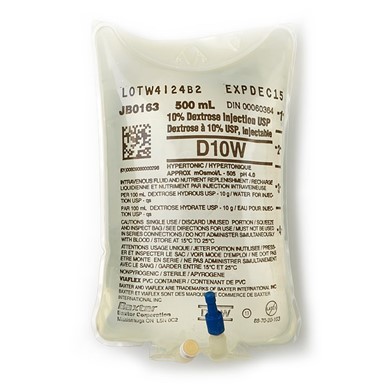
This is because abruptly stopping TPN can cause hypoglycemia, which is a low blood sugar level that can cause shakiness, diaphoresis, confusion, and seizures. Therefore, infusing dextrose 10% in water temporarily at the same rate as the TPN can prevent this adverse effect. Dextrose 10% in water is a hypertonic solution that contains 340 calories per liter and can maintain the client’s blood glucose level until the new TPN bag arrives.
Choice A is wrong because giving 500 mL of lactated Ringer’s solution would not provide enough calories or glucose to prevent hypoglycemia. Lactated Ringer’s solution is an isotonic solution that contains electrolytes but no calories or glucose.
Choice B is wrong because temporarily discontinuing the infusion would cause hypoglycemia, which can be life-threatening for the client.
Choice C is wrong because slowing the TPN infusion rate would also cause hypoglycemia, as the client would receive less calories and glucose than prescribed.
A nurse is caring for a client who has end-stage liver disease and is undergoing a paracentesis. Which of the following actions should the nurse take to evaluate the effectiveness of the procedure?
A. Compare the clients current weight with preprocedure weight
Comparing the client’s current weight with preprocedure weight is the best way to evaluate the effectiveness of the paracentesis, which is a procedure to remove excess fluid from the abdominal cavity. The fluid buildup, or ascites, is a common complication of end-stage liver disease (ESLD), which is a condition in which the liver is severely damaged and cannot function adequately.
B. Examine for leakage at the site of the procedure.
wrong because examining for leakage at the site of the procedure is not a measure of effectiveness, but a potential complication that should be monitored and reported.
C. Check the client’s serum albumin levels
because checking the client’s serum albumin levels is not relevant to the paracentesis. Albumin is a protein that helps maintain fluid balance in the body, but it is not affected by the removal of fluid from the abdomen.
D. Confirm that the client is able to urinate
wrong because confirming that the client is able to urinate is not related to the paracentesis.
Full Explanation
The correct answer is choice A. Comparing the client’s current weight with preprocedure weight is the best way to evaluate the effectiveness of the paracentesis, which is a procedure to remove excess fluid from the abdominal cavity. The fluid buildup, or ascites, is a common complication of end-stage liver disease (ESLD), which is a condition in which the liver is severely damaged and cannot function adequately.
Choice B is wrong because examining for leakage at the site of the procedure is not a measure of effectiveness, but a potential complication that should be monitored and reported.
Choice C is wrong because checking the client’s serum albumin levels is not relevant to the paracentesis.
Albumin is a protein that helps maintain fluid balance in the body, but it is not affected by the removal of fluid from the abdomen.
Choice D is wrong because confirming that the client is able to urinate is not related to the paracentesis.
Urination is a function of the kidneys, not the liver, and it does not reflect the amount of fluid removed from the abdomen.
A nurse is planning teaching for a client and their family about home oxygen therapy. Which of the following information should the nurse plan to include in the teaching?
A. Use synthetic fabrics for the client’s bedding
because synthetic fabrics can generate static electricity, which can also cause sparks and ignite oxygen. The client’s bedding should be made of cotton or wool, which are natural fabrics that do not produce static electricity.
B. Apply petroleum jelly to soothe the mucous membranes
because petroleum jelly is a petroleum-based product that can react with oxygen and cause skin irritation or burns. The client should use water-based moisturizers to soothe the mucous membranes.
C. Clean the equipment with an alcohol-based cleaning product
because alcohol-based cleaning products are also flammable and can cause fires or explosions when exposed to oxygen.
D. Avoid using nail polish remover around the client
Avoid using nail polish remover around the client. Nail polish remover contains acetone, which is a flammable substance that can ignite in the presence of oxygen. Using nail polish remover around the client can increase the risk of fire and burn injuries.
Full Explanation
The correct answer is choice D. Avoid using nail polish remover around the client. Nail polish remover contains acetone, which is a flammable substance that can ignite in the presence of oxygen.
Using nail polish remover around the client can increase the risk of fire and burn injuries.
Choice A is wrong because synthetic fabrics can generate static electricity, which can also cause sparks and ignite oxygen.
The client’s bedding should be made of cotton or wool, which are natural fabrics that do not produce static electricity.
Choice B is wrong because petroleum jelly is a petroleum-based product that can react with oxygen and cause skin irritation or burns.
The client should use water-based moisturizers to soothe the mucous membranes.
Choice C is wrong because alcohol-based cleaning products are also flammable and can cause fires or explosions when exposed to oxygen.
The client should use mild soap and water to clean the equipment, and follow the manufacturer’s instructions for maintenance.
Some general safety tips for home oxygen therapy are:
- Keep away from heat and flame, such as candles, matches, lighters, stoves, fireplaces, etc.
- Do not smoke or allow others to smoke near the oxygen source
- Do not use aerosols, vapor rubs, oils, or other products that contain flammable substances near the oxygen source
- Store oxygen tanks or cylinders in a well-ventilated area away from direct sunlight and heat sources
- Secure oxygen tanks or cylinders to prevent them from falling or rolling
- Use the exact rate of oxygen prescribed by the doctor for each activity
- Check the oxygen gauge or level regularly and call the medical supply company when it is low
- Use a humidifier bottle if prescribed by the doctor to prevent dryness of the mucous membranes
- Change the nasal cannula, mask, and tubing as instructed by the medical supply company to prevent