
Nursing practice questions with comprehensive rationales
NurseDive Free Nursing Practice Question
A nurse is reviewing the laboratory results for four clients. The nurse should recognize which of the following clients has a manifestation of hypoparathyroidism?
A. A client who has a phosphate of 5.7 mg/dL.
The client with a phosphate level of 5.7 mg/dL likely has a manifestation of hypoparathyroidism. Hypoparathyroidism leads to decreased parathyroid hormone (PTH) secretion, which causes increased renal phosphate reabsorption, leading to elevated phosphate levels in the blood.
B. A client who has a calcium of 9.8 mg/dL.
A calcium level of 9.8 mg/dL is within the normal range (8.5-10.2 mg/dL) and does not indicate hypoparathyroidism.
C. A client who has a vitamin D of 25 ng/mL.
A vitamin D level of 25 ng/mL is within the normal range (30-100 ng/mL) and does not suggest hypoparathyroidism.
D. A client who has a magnesium of 1.8 mEq/L.
A magnesium level of 1.8 mEq/L is within the normal range (1.7-2.2 mEq/L) and does not directly indicate hypoparathyroidism.
This question is an excerpt from Nurse Dive's nursing test bank - ATI custom Fluid and Electrolyte Exam Summer 2023 Proctored Exam. Take the full exam now
Full Explanation
Choice A rationale:
The client with a phosphate level of 5.7 mg/dL likely has a manifestation of hypoparathyroidism. Hypoparathyroidism leads to decreased parathyroid hormone (PTH) secretion, which causes increased renal phosphate reabsorption, leading to elevated phosphate levels in the blood.
Choice B rationale:
A calcium level of 9.8 mg/dL is within the normal range (8.5-10.2 mg/dL) and does not indicate hypoparathyroidism.
Choice C rationale:
A vitamin D level of 25 ng/mL is within the normal range (30-100 ng/mL) and does not suggest hypoparathyroidism.
Choice D rationale:
A magnesium level of 1.8 mEq/L is within the normal range (1.7-2.2 mEq/L) and does not directly indicate hypoparathyroidism.
Similar Questions
The patient who has a serum magnesium level of 1.4 mg/dL is being treated with dietary modification. Which foods should the nurse suggest for this patient?
A. Romaine lettuce.
Romaine lettuce is a good dietary source of magnesium. Since the patient has a low serum magnesium level, suggesting foods rich in magnesium like romaine lettuce can help improve magnesium levels.
B. Lean red meat.
Lean red meat is not a good suggestion for a patient with low magnesium levels. While it contains magnesium, it is not as rich in magnesium as some other food choices.
C. Almonds.
Almonds are a good dietary source of magnesium and can be recommended to the patient with low magnesium levels to help increase their magnesium intake.
D. White rice.
White rice is not a significant source of magnesium and may not be helpful in improving the patient's low magnesium levels.
Full Explanation
Choice A rationale:
Romaine lettuce is a good dietary source of magnesium. Since the patient has a low serum magnesium level, suggesting foods rich in magnesium like romaine lettuce can help improve magnesium levels.
Choice B rationale:
Lean red meat is not a good suggestion for a patient with low magnesium levels. While it contains magnesium, it is not as rich in magnesium as some other food choices.
Choice C rationale:
Almonds are a good dietary source of magnesium and can be recommended to the patient with low magnesium levels to help increase their magnesium intake.
Choice D rationale:
White rice is not a significant source of magnesium and may not be helpful in improving the patient's low magnesium levels.
Choice E rationale:
Seafood is a good source of various nutrients but is not particularly rich in magnesium compared to other options like almonds and romaine lettuce. Thus, it may not be the best suggestion for the patient's low magnesium levels.
The patient is prescribed to receive intravenous potassium chloride (KCL). Which actions should the nurse take when administering this medication? Select all that apply.
A. Add the ordered dose to the IV hanging.
Adding the ordered dose to the IV hanging is incorrect because potassium chloride should never be added to an already hanging IV solution due to the risk of uneven distribution and potential overdose.
B. Administer the dose IV push over 3 minutes.
Administering the dose IV push over 3 minutes is incorrect because potassium chloride should never be given by direct IV injection. It must always be diluted and administered slowly to prevent cardiac complications.
C. Monitor the injection site for redness.
Monitoring the injection site for redness is correct because potassium chloride can cause irritation and phlebitis at the injection site.
D. D. Use an infusion controller for the IV. E. Monitor fluid intake and output.
Using an infusion controller for the IV is correct because it ensures the potassium chloride is administered at a controlled rate, reducing the risk of rapid infusion and potential cardiac issues. Monitoring fluid intake and output is correct because it helps assess the patient’s overall fluid balance and detect any signs of fluid overload or deficit, which is crucial when administering potassium.
Full Explanation
The correct answer is choice C. Monitor the injection site for redness, D. Use an infusion controller for the IV, and E. Monitor fluid intake and output.
Choice A rationale:
Adding the ordered dose to the IV hanging is incorrect because potassium chloride should never be added to an already hanging IV solution due to the risk of uneven distribution and potential overdose.
Choice B rationale:
Administering the dose IV push over 3 minutes is incorrect because potassium chloride should never be given by direct IV injection. It must always be diluted and administered slowly to prevent cardiac complications.
Choice C rationale:
Monitoring the injection site for redness is correct because potassium chloride can cause irritation and phlebitis at the injection site.
Choice D rationale:
Using an infusion controller for the IV is correct because it ensures the potassium chloride is administered at a controlled rate, reducing the risk of rapid infusion and potential cardiac issues.
Choice E rationale:
Monitoring fluid intake and output is correct because it helps assess the patient’s overall fluid balance and detect any signs of fluid overload or deficit, which is crucial when administering potassium.
The nurse is concerned that a patient recovering from a thyroidectomy is developing hypocalcemia. What findings did the nurse use to come to this conclusion? Select all that apply.
A. Contraction of the facial muscles.
The nurse considered contraction of facial muscles as a finding of hypocalcemia because it is associated with Chvostek's sign, which indicates neuromuscular irritability due to low calcium levels.
B. Complaints of fingers tingling.
e: Complaints of fingers tingling are indicative of hypocalcemia since tingling sensations (paresthesias) in the extremities can result from decreased calcium levels affecting nerve function.
C. Carpal spasm with blood pressure measurement.
e: Carpal spasm with blood pressure measurement is known as Trousseau's sign and is associated with hypocalcemia. When the blood pressure cuff is inflated above systolic pressure, it can cause tetany in the hand if the calcium levels are low.
D. Asked when the foot numbness would go away.
e: Asking when foot numbness would go away does not directly relate to hypocalcemia or its symptoms. It is not a finding used to come to the conclusion of hypocalcemia in this scenario.
Full Explanation
Choice A rationale:
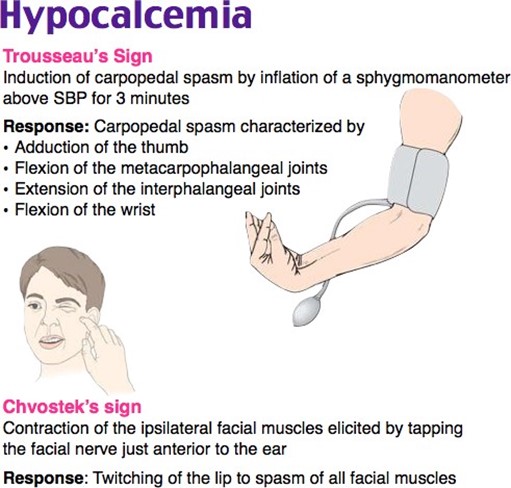
The nurse considered contraction of facial muscles as a finding of hypocalcemia because it is associated with Chvostek's sign, which indicates neuromuscular irritability due to low calcium levels.
Choice B rationale:
Complaints of fingers tingling are indicative of hypocalcemia since tingling sensations (paresthesias) in the extremities can result from decreased calcium levels affecting nerve function.
Choice C rationale:
Carpal spasm with blood pressure measurement is known as Trousseau's sign and is associated with hypocalcemia. When the blood pressure cuff is inflated above systolic pressure, it can cause tetany in the hand if the calcium levels are low.
Choice D rationale:
Asking when foot numbness would go away does not directly relate to hypocalcemia or its symptoms. It is not a finding used to come to the conclusion of hypocalcemia in this scenario.
Choice E rationale:
The heart rate being 88 and regular does not directly indicate hypocalcemia. While hypocalcemia can lead to cardiac arrhythmias, a heart rate of 88 and regular is within the normal range and not a specific finding for hypocalcemia.