
Nursing practice questions with comprehensive rationales
NurseDive Free Nursing Practice Question
A nurse is taking notes of client information on a piece of paper while receiving a report.
Which of the following actions should the nurse take to dispose of the paper?
A. Obscure the client's name with a marker prior to disposal.
Obscure the client's name with a marker prior to disposal: While obscuring the client's name is better than not doing anything, it does not fully protect their confidential information. The paper could still be read by someone with access to it.
B. Place the paper in a trash can at the nurses' station.
Place the paper in a trash can at the nurses' station: This action does not ensure the proper disposal of confidential information. It could be accessible to unauthorized individuals and breach the client's privacy.
C. Shred the paper in a secure container.
Shred the paper in a secure container: Correct. Shredding confidential information is the best way to ensure that it cannot be accessed or read by unauthorized individuals.
D. Secure the paper in the nurse's personal locker.
Secure the paper in the nurse's personal locker: While securing the paper in a personal locker is better than leaving it exposed, it is not the most secure method of disposal for confidentialinformation.
This question is an excerpt from Nurse Dive's nursing test bank - LPN ATI fundamental proctored exam. Take the full exam now
Full Explanation
A. Obscure the client's name with a marker prior to disposal: While obscuring the client's name is better than not doing anything, it does not fully protect their confidential information. The paper could still be read by someone with access to it.
B. Place the paper in a trash can at the nurses' station: This action does not ensure the proper disposal of confidential information. It could be accessible to unauthorized individuals and breach the client's privacy.
C. Shred the paper in a secure container: Correct. Shredding confidential information is the best way to ensure that it cannot be accessed or read by unauthorized individuals.
D. Secure the paper in the nurse's personal locker: While securing the paper in a personal locker is better than leaving it exposed, it is not the most secure method of disposal for confidential
information.
Similar Questions
A nurse is assisting with the care of a recently deceased client. Which of the following actions should the nurse complete prior to the family viewing the body?
A. Remove dentures.
Removing dentures is a step often performed during post-mortem care but may not necessarily need to be completed before family viewing, especially if the dentures are normally worn by the deceased.
B. Apply a shroud around the body with a visible identification tag.
Applying a shroud with a visible identification tag is an important step for dignified covering and identification but might be more appropriate after the family has viewed the body.
C. Clean soiled areas of the body.
This is the most appropriate action to ensure the body appears as dignified and comfortable as possible for family viewing. It involves cleaning any visible soiled areas to provide a respectful presentation to the family.
D. Place the client's head in a dependent position.
Placing the client's head in a dependent position is not typically necessary or recommended in this context. The goal is to ensure the body appears as natural and dignified as possible.
Full Explanation
A. Remove dentures:
- Removing dentures is a step often performed during post-mortem care but may not necessarily need to be completed before family viewing, especially if the dentures are normally worn by the deceased.
B. Apply a shroud around the body with a visible identification tag:
- Applying a shroud with a visible identification tag is an important step for dignified covering and identification but might be more appropriate after the family has viewed the body.
C. Clean soiled areas of the body:
- This is the most appropriate action to ensure the body appears as dignified and comfortable as possible for family viewing. It involves cleaning any visible soiled areas to provide a respectful presentation to the family.
D. Place the client's head in a dependent position:
- Placing the client's head in a dependent position is not typically necessary or recommended in this context. The goal is to ensure the body appears as natural and dignified as possible.
A nurse is collecting data from a client who has an NG tube set to low intermittent suction. Which of the following findings indicates hypomagnesemia?
A. Bone pain
Bone pain: Bone pain is not a characteristic finding of hypomagnesemia. Hypomagnesemia is an electrolyte imbalance, and bone pain is not a typical symptom associated with it.
B. Drowsiness
Drowsiness: Drowsiness may occur in hypomagnesemia, but it is not a specific or characteristic sign of this condition. Other electrolyte imbalances and medical conditions can also cause drowsiness.
C. Bowel hypomotility
Bowel hypomotility: Hypomagnesemia can cause bowel hypomotility (decreased bowel movements), but it is not the most specific finding associated with this condition.
D. Positive Chvostek's sign
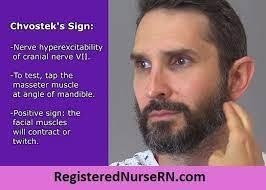
Positive Chvostek's sign: Correct. Hypomagnesemia can lead to neuromuscular irritability, and a positive Chvostek's sign is a clinical manifestation of this condition. A positive Chvostek's sign is elicited by tapping the facial nerve (at the level of the zygomatic arch) and observing the atwitching of the facial muscles, which indicates increased neuromuscular excitability.
Full Explanation
A. Bone pain: Bone pain is not a characteristic finding of hypomagnesemia. Hypomagnesemia is an electrolyte imbalance, and bone pain is not a typical symptom associated with it.
B. Drowsiness: Drowsiness may occur in hypomagnesemia, but it is not a specific or characteristic sign of this condition. Other electrolyte imbalances and medical conditions can also cause drowsiness.
C. Bowel hypomotility: Hypomagnesemia can cause bowel hypomotility (decreased bowel movements), but it is not the most specific finding associated with this condition.
D. Positive Chvostek's sign: Correct. Hypomagnesemia can lead to neuromuscular irritability, and a positive Chvostek's sign is a clinical manifestation of this condition. A positive Chvostek's sign is elicited by tapping the facial nerve (at the level of the zygomatic arch) and observing a
twitching of the facial muscles, which indicates increased neuromuscular excitability.
A charge nurse is reinforcing teaching with an assistive personnel (AP) about performing pulse oximetry. Which of the following information should the nurse include in the teaching?
A. Select an alternate site to place the oximetry probe if the capillary refill is less than 2 seconds.
Select an alternate site to place the oximetry probe if the capillary refill is less than 2 seconds: Capillary refill time is not directly related to the placement of the pulse oximetry probe.Capillary refill is assessed to evaluate peripheral perfusion.
B. Use an adhesive oximetry probe for a client who has a latex allergy.
Use an adhesive oximetry probe for a client who has a latex allergy: The type of probe used for pulse oximetry is important, especially for clients with latex allergies. However, the correct action is to use a nonlatex probe or a probe that is compatible with the client's allergy, not necessarily an adhesive probe.
C. Remove polish from the client's fingernail before applying the oximetry probe.
Remove polish from the client's fingernail before applying the oximetry probe: Correct. Nail polish can interfere with the accuracy of pulse oximetry readings, as it may affect light transmission through the nail bed. It is essential to remove nail polish or artificial nails before applying the probe.
D. Lubricate the tip of the oximetry probe.
Lubricate the tip of the oximetry probe: Lubricating the tip of the oximetry probe is not necessary for proper use and may interfere with the accuracy of readings.
Full Explanation
A. Select an alternate site to place the oximetry probe if the capillary refill is less than 2 seconds: Capillary refill time is not directly related to the placement of the pulse oximetry probe.
Capillary refill is assessed to evaluate peripheral perfusion.
B. Use an adhesive oximetry probe for a client who has a latex allergy: The type of probe used for pulse oximetry is important, especially for clients with latex allergies. However, the correct action is to use a nonlatex probe or a probe that is compatible with the client's allergy, not necessarily an adhesive probe.
C. Remove polish from the client's fingernail before applying the oximetry probe: Correct. Nail polish can interfere with the accuracy of pulse oximetry readings, as it may affect light transmission through the nail bed. It is essential to remove nail polish or artificial nails before applying the probe.
D. Lubricate the tip of the oximetry probe: Lubricating the tip of the oximetry probe is not necessary for proper use and may interfere with the accuracy of readings.