
Nursing practice questions with comprehensive rationales
NurseDive Free Nursing Practice Question
A nurse is teaching a newly licensed nurse about the care of a client who has a methicillin-resistant Staphylococcus aureus (MRSA) infection.
Which of the following statements by the newly licensed nurse indicates an understanding of the teaching?
A. "I will wear an N95 respirator mask when caring for the client.".
Choice A is wrong because an N95 respirator mask is not necessary when caring for a client with an MRSA infection.
B. "I will place the client in a private room.".
A client with MRSA infection should be placed in a private room to prevent the spread of infection.
C. "I will remove my gown before my gloves after providing client care.".
Choice C is wrong because the proper sequence for removing personal protective equipment is to remove gloves first, then the gown.
D. "I will tell the client's visitors to wear a mask when they are within 3 feet of the client.".
Choice D is wrong because visitors do not need to wear a mask when they are within 3 feet of the client with an MRSA infection.
This question is an excerpt from Nurse Dive's nursing test bank - ATI RN Fundamentals 2019 with NGN Proctored Exam. Take the full exam now
Full Explanation
A client with MRSA infection should be placed in a private room to prevent the spread of infection.
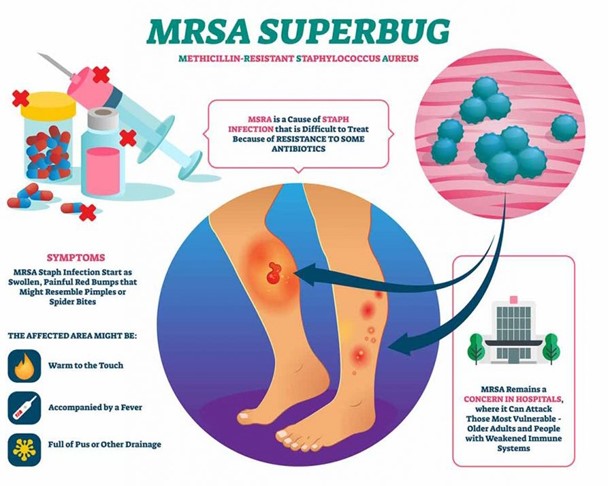
Choice A is wrong because an N95 respirator mask is not necessary when caring for a client with an MRSA infection.
Choice C is wrong because the proper sequence for removing personal protective equipment is to remove gloves first, then the gown.
Choice D is wrong because visitors do not need to wear a mask when they are within 3 feet of the client with an MRSA infection.
Similar Questions
A community health nurse is teaching a group of clients about Kegel exercises to prevent urinary incontinence.
Which of the following instructions should the nurse include?
A. "Hold your breath when performing the exercises.".
Choice A is wrong because you should avoid holding your breath while doing Kegel exercises. Instead, breathe freely during the exercises.
B. "Contract your pelvic muscle when performing the exercises.".
“Contract your pelvic muscle when performing the exercises.” Kegel exercises strengthen the pelvic floor muscles, which support the uterus, bladder, small intestine, and rectum. To do Kegels correctly, you need to contract and relax your pelvic floor muscles.
C. "Tighten your buttocks when performing the exercises.".
Choice C is wrong because you should focus on tightening only your pelvic floor muscles and be careful not to flex the muscles in your buttocks.
D. "Expect improvement after 2 weeks of performing the exercises.".
Choice D is wrong because it takes time to strengthen pelvic floor muscles. You should aim for at least three sets of 10 to 15 repetitions a day and give it 3 to 6 weeks before expecting improvement12.
Full Explanation
“Contract your pelvic muscle when performing the exercises.” Kegel exercises strengthen the pelvic floor muscles, which support the uterus, bladder, small intestine, and rectum.
To do Kegels correctly, you need to contract and relax your pelvic floor muscles.
Choice A is wrong because you should avoid holding your breath while doing Kegel exercises.
Instead, breathe freely during the exercises.
Choice C is wrong because you should focus on tightening only your pelvic floor muscles and be careful not to flex the muscles in your buttocks.
Choice D is wrong because it takes time to strengthen pelvic floor muscles.
You should aim for at least three sets of 10 to 15 repetitions a day and give it 3 to 6 weeks before expecting improvement12.
A nurse is caring for an infant who is to undergo surgery.
The nurse should identify which of the following individuals should sign the consent form?
A. The mother's 21-year-old sibling.
Choice A is wrong because the mother’s 21-year-old sibling is not a parent or legal guardian of the infant.
B. The infant's provider.
Choice B is wrong because the infant’s provider cannot sign the consent form on behalf of the infant.
C. The infant's grandparent.
Choice C is wrong because the infant’s grandparent cannot sign the consent form unless they are a legal guardian of the infant.
D. The infant's 17-year-old mother.
In general, parental (or legal guardian) consent is required for any diagnostic or surgical procedure performed on a child under the age of 181.
Full Explanation
In general, parental (or legal guardian) consent is required for any diagnostic or surgical procedure performed on a child under the age of 181.
Choice A is wrong because the mother’s 21-year-old sibling is not a parent or legal guardian of the infant.
Choice B is wrong because the infant’s provider cannot sign the consent form on behalf of the infant.
Choice C is wrong because the infant’s grandparent cannot sign the consent form unless they are a legal guardian of the infant.
A home health nurse is teaching a client about home safety.
Which of the following statements by the client indicates an understanding of the teaching? (Select all that apply.).
A. "I need to set my hot water heater to 140 degrees Fahrenheit.".
Choice A is wrong because setting the hot water heater to 140 degrees Fahrenheit is too high and can increase the risk of scalding. The recommended temperature for a hot water heater is 120 degrees Fahrenheit.
B. "I will apply tape over frayed areas of electrical cords.".
Choice B is wrong because applying tape over frayed areas of electrical cords is not a safe solution. Frayed electrical cords should be replaced to prevent electrical hazards.
C. "I need to have a fire escape plan with my family.".
“I need to have a fire escape plan with my family,” “I will use the grab bars when getting in and out of the bathtub,” and “I need to check my medications for expiration dates” are all important home safety measures.
D. "I will use the grab bars when getting in and out of the bathtub.".
“I need to have a fire escape plan with my family,” “I will use the grab bars when getting in and out of the bathtub,” and “I need to check my medications for expiration dates” are all important home safety measures.
E. "I need to check my medications for expiration dates.".
“I need to have a fire escape plan with my family,” “I will use the grab bars when getting in and out of the bathtub,” and “I need to check my medications for expiration dates” are all important home safety measures.
Full Explanation
“I need to have a fire escape plan with my family,” “I will use the grab bars when getting in and out of the bathtub,” and “I need to check my medications for expiration dates” are all important home safety measures.
Choice A is wrong because setting the hot water heater to 140 degrees Fahrenheit is too high and can increase the risk of scalding.
The recommended temperature for a hot water heater is 120 degrees Fahrenheit.
Choice B is wrong because applying tape over frayed areas of electrical cords is not a safe solution.
Frayed electrical cords should be replaced to prevent electrical hazards.