
Nursing practice questions with comprehensive rationales
NurseDive Free Nursing Practice Question
A nurse is teaching a school-age child who has type 1 diabetes mellitus and his parents about illness management. Which of the following instructions should the nurse include?
A. "Limit fluid intake during meal time."
Limiting fluid intake during meals is not a standard practice for managing type 1 diabetes. Proper hydration is important for overall health, and fluids should be consumed as needed.
B. "Notify the provider if blood glucose levels are over 350 milligrams/decilitre
Blood glucose levels over 350 mg/dL can indicate hyperglycemia, which requires prompt attention. High blood glucose levels can lead to complications if not addressed promptly. Contacting the healthcare provider is an appropriate step. However, consistentBlood Glucose Levels Above 240 mg/dL (13.3 mmol/L) or presence of symptoms likefrequent urination, thirst, blurry vision, or fatigue) are concerning. The clientshould have contacted the health care provider by this point.
C. Test the urine for ketones.
Testing urine for ketones is an important instruction. Ketones are produced when the body breaks down fat for energy, often in the absence of sufficient insulin. High ketone levels can indicate diabetic ketoacidosis (DKA), a serious complication. Regular ketone testing, especially during illness or high blood glucose levels, helps monitor for DKA.
D. "Withhold insulin dose if feeling nauseous"
This instruction is not accurate. Nausea could be a sign of various conditions, including illness. Insulin should not be withheld without consulting a healthcare provider. Managing insulin doses appropriately is crucial to maintaining blood glucose control
This question is an excerpt from Nurse Dive's nursing test bank - ATI PAEDIATRICS PROCTORED EXAM - SIMMONS U BSN. Take the full exam now
Full Explanation
A) "Limit fluid intake during mealtime":
Limiting fluid intake during meals is not a standard practice for managing type 1 diabetes. Proper hydration is important for overall health, and fluids should be consumed as needed.
B) "Notify the provider if blood glucose levels are over 350 milligrams/deciliter":
Blood glucose levels over 350 mg/dL can indicate hyperglycemia, which requires prompt attention. High blood glucose levels can lead to complications if not addressed promptly. Contacting the healthcare provider is an appropriate step. However, consistent Blood Glucose Levels Above 240 mg/dL (13.3 mmol/L) or presence of symptoms like frequent urination, thirst, blurry vision, or fatigue) are concerning. The client should have contacted the health care provider by this point.
C) "Test the urine for ketones":
Testing urine for ketones is an important instruction. Ketones are produced when the body breaks down fat for energy, often in the absence of sufficient insulin. High ketone levels can indicate diabetic ketoacidosis (DKA), a serious complication. Regular ketone testing, especially during illness or high blood glucose levels, helps monitor for DKA.
D) "Withhold insulin dose if feeling nauseous":
This instruction is not accurate. Nausea could be a sign of various conditions, including illness. Insulin should not be withheld without consulting a healthcare provider. Managing insulin doses appropriately is crucial to maintaining blood glucose control
Similar Questions
A nurse is orienting a newly licensed nurse in the care of an infant who has myelomeningocele. Which of the following actions by the new nurse indicates the teaching has been effective?
A. Places the infant in a side-lying position.
Positioning is important in the care of an infant with myelomeningocele. The infant is usually placed in a prone (on the abdomen) position to prevent pressure on the sac and protect the neural tissue. Placing the infant in a side-lying position may not provide the needed protection.
B. Maintains a dry dressing over the sac
The sac should be kept moist with a sterile, non-adherent dressing moistened with saline to prevent drying and cracking, which could lead to infection.
C. Performs range of motion on the infant's hips
Infants with myelomeningocele often have flaccid paralysis below the lesion, and excessive manipulation of the lower limbs could cause injury.
D. Takes an axillary temperature
Rectal temperatures should never be taken, as they can cause mucosal damage or irritate the exposed spinal cord, leading to complications like meningitis. The axillary route is the safest method for temperature assessment.
Full Explanation
A) Places the infant in a side-lying position:
Positioning is important in the care of an infant with myelomeningocele. The infant is usually placed in a prone (on the abdomen) position to prevent pressure on the sac and protect the neural tissue. Placing the infant in a side-lying position may not provide the needed protection.
B) Maintains a dry dressing over the sac:
The sac should be kept moist with a sterile, non-adherent dressing moistened with saline to prevent drying and cracking, which could lead to infection.
C) Performs range of motion on the infant's hips:
Infants with myelomeningocele often have flaccid paralysis below the lesion, and excessive manipulation of the lower limbs could cause injury.
D) Takes an axillary temperature:
Rectal temperatures should never be taken, as they can cause mucosal damage or irritate the exposed spinal cord, leading to complications like meningitis. The axillary route is the safest method for temperature assessment.
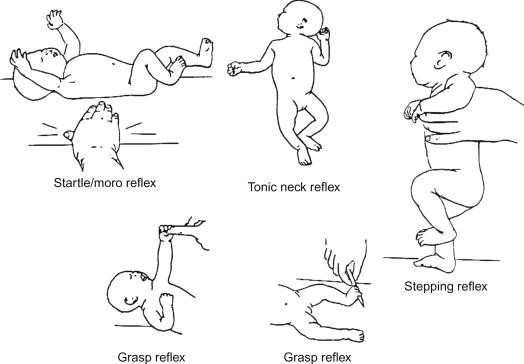
The nurse is doing a neurologic assessment on a 2-month-old infant after a car accident. Moro, tonic neck, and withdrawal reflexes are present. The nurse should recognize that these reflexes are:
A. Symptomatic of decorticate posturing
B. Symptomatic of decerebrate posturing
C. Indicators of severe brain damage
D. Normal Findings
Full Explanation
Reflexes play a crucial role in evaluating the neurological status of infants.
Moro reflex: Also known as the startle reflex, the Moro reflex is a normal response in infants. It occurs when an infant is startled by a sudden noise or movement. The baby responds by extending their arms and legs, followed by a quick contraction. This reflex usually disappears around 4-6 months of age.
Tonic neck reflex (fencer's reflex): This reflex involves turning an infant's head to one side, causing the arm on that side to extend and the opposite arm to flex. It's a normal reflex that typically disappears around 4-6 months of age.
Withdrawal reflex: The withdrawal reflex is a normal response to a stimulus, such as touching a baby's foot with a cold object. The baby will pull their leg away in response to the stimulus.
Symptomatic of decorticate or decerebrate posturing (options A and B):
Decorticate and decerebrate posturing are abnormal postures seen in individuals with severe brain damage or injury. Decorticate posturing involves the arms being flexed and held close to the body, while decerebrate posturing involves the arms being extended and the wrists being pronated. These reflexes are typically indicative of significant neurological dysfunction and are not expected in a 2-month-old infant after a car accident.
Indicators of severe brain damage (option C):
The reflexes described (Moro, tonic neck, and withdrawal reflexes) are not indicative of severe brain damage in a 2-month-old infant. These reflexes are normal for an infant of this age and are part of their typical neurological development.
Normal findings (option D):
The reflexes described are normal findings in a 2-month-old infant and are expected as part of their developmental milestones.
A nurse is caring for a child who has a suspected diagnosis of bacterial meningitis. Which of the following actions is the nurse's priority?
A. Document intake and output.
Document intake and output:Documenting intake and output is an important nursing task, but it is not the top priority in a suspected case of bacterial meningitis. Timely administration of antibiotics to treat the infection takes precedence over documentation of intake and output.
B. Administer antibiotics when available
Administer antibiotics when available. Explanation: Bacterial meningitis is a serious and potentially life-threatening infection of the membranes covering the brain and spinal cord. Rapid administration of antibiotics is crucial to effectively treat the infection and prevent its spread. Delay in antibiotic administration can lead to worsening symptoms and complications. Therefore, getting the appropriate antibiotics to the child as soon as they are available is the nurse's priority.
C. Reduce environmental stimuli
Reduce environmental stimuli:Reducing environmental stimuli can be helpful in managing symptoms and providing comfort to the child with meningitis, but it is not the priority action. The immediate concern in a suspected case of bacterial meningitis is to treat the infection.
D. Maintain seizure precaution
Maintain seizure precaution: While maintaining seizure precautions is important, especially if the child has a history of seizures, it is not the top priority in a suspected case of bacterial meningitis. Administering antibiotics to treat the infection and prevent its progression is the primary concern.
Full Explanation
A) Document intake and output:
Documenting intake and output is an important nursing task, but it is not the top priority in a suspected case of bacterial meningitis. Timely administration of antibiotics to treat the infection takes precedence over documentation of intake and output.
B) Administer antibiotics when available.
Explanation:
Bacterial meningitis is a serious and potentially life-threatening infection of the membranes covering the brain and spinal cord. Rapid administration of antibiotics is crucial to effectively treat the infection and prevent its spread. Delay in antibiotic administration can lead to worsening symptoms and complications. Therefore, getting the appropriate antibiotics to the child as soon as they are available is the nurse's priority.
C) Reduce environmental stimuli:
Reducing environmental stimuli can be helpful in managing symptoms and providing comfort to the child with meningitis, but it is not the priority action. The immediate concern in a suspected case of bacterial meningitis is to treat the infection.
D) Maintain seizure precaution:
While maintaining seizure precautions is important, especially if the child has a history of seizures, it is not the top priority in a suspected case of bacterial meningitis. Administering antibiotics to treat the infection and prevent its progression is the primary concern.