Nursing practice questions with comprehensive rationales
NurseDive Free Nursing Practice Question
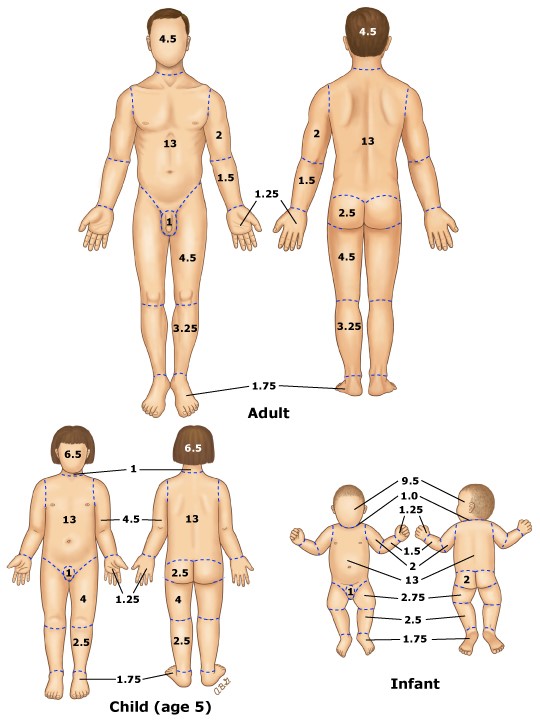
A patient experiences a gasoline tank fire when riding a motorcycle and is admitted to the emergency department (ED. with partial-thickness burns on the anterior surfaces of both lower extremities. Which percentage of body surface area should the nurse document in the electronic medical record (EMR)?
A. 18%.
This is the correct answer.According to the rule of nines, each leg accounts for 18% of the total body surface area, and the anterior surface of each leg accounts for half of that, or 9%. Therefore, the patient has partial-thickness burns on 9% + 9% = 18% of the body surface area.
B. 45%.
This is incorrect. This would be the case if the patient had partial-thickness burns on the anterior and posterior surfaces of both legs, as well as the head and neck, which is not given in the question.
C. 9%.
This is incorrect. This would be the case if the patient had partial-thickness burns on the anterior surface of only one leg, which is not given in the question.
D. 36%.
This is incorrect. This would be the case if the patient had partial-thickness burns on the anterior and posterior surfaces of both legs, which is not given in the question.
This question is an excerpt from Nurse Dive's nursing test bank - HESI Exit II Proctored Exam. Take the full exam now
Full Explanation
Choice A reason: This is the correct answer. According to the rule of nines, each leg accounts for 18% of the total body surface area, and the anterior surface of each leg accounts for half of that, or 9%. Therefore, the patient has partial-thickness burns on 9% + 9% = 18% of the body surface area.
Choice B reason: This is incorrect. This would be the case if the patient had partial-thickness burns on the anterior and posterior surfaces of both legs, as well as the head and neck, which is not given in the question.
Choice C reason: This is incorrect. This would be the case if the patient had partial-thickness burns on the anterior surface of only one leg, which is not given in the question.
Choice D reason: This is incorrect. This would be the case if the patient had partial-thickness burns on the anterior and posterior surfaces of both legs, which is not given in the question.
Similar Questions
The nurse is planning to teach infant care and preventive measures for sudden infant death syndrome (SIDS) to a group of new parents. Which information is most important for the nurse to include?
A. Ensure that the infant's crib mattress is firm.
This is correct because a firm mattress reduces the risk of suffocation and rebreathing of carbon dioxide, which are associated with SIDS.
B. Prop the infant with a pillow when in a side-lying position.
This is incorrect because propping the infant with a pillow can cause the infant to slide down and suffocate or obstruct the airway.
C. Swaddle the infant in a blanket for sleeping.
This is incorrect because swaddling the infant in a blanket can cause overheating, which is a risk factor for SIDS.
D. Place the infant in a prone position whenever possible.
This is incorrect because placing the infant in a prone position can increase the risk of SIDS by impairing gas exchange and thermoregulation.
Full Explanation
Choice A reason: This is correct because a firm mattress reduces the risk of suffocation and rebreathing of carbon dioxide, which are associated with SIDS.
Choice B reason: This is incorrect because propping the infant with a pillow can cause the infant to slide down and suffocate or obstruct the airway.
Choice C reason: This is incorrect because swaddling the infant in a blanket can cause overheating, which is a risk factor for SIDS.
Choice D reason: This is incorrect because placing the infant in a prone position can increase the risk of SIDS by impairing gas exchange and thermoregulation.
The nurse on a pediatric unit observes a distraught mother in the hallway scolding her 3-year-old son for wetting his pants. What initial action should the nurse take?
A. Provide disposable training pants while calming the mother.
This is correct because it addresses both the physical and emotional needs of the child and the mother. The nurse should provide comfort and reassurance to the mother and explain that occasional accidents are normal and not a sign of failure.
B. Refer the mother to a community parent education program.
This is incorrect because it implies that the mother is incompetent and needs external help. The nurse should first establish rapport and trust with the mother before suggesting any resources or interventions.
C. Suggest that the mother consult a pediatric nephrologist.
This is incorrect because it suggests that there is something wrong with the child's kidneys, which may alarm and offend the mother. The nurse should not jump to conclusions without assessing the child's history and symptoms.
D. Inform the mother that toilet training is slower for boys.
This is incorrect because it generalizes and stereotypes boys as being slower than girls in toilet training. The nurse should not make assumptions based on gender and should respect individual differences.
Full Explanation
Choice A reason: This is correct because it addresses both the physical and emotional needs of the child and the mother. The nurse should provide comfort and reassurance to the mother and explain that occasional accidents are normal and not a sign of failure.
Choice B reason: This is incorrect because it implies that the mother is incompetent and needs external help. The nurse should first establish rapport and trust with the mother before suggesting any resources or interventions.
Choice C reason: This is incorrect because it suggests that there is something wrong with the child's kidneys, which may alarm and offend the mother. The nurse should not jump to conclusions without assessing the child's history and symptoms.
Choice D reason: This is incorrect because it generalizes and stereotypes boys as being slower than girls in toilet training. The nurse should not make assumptions based on gender and should respect individual differences.
A patient who is hypotensive is receiving dopamine, an adrenergic agonist IV at the rate of 6 mcg/kg/min. Which intervention should the nurse implement when administering this medication?
A. Implement seizure precautions.
This is incorrect because seizure precautions are not indicated for dopamine administration. Dopamine does not lower the seizure threshold or cause convulsions.
B. Monitor serum potassium frequently.
This is incorrect because monitoring serum potassium frequently is not necessary for dopamine administration. Dopamine does not affect potassium levels or cause hyperkalemia or hypokalemia.
C. Ensure pump accuracy to prevent toxicity.
This is correct because ensuring pump accuracy to prevent toxicity is essential for dopamine administration. Dopamine is a potent vasoconstrictor that can cause tissue necrosis, gangrene, and hypertension if overdosed.
D. Encourage the patient to ambulate every hour.
Dopamine is given to hypotensive patients, meaning they may be weak, dizzy, or at risk of falls. Ambulating frequently could worsen hypotension and increase fall risk rather than help the patient. Instead, the nurse should monitor the patient’s hemodynamic status and ensure bed rest as needed until blood pressure stabilizes.
Full Explanation
Choice A reason: This is incorrect because seizure precautions are not indicated for dopamine administration. Dopamine does not lower the seizure threshold or cause convulsions.
Choice B reason: This is incorrect because monitoring serum potassium frequently is not necessary for dopamine administration. Dopamine does not affect potassium levels or cause hyperkalemia or hypokalemia.
Choice C reason: This is correct because ensuring pump accuracy to prevent toxicity is essential for dopamine administration. Dopamine is a potent vasoconstrictor that can cause tissue necrosis, gangrene, and hypertension if overdosed.
Choice D reason: Dopamine is given to hypotensive patients, meaning they may be weak, dizzy, or at risk of falls. Ambulating frequently could worsen hypotension and increase fall risk rather than help the patient. Instead, the nurse should monitor the patient’s hemodynamic status and ensure bed rest as needed until blood pressure stabilizes.