
Nursing practice questions with comprehensive rationales
NurseDive Free Nursing Practice Question
he nurse observes the client experiencing a panic attack in the day room in the behavioral health unit. Which is the priority action by the nurse?
A. Educate the client in ways to prevent a future panic attack.
B. Take the client for a walk around the unit
C. Stay with the client and maintain a safe environment
D. Redirect the client to an activity or task
This question is an excerpt from Nurse Dive's nursing test bank - ATI Mental Health Proctored Exam 1. Take the full exam now
Full Explanation
During a panic attack, the client may experience intense fear and anxiety, accompanied by physical symptoms such as rapid heart rate, shortness of breath, and trembling. The most critical action the nurse should take is to stay with the client and provide support. By remaining present, the nurse can help the client feel safe and reassured, while also monitoring their condition for any signs of worsening distress or the need for further intervention. Maintaining a safe environment is also crucial to prevent any harm to the client or others. Once the immediate crisis is managed and the client starts to calm down, the nurse can then proceed with other interventions, such as education on coping strategies or engaging in activities to redirect their focus. However, in this situation, the priority is to provide immediate support and ensure the client's safety.
The following are incorrect because:
Educate the client in ways to prevent a future panic attack: While education on preventing future panic attacks is important, it is not the priority action during an ongoing panic attack. The client is currently in distress and needs immediate support and assistance in managing the panic attack. Education can be provided at a later time when the client is calmer and more receptive to learning.
Take the client for a walk around the unit: Taking the client for a walk may be a beneficial intervention to help reduce anxiety and promote relaxation in some situations. However, during an active panic attack, the client may be experiencing significant distress and physical symptoms that can make movement difficult or exacerbate their symptoms. It is essential to prioritize the client's immediate needs and provide a supportive environment before considering other activities or interventions.
Redirect the client to an activity or task: Redirecting the client to an activity or task may be helpful in some situations to distract them from their anxiety. However, during a panic attack, the client may find it challenging to engage in activities or focus on tasks due to their heightened state of anxiety. Redirecting their attention without addressing their immediate distress may not be as effective or appropriate as providing support and maintaining a safe environment.
Similar Questions
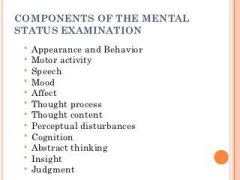
A nurse is performing a mental status examination (MSE) on a client who has a new diagnosis of dementia. Which of the following components should the nurse include? (Select all that apply.)
A. Grooming
None
B. Long-term memory
None
C. Support systems
None
D. Presence of pain
None
E. Affect
None
Full Explanation
The nurse should include the following components when performing a mental status examination (MSE) on a client with a new diagnosis of dementia:
● Grooming: Assessing the client's grooming and personal hygiene can provide insights into their ability to care for themselves and maintain basic activities of daily living.
● Long-term memory: Evaluating the client's long-term memory can help identify any deficits or impairments in their ability to recall past events, experiences, or personal information. This is particularly relevant in dementia, as it often affects memory function.
● Support systems: Assessing the client's support systems, such as family members, friends, or caregivers, is essential in understanding the resources available to the client and the level of assistance they may require in managing their dementia. However, this does not occur within the mental status exam.
● Affect: Evaluating the client's affect refers to observing their emotional expression and responsiveness during the assessment. In dementia, changes in affect can occur, such as a flat affect or inappropriate emotional responses.
The component that should not be included in the MSE for a client with dementia is:
● Presence of pain: While pain assessment is an important aspect of caring for individuals with various health conditions, including dementia, it is not a specific component of the mental status examination. Pain assessment is typically addressed separately and should be conducted when necessary or based on the client's specific complaints or indications of pain.
A nurse is assessing a client's circulatory system. Which of the following pulse sites should the nurse avoid assessing bilaterally at the same time?
A. Femoral
B. Popliteal
C. Brachial
D. Carotid
Full Explanation
Assessing the carotid pulse simultaneously on both sides of the neck can potentially lead to excessive pressure on the carotid arteries, which supply blood to the brain. This pressure can compromise blood flow to the brain and result in adverse effects, such as decreased blood supply and oxygenation to the brain tissues.
In clinical practice, it is generally recommended to assess the carotid pulse unilaterally, meaning one side at a time, to ensure adequate blood flow to the brain is maintained during the assessment. This allows for a proper evaluation of the pulse without interfering with the circulatory system.
The other choice are incorrect:
Femoral: Assessing the femoral pulse bilaterally at the same time is generally considered safe. The femoral artery is located in the groin area and provides blood supply to the lower
extremities. Bilateral assessment allows for comparison of pulses and evaluation of circulation in both legs.
Popliteal: The popliteal pulse is located behind the knee. Similar to the femoral pulse, assessing the popliteal pulse bilaterally at the same time is typically safe. It allows for comparison between both legs and evaluation of lower limb circulation.
Brachial: The brachial pulse is located in the upper arm and is commonly used for blood pressure measurement in clinical settings. Assessing the brachial pulse bilaterally at the same time is generally considered safe and is routinely done during blood pressure assessment.

A novice nurse is beginning work on a behavioral health unit and states to the preceptor, "What if I encounter a client that is sexually aggressive? Which is the appropriate response by the preceptor?
A. "Set firm limits and boundaries for the client."
B. “Tell the client that you are going to report to the director of the unit.”
C. "Walk away and have someone else take care of the client."
D. "It happens frequently so just ignore it they will stop."
Full Explanation
When encountering a client who is sexually aggressive, it is important for the nurse to establish firm limits and boundaries to ensure the safety and well-being of both the client and the healthcare team. This response promotes the maintenance of a therapeutic environment and helps prevent potential harm to the client, staff, and other patients.
the other choices are incorrect:
1. "Tell the client that you are going to report to the director of the unit." While it is important to report any concerning behaviors or incidents to the appropriate personnel, simply informing the client about reporting to the director may not be the most effective initial response. Prioritizing immediate actions to ensure safety and setting boundaries is crucial before involving higher-level staff.
2. "Walk away and have someone else take care of the client." Leaving the situation and passing the responsibility to someone else without addressing the issue directly is not an appropriate response. It is the nurse's responsibility to provide care and manage challenging situations within their scope of practice and training. Collaboration and support from the healthcare team may be sought, but abandoning the client is not an acceptable approach.
3. "It happens frequently, so just ignore it; they will stop." Ignoring sexually aggressive behavior is not an appropriate response. Such behavior should be taken seriously and addressed promptly to ensure the safety and well-being of everyone involved. Ignoring the behavior may enable its continuation and potentially lead to further harm or escalation of the situation.