
Nursing practice questions with comprehensive rationales
NurseDive Free Nursing Practice Question
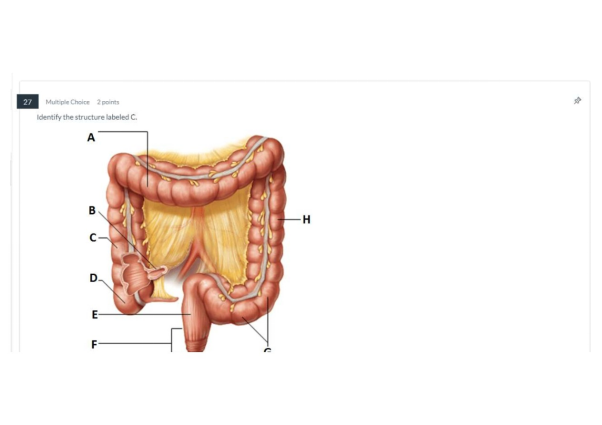
Identify the structure labeled C.
A. A
B. B
C. C
C- Ascending colon: The ascending colon is the right-sided large-intestine segment that ascends from the cecum to the hepatic (right colic) flexure; on a standard abdominal/colonic diagram the ascending colon is vertical on the right side and shows haustral markings.
D. D
E. E
This question is an excerpt from Nurse Dive's nursing test bank - HUMAN ANATOMY AND PHYSIOLOGY II PROCTORED EXAM (ARIZONA COLLEGE). Take the full exam now
Full Explanation
C- Ascending colon: The ascending colon is the right-sided large-intestine segment that ascends from the cecum to the hepatic (right colic) flexure; on a standard abdominal/colonic diagram the ascending colon is vertical on the right side and shows haustral markings.
Similar Questions
Which hormone is responsible for regulating the process of spermatogenesis?
A. Follicle Stimulating Hormone (FSH)
Follicle Stimulating Hormone (FSH): FSH directly stimulates Sertoli cells in the testes to support sperm development and the process of spermatogenesis .
B. Luteinizing Hormone (LH)
Luteinizing Hormone (LH): LH stimulates Leydig cells to produce testosterone, which indirectly supports spermatogenesis, but LH itself is not the primary regulator of the spermatogenic process.
C. Estrogen
Estrogen: Estrogen is present in males in small amounts (via aromatization of androgens) and has modulatory roles, but it is not the main hormone regulating spermatogenesis.
D. Progesterone
Progesterone: Progesterone has little to no direct role in regulating spermatogenesis in males.
Full Explanation
A. Follicle Stimulating Hormone (FSH): FSH directly stimulates Sertoli cells in the testes to support sperm development and the process of spermatogenesis .
B. Luteinizing Hormone (LH): LH stimulates Leydig cells to produce testosterone, which indirectly supports spermatogenesis, but LH itself is not the primary regulator of the spermatogenic process.
C. Estrogen: Estrogen is present in males in small amounts (via aromatization of androgens) and has modulatory roles, but it is not the main hormone regulating spermatogenesis.
D. Progesterone: Progesterone has little to no direct role in regulating spermatogenesis in males.
The stomach can expand up to eighty times its empty volume partly due to _______ in its walls.
A. Microvilli
Microvilli: Microvilli are tiny apical membrane projections that greatly increase surface area for absorption (mainly in the small intestine), not responsible for stomach expansion.
B. Plica circularis
Plica circularis: Plicae circularis (circular folds) are permanent folds of the small intestine mucosa that aid absorption, not found in the stomach.
C. Haustra
Haustra: Haustra are sacculations of the large intestine (colon), not structures of the stomach.
D. Rugae
Rugae: Rugae are the longitudinal mucosal folds in the stomach wall that allow the stomach to stretch and expand as it fills .
Full Explanation
A. Microvilli: Microvilli are tiny apical membrane projections that greatly increase surface area for absorption (mainly in the small intestine), not responsible for stomach expansion.
B. Plica circularis: Plicae circularis (circular folds) are permanent folds of the small intestine mucosa that aid absorption, not found in the stomach.
C. Haustra: Haustra are sacculations of the large intestine (colon), not structures of the stomach.
D. Rugae: Rugae are the longitudinal mucosal folds in the stomach wall that allow the stomach to stretch and expand as it fills .
A nurse is caring for a client with impaired renal function and is reviewing the processes involved in urine formation. Which of the following statements best describes the process of tubular secretion in the nephron?
A. Tubular secretion involves the reabsorption of substances from the renal tubules into the peritubular capillaries.
Tubular secretion involves the reabsorption of substances from the renal tubules into the peritubular capillaries.: That describes reabsorption, the opposite of secretion.
B. Tubular secretion is a passive process that occurs in the glomerulus, allowing the filtration of waste products.
Tubular secretion is a passive process that occurs in the glomerulus, allowing the filtration of waste products.: Filtration in the glomerulus is a separate, largely passive process; tubular secretion is an active transport process occurring in the renal tubules.
C. Tubular secretion is the movement of substances from the blood in the peritubular capillaries into the renal tubules.
Tubular secretion is the movement of substances from the blood in the peritubular capillaries into the renal tubules.: This correctly describes tubular secretion (e.g., H⁺, K⁺, drugs) .
D. Tubular secretion primarily occurs in the Bowman's capsule, facilitating the selective reabsorption of essential nutrients.
Tubular secretion primarily occurs in the Bowman's capsule, facilitating the selective reabsorption of essential nutrients.: Bowman's capsule is the site of filtration, not tubular secretion; selective reabsorption occurs later in the tubules.
Full Explanation
A. Tubular secretion involves the reabsorption of substances from the renal tubules into the peritubular capillaries.: That describes reabsorption, the opposite of secretion.
B. Tubular secretion is a passive process that occurs in the glomerulus, allowing the filtration of waste products.: Filtration in the glomerulus is a separate, largely passive process; tubular secretion is an active transport process occurring in the renal tubules.
C. Tubular secretion is the movement of substances from the blood in the peritubular capillaries into the renal tubules.: This correctly describes tubular secretion (e.g., H⁺, K⁺, drugs) .
D. Tubular secretion primarily occurs in the Bowman's capsule, facilitating the selective reabsorption of essential nutrients.: Bowman's capsule is the site of filtration, not tubular secretion; selective reabsorption occurs later in the tubules.