
Nursing practice questions with comprehensive rationales
NurseDive Free Nursing Practice Question
In evaluating the effectiveness of a postoperative client's intermittent pneumatic compression devices, which assessment is most important for the nurse to complete?
A. Palpate all peripheral pulse points for volume and strength.
Palpating all peripheral pulse points for volume and strength is important for assessing circulation, but it does not directly evaluate the effectiveness of intermittent pneumatic compression (IPC) devices. IPC devices are primarily used to prevent deep vein thrombosis (DVT) and improve venous return, so monitoring for signs of DVT is more relevant.
B. Monitor the amount of drainage from the client's incision.
Monitoring the amount of drainage from the client’s incision is crucial for assessing wound healing and detecting potential infections, but it is not related to the effectiveness of IPC devices.
C. Observe both lower extremities for redness and swelling.
Observing both lower extremities for redness and swelling is the most important assessment for evaluating the effectiveness of IPC devices. Redness and swelling can be signs of DVT, which IPC devices are designed to prevent. Therefore, this assessment directly measures whether the devices are functioning as intended.
D. Evaluate the client's ability to use an incentive spirometer.
Evaluating the client’s ability to use an incentive spirometer is important for preventing postoperative pulmonary complications, but it does not assess the effectiveness of IPC devices.
This question is an excerpt from Nurse Dive's nursing test bank - RN Hesi Exit Proctored Exam. Take the full exam now
Full Explanation
The correct answer is choice C. Observe both lower extremities for redness and swelling.
Choice A rationale:
Palpating all peripheral pulse points for volume and strength is important for assessing circulation, but it does not directly evaluate the effectiveness of intermittent pneumatic compression (IPC) devices. IPC devices are primarily used to prevent deep vein thrombosis (DVT) and improve venous return, so monitoring for signs of DVT is more relevant.
Choice B rationale:
Monitoring the amount of drainage from the client’s incision is crucial for assessing wound healing and detecting potential infections, but it is not related to the effectiveness of IPC devices.
Choice C rationale:
Observing both lower extremities for redness and swelling is the most important assessment for evaluating the effectiveness of IPC devices. Redness and swelling can be signs of DVT, which IPC devices are designed to prevent. Therefore, this assessment directly measures whether the devices are functioning as intended.
Choice D rationale:
Evaluating the client’s ability to use an incentive spirometer is important for preventing postoperative pulmonary complications, but it does not assess the effectiveness of IPC devices.
Similar Questions
The nurse observes a client prepare a meal in the kitchen of a rehabilitation facility prior to discharge. Which behavior(s) indicate the client understands how to maintain balance safely? (Select all that apply.)
A. Bends from the waist to pick trash off the floor.
Incorrect- This behavior is not safe for maintaining balance. Bending from the waist can increase the risk of falling. Clients should bend at the knees and use proper body mechanics to pick up objects from the floor.
B. Widens stance while working near the sink.
Correct- Widening the stance provides a broader base of support, which can help improve balance and stability while working near the sink. This is a safe behavior to maintain balance.
C. Locks knees while preparing food on the counter.
Incorrect- Locking the knees while standing can lead to instability and decreased balance. It is recommended to keep the knees slightly flexed to maintain better balance.
D. Brings a heavy can close to body before lifting.
Correct- Bringing a heavy object close to the body before lifting minimizes strain on the back and helps maintain balance. This is a safe behavior when lifting objects.
E. Leans forward to pull a pan from a high shelf
Incorrect- Leaning forward to pull an object from a high shelf can disrupt the center of balance and increase the risk of falling. It's important to use a step stool or ask for assistance when reaching for items on high shelves.
Full Explanation
A) Incorrect- This behavior is not safe for maintaining balance. Bending from the waist can increase the risk of falling. Clients should bend at the knees and use proper body mechanics to pick up objects from the floor.
B) Correct- Widening the stance provides a broader base of support, which can help improve balance and stability while working near the sink. This is a safe behavior to maintain balance.
C) Incorrect- Locking the knees while standing can lead to instability and decreased balance. It is recommended to keep the knees slightly flexed to maintain better balance.
D) Correct- Bringing a heavy object close to the body before lifting minimizes strain on the back and helps maintain balance. This is a safe behavior when lifting objects.
E) Incorrect- Leaning forward to pull an object from a high shelf can disrupt the center of balance and increase the risk of falling. It's important to use a step stool or ask for assistance when reaching for items on high shelves.
The nurse is caring for a client with pulmonary edema who is short of breath and coughing pink tinged sputum. Which position should the nurse place the client to ease respiratory distress?
A. Left lateral position.
Incorrect- The left lateral position might not provide enough lung expansion for a client in respiratory distress.
B. Reverse Trendelenburg.
Incorrect- Reverse Trendelenburg (head of bed elevated, foot of bed lowered) might not provide enough lung expansion and could exacerbate respiratory distress.
C. High-Fowler's position.
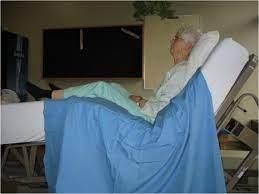
Correct- The High-Fowler's position, where the client is sitting upright at a 90-degree angle or as upright as tolerated, helps to improve lung expansion, reduce pressure on the diaphragm, and promote optimal oxygenation. This position is commonly used for clients with respiratory distress.
D. Supine
Incorrect- The supine position may worsen pulmonary congestion and compromise lung expansion in clients with pulmonary edema.
Full Explanation
A) Incorrect- The left lateral position might not provide enough lung expansion for a client in respiratory distress.
B) Incorrect- Reverse Trendelenburg (head of bed elevated, foot of bed lowered) might not provide enough lung expansion and could exacerbate respiratory distress.
C) Correct- The High-Fowler's position, where the client is sitting upright at a 90-degree angle or as upright as tolerated, helps to improve lung expansion, reduce pressure on the diaphragm, and promote optimal oxygenation. This position is commonly used for clients with respiratory distress.
D) Incorrect- The supine position may worsen pulmonary congestion and compromise lung expansion in clients with pulmonary edema.
The healthcare provider prescribes dopamine 2 mcg/kg/min intravenously (IV) for client who weighs 60 kg. The IV bag contains dopamine 200 mg in dextrose 5% in water (DW) 250 mL. The nurse should program the infusion pump to deliver how many mL/hour? (Enter numerical value only.)
Full Explanation
Here are the steps you can follow to calculate the infusion pump flow rate:
Step 1: Calculate the prescribed dose in mcg/min
- Dose per weight: 2 mcg/kg/min * 60 kg = 120 mcg/min
Step 2: Convert the concentration in the IV bag to mcg/mL
- Convert mg to mcg: 200 mg * 1000 mcg/mg = 200,000 mcg
- Concentration: 200,000 mcg / 250 mL = 800 mcg/mL
Step 3: Calculate the flow rate in mL/min
- Flow rate: 120 mcg/min / 800 mcg/mL = 0.15 mL/min
Step 4: Convert the flow rate to mL/hour
- Hour conversion: 0.15 mL/min * 60 min/hour = 9 mL/hour
Therefore, the nurse should program the infusion pump to deliver 9 mL/hour.