
Nursing practice questions with comprehensive rationales
NurseDive Free Nursing Practice Question
Name the structure labeled #3 on the following image:
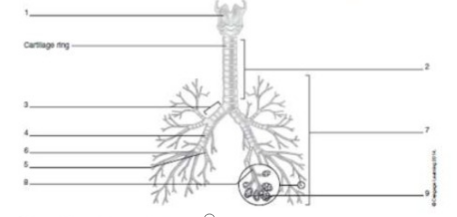
A. Primary bronchus
Primary bronchus: The primary (main) bronchus is the first large airway branch that arises at the carina from the trachea and conducts air into each lung.
B. Respiratory bronchiole
Respiratory bronchiole: Respiratory bronchioles are very small distal airways that contain alveoli and are deep within the lung parenchyma; they are much smaller than the structure shown near the main branch.
C. Trachea
Trachea: The trachea is the central airway above the bifurcation (a vertical tube with cartilage rings); a label on the long central tube would indicate the trachea, not the branching airway.
D. Secondary bronchus
Secondary bronchus: Secondary (lobar) bronchi are branches of the primary bronchus that lead to lung lobes; they are a generation distal to the main bronchus and are smaller than the primary bronchus.
This question is an excerpt from Nurse Dive's nursing test bank - HUMAN ANATOMY AND PHYSIOLOGY II PROCTORED EXAM (ARIZONA COLLEGE). Take the full exam now
Full Explanation
A. Primary bronchus: The primary (main) bronchus is the first large airway branch that arises at the carina from the trachea and conducts air into each lung.
B. Respiratory bronchiole: Respiratory bronchioles are very small distal airways that contain alveoli and are deep within the lung parenchyma; they are much smaller than the structure shown near the main branch.
C. Trachea: The trachea is the central airway above the bifurcation (a vertical tube with cartilage rings); a label on the long central tube would indicate the trachea, not the branching airway.
D. Secondary bronchus: Secondary (lobar) bronchi are branches of the primary bronchus that lead to lung lobes; they are a generation distal to the main bronchus and are smaller than the primary bronchus.
Similar Questions
Which statement about diffusion of gas across the alveolar capillary membrane is true?
A. Diffusion of gas does not depend on the partial pressure gradient
Diffusion of gas does not depend on the partial pressure gradient: Incorrect -gas diffusion across membranes depends on partial pressure gradients (and membrane properties).
B. Gas diffuses from high partial pressure to low partial pressure
Gas diffuses from high partial pressure to low partial pressure: Correct -diffusion follows the partial pressure gradient (for example O₂ moves from alveoli where PO₂ is higher into blood where PO₂ is lower).
C. Gas diffuses from low partial pressure to high partial pressure
Gas diffuses from low partial pressure to high partial pressure: Incorrect -that direction would require active transport; gases passively diffuse down their gradients.
D. Equilibrium can be reached without partial pressure gradient
Equilibrium can be reached without partial pressure gradient: Incorrect -equilibrium is reached when partial pressures equalize; without a gradient diffusion won’t proceed.
Full Explanation
A. Diffusion of gas does not depend on the partial pressure gradient: Incorrect -gas diffusion across membranes depends on partial pressure gradients (and membrane properties).
B. Gas diffuses from high partial pressure to low partial pressure: Correct -diffusion follows the partial pressure gradient (for example O₂ moves from alveoli where PO₂ is higher into blood where PO₂ is lower).
C. Gas diffuses from low partial pressure to high partial pressure: Incorrect -that direction would require active transport; gases passively diffuse down their gradients.
D. Equilibrium can be reached without partial pressure gradient: Incorrect -equilibrium is reached when partial pressures equalize; without a gradient diffusion won’t proceed.
Identify substances that, when present in significant amounts in urine, may indicate a potential diabetic health issue. (Select all that apply)
A. Urea
Urea: Urea is a normal nitrogenous waste product excreted in urine; its presence alone is not indicative of diabetes (it reflects protein metabolism/kidney function).
B. Creatinine
Creatinine: Creatinine is a normal urinary waste product used to assess kidney function; its presence alone is not diagnostic of diabetes.
C. Glucose
Glucose: Glucosuria (significant glucose in urine) suggests hyperglycemia and impaired glucose handling (common in diabetes) -indicative of a diabetic problem if present in large amounts.
D. Ketones
Ketones: Ketonuria (significant ketones in urine) indicates fat breakdown/ketosis and is a sign of uncontrolled diabetes (e.g., diabetic ketoacidosis) -indicative of diabetic metabolic disturbance.
Full Explanation
A. Urea: Urea is a normal nitrogenous waste product excreted in urine; its presence alone is not indicative of diabetes (it reflects protein metabolism/kidney function).
B. Creatinine: Creatinine is a normal urinary waste product used to assess kidney function; its presence alone is not diagnostic of diabetes.
C. Glucose: Glucosuria (significant glucose in urine) suggests hyperglycemia and impaired glucose handling (common in diabetes) -indicative of a diabetic problem if present in large amounts.
D. Ketones: Ketonuria (significant ketones in urine) indicates fat breakdown/ketosis and is a sign of uncontrolled diabetes (e.g., diabetic ketoacidosis) -indicative of diabetic metabolic disturbance.
What is the primary function of the scrotum in the male reproductive system?
A. Regulating body temperature of the testes
Regulating body temperature of the testes: Correct -the scrotum suspends the testes and adjusts their position to keep testicular temperature slightly below core body temperature, which is necessary for optimal sperm production.
B. Storing urine
Storing urine: Incorrect -urine is stored in the urinary bladder, not in the scrotum.
C. Producing sperm
Producing sperm: Incorrect -sperm are produced in the seminiferous tubules inside the testes; the scrotum is a protective/powerful thermoregulatory sac, not the sperm-producing tissue.
D. Carrying sperm to the urethra
Carrying sperm to the urethra: Incorrect -ducts such as the vas (ductus) deferens carry sperm toward the urethra; the scrotum does not transport sperm.
Full Explanation
A. Regulating body temperature of the testes: Correct -the scrotum suspends the testes and adjusts their position to keep testicular temperature slightly below core body temperature, which is necessary for optimal sperm production.
B. Storing urine: Incorrect -urine is stored in the urinary bladder, not in the scrotum.
C. Producing sperm: Incorrect -sperm are produced in the seminiferous tubules inside the testes; the scrotum is a protective/powerful thermoregulatory sac, not the sperm-producing tissue.
D. Carrying sperm to the urethra: Incorrect -ducts such as the vas (ductus) deferens carry sperm toward the urethra; the scrotum does not transport sperm.