
Nursing practice questions with comprehensive rationales
NurseDive Free Nursing Practice Question
Name this duct:
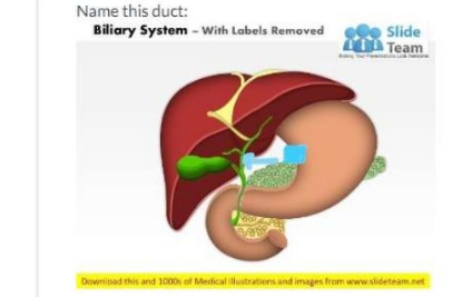
A. Pancreatic duct
Pancreatic duct: The pancreatic duct (duct of Wirsung) conveys pancreatic enzymes from the pancreas to the duodenum and typically joins the bile duct at the hepatopancreatic ampulla.
B. Common bile duct
Common bile duct: The common bile duct is formed by the union of the common hepatic duct and cystic duct and carries bile from the liver/gallbladder to the duodenum.
C. Common hepatic duct
Common hepatic duct: The common hepatic duct drains bile from the right and left hepatic ducts of the liver and joins the cystic duct to form the common bile duct.
D. Cystic duct
Cystic duct: The cystic duct connects the gallbladder to the common bile duct and allows bile to flow into and out of the gallbladder for storage and release.
This question is an excerpt from Nurse Dive's nursing test bank - HUMAN ANATOMY AND PHYSIOLOGY II PROCTORED EXAM (ARIZONA COLLEGE). Take the full exam now
Full Explanation
A. Pancreatic duct: The pancreatic duct (duct of Wirsung) conveys pancreatic enzymes from the pancreas to the duodenum and typically joins the bile duct at the hepatopancreatic ampulla.
B. Common bile duct: The common bile duct is formed by the union of the common hepatic duct and cystic duct and carries bile from the liver/gallbladder to the duodenum.
C. Common hepatic duct: The common hepatic duct drains bile from the right and left hepatic ducts of the liver and joins the cystic duct to form the common bile duct.
D. Cystic duct: The cystic duct connects the gallbladder to the common bile duct and allows bile to flow into and out of the gallbladder for storage and release.
Similar Questions
_________ occurs when the external intercostal muscles contract, pulling the ribs up and expanding laterally.
A. Vital capacity
Vital capacity: Vital capacity is a lung-volume measurement (maximum inhale → maximum exhale), not the mechanical action of rib elevation.
B. Expiration
Expiration: Expiration (quiet) is produced by relaxation and elastic recoil; active rib elevation is not part of expiration.
C. Inspiration
Inspiration: Contraction of the external intercostals (and diaphragm) raises the ribs and expands the thoracic cage, producing inspiration.
D. Ventilation
Ventilation: Ventilation is the overall process of air movement in and out of the lungs; rib elevation specifically describes inspiration rather than the whole process.
Full Explanation
A. Vital capacity: Vital capacity is a lung-volume measurement (maximum inhale → maximum exhale), not the mechanical action of rib elevation.
B. Expiration: Expiration (quiet) is produced by relaxation and elastic recoil; active rib elevation is not part of expiration.
C. Inspiration: Contraction of the external intercostals (and diaphragm) raises the ribs and expands the thoracic cage, producing inspiration.
D. Ventilation: Ventilation is the overall process of air movement in and out of the lungs; rib elevation specifically describes inspiration rather than the whole process.
A biology instructor is assessing the understanding of reproductive processes among a group of students. Which statement accurately describes the primary purpose of spermatogenesis in males and oogenesis in females?
A. Spermatogenesis and oogenesis both contribute to the maturation of the embryo.
Spermatogenesis and oogenesis both contribute to the maturation of the embryo: gametogenesis produces gametes for fertilization; embryonic maturation occurs after fertilization.
B. Spermatogenesis produces mature sperm for fertilization, while oogenesis generates mature ova for fertilization.
Spermatogenesis produces mature sperm for fertilization, while oogenesis generates mature ova for fertilization: spermatogenesis and oogenesis are the gamete-producing processes that supply sperm and ova needed for sexual reproduction.
C. Spermatogenesis is responsible for the development of the uterine lining, while oogenesis produces hormones to regulate the menstrual cycle.
Spermatogenesis is responsible for the development of the uterine lining, while oogenesis produces hormones to regulate the menstrual cycle: uterine lining development is driven by ovarian hormones (estrogen/progesterone); gametogenesis itself does not directly build the endometrium.
D. Spermatogenesis and oogenesis are sex hormones necessary for reproductive health.
Spermatogenesis and oogenesis are sex hormones necessary for reproductive health: spermatogenesis and oogenesis are cellular processes (gamete production), not hormones.
Full Explanation
A. Spermatogenesis and oogenesis both contribute to the maturation of the embryo: gametogenesis produces gametes for fertilization; embryonic maturation occurs after fertilization.
B. Spermatogenesis produces mature sperm for fertilization, while oogenesis generates mature ova for fertilization: spermatogenesis and oogenesis are the gamete-producing processes that supply sperm and ova needed for sexual reproduction.
C. Spermatogenesis is responsible for the development of the uterine lining, while oogenesis produces hormones to regulate the menstrual cycle: uterine lining development is driven by ovarian hormones (estrogen/progesterone); gametogenesis itself does not directly build the endometrium.
D. Spermatogenesis and oogenesis are sex hormones necessary for reproductive health: spermatogenesis and oogenesis are cellular processes (gamete production), not hormones.
A nurse is providing education to a client who has recently undergone pelvic floor surgery. The client asks about the voluntary control of urination. Which anatomical structure allows for conscious control over the initiation of urine flow?
A. Ileocecal sphincter
Ileocecal sphincter: the ileocecal valve/sphincter regulates flow from ileum to cecum in the GI tract, unrelated to urinary control.
B. Internal urethral sphincter
Internal urethral sphincter: Incorrect (mostly involuntary) -the internal sphincter (smooth muscle) provides involuntary control of urine retention at the bladder neck via autonomic regulation.
C. Internal anal sphincter
Internal anal sphincter: the internal anal sphincter controls fecal continence (involuntary), not urinary flow.
D. External urethral sphincter
External urethral sphincter: the external urethral sphincter is skeletal muscle under voluntary control and allows conscious initiation or delay of urination.
Full Explanation
A. Ileocecal sphincter: the ileocecal valve/sphincter regulates flow from ileum to cecum in the GI tract, unrelated to urinary control.
B. Internal urethral sphincter: Incorrect (mostly involuntary) -the internal sphincter (smooth muscle) provides involuntary control of urine retention at the bladder neck via autonomic regulation.
C. Internal anal sphincter: the internal anal sphincter controls fecal continence (involuntary), not urinary flow.
D. External urethral sphincter: the external urethral sphincter is skeletal muscle under voluntary control and allows conscious initiation or delay of urination.