
Nursing practice questions with comprehensive rationales
NurseDive Free Nursing Practice Question
Nurses are responsible not only for their actions but also for the actions of the staff to whom they delegate work, including accurate documentation. What is the principle associated with this responsibility?
A. Accountability
The principle associated with the responsibility of nurses for their actions and the actions of the staff to whom they delegate work, including accurate documentation, is accountability. This means that nurses are responsible for ensuring that the care provided by themselves and their staff meets the appropriate standards and that all documentation is accurate and complete.
B. Conflict resolution
Option B is incorrect because conflict resolution is a process for resolving disagreements or disputes.
C. Coordination of care
Option C is incorrect because coordination of care refers to the process of organizing and managing a patient's healthcare needs.
D. Authoritativeness
Option D is incorrect because authoritativeness refers to the ability to make decisions and provide direction.
This question is an excerpt from Nurse Dive's nursing test bank - ATI PN Medical Surgical Leadership Proctored Exam. Take the full exam now
Full Explanation
The principle associated with the responsibility of nurses for their actions and the actions of the staff to whom they delegate work, including accurate documentation, is accountability. This means that nurses are responsible for ensuring that the care provided by themselves and their staff meets the appropriate standards and that all documentation is accurate and complete.
Option B is incorrect because conflict resolution is a process for resolving disagreements or disputes.
Option C is incorrect because coordination of care refers to the process of organizing and managing a patient's healthcare needs.
Option D is incorrect because authoritativeness refers to the ability to make decisions and provide direction.
Similar Questions
Focuses on the day-to-day operations of the unit.
A. Leadership
Option A is incorrect because leadership refers to the ability to inspire and motivate others to achieve a common goal.
B. Visionary
Option B is incorrect because visionary refers to the ability to see and plan for the future.
C. Bioethics
Option C is incorrect because bioethics is the study of ethical issues in medicine and healthcare.
D. Management
Focusing on the day-to-day operations of the unit is a function of management. Management involves planning, organizing, directing, and controlling the resources of an organization to achieve its goals. In the context of a healthcare unit, this includes managing staff, resources, and processes to ensure that the unit runs smoothly and provides high-quality care to patients.
Full Explanation
Focusing on the day-to-day operations of the unit is a function of management. Management involves planning, organizing, directing, and controlling the resources of an organization to achieve its goals. In the context of a healthcare unit, this includes managing staff, resources, and processes to ensure that the unit runs smoothly and provides high-quality care to patients.
Option A is incorrect because leadership refers to the ability to inspire and motivate others to achieve a common goal.
Option B is incorrect because visionary refers to the ability to see and plan for the future.
Option C is incorrect because bioethics is the study of ethical issues in medicine and healthcare.
A nurse is performing care for several clients with the help of an assistive personnel (AP). Which task should the nurse ask the AP to perform first?
A. Give fresh water to each client who does not have NPO status.
Option A is incorrect because giving fresh water to clients who do not have NPO status is not as time-sensitive as taking an ABG specimen to the laboratory.
B. Obtain a routine urine sample from a client right after admission.
Option B is incorrect because obtaining a routine urine sample from a client right after admission is not as time-sensitive as taking an ABG specimen to the laboratory.
C. Transport a client to the radiology department for an x-ray.
Option C is incorrect because transporting a client to the radiology department for an x-ray is not as time-sensitive as taking an ABG specimen to the laboratory.
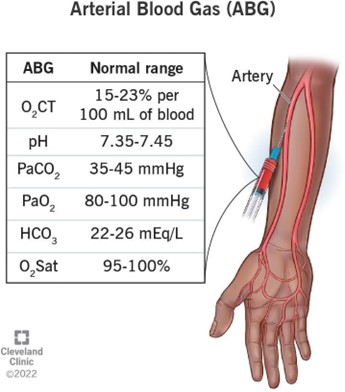
D. Take an ABG specimen to the laboratory.
The nurse should ask the AP to perform the task of taking an ABG (arterial blood gas) specimen to the laboratory first. This is because ABG specimens need to be analyzed promptly to ensure accurate results. Timely analysis of ABG specimens is important for making clinical decisions and providing appropriate care to the client.
Full Explanation
The nurse should ask the AP to perform the task of taking an ABG (arterial blood gas) specimen to the laboratory first. This is because ABG specimens need to be analyzed promptly to ensure accurate results. Timely analysis of ABG specimens is important for making clinical decisions and providing appropriate care to the client.
Option A is incorrect because giving fresh water to clients who do not have NPO status is not as time-sensitive as taking an ABG specimen to the laboratory.
Option B is incorrect because obtaining a routine urine sample from a client right after admission is not as time-sensitive as taking an ABG specimen to the laboratory.
Option C is incorrect because transporting a client to the radiology department for an x-ray is not as time-sensitive as taking an ABG specimen to the laboratory.
A nurse wants to prepare a patient report utilizing SBAR, which she knows is a systematic method of communication. To ensure the report is thorough, what types of information does she need? SELECT ALL THAT APPLY
A. Assessment of the patient.
B. Recommendations for moving forward.
C. Situation of the patient.
D. Barriers to providing treatment.
barriers to providing treatment are not part of the SBAR framework.
F. Reason why the report is needed.
the reason why the report is needed is not part of the SBAR framework.
Full Explanation
SBAR stands for Situation, Background, Assessment, and Recommendation. It is a systematic method of communication that provides a structured framework for conveying important information about a patient. To ensure that the report is thorough, the nurse needs to include information about the situation of the patient, the background leading up to the situation, an assessment of the patient, and recommendations for moving forward.
Option d is incorrect because barriers to providing treatment are not part of the SBAR framework.
Option f is incorrect because the reason why the report is needed is not part of the SBAR framework.