Nursing practice questions with comprehensive rationales
NurseDive Free Nursing Practice Question
On admission to the emergency department, a patient with a C5 compression fracture can move only his head and has flaccid paralysis of all extremities. The distraught family asks if the paralysis is permanent. Which is the best response by the nurse?
A. "It is too early to tell. When the spinal shock subsides, we will know more."
"It is too early to tell. When the spinal shock subsides, we will know more."This response is appropriate. Spinal shock can initially obscure the extent of neurological injury, and it may take time for the full extent of the injury to become apparent. By acknowledging this and suggesting that more information will be available once spinal shock subsides, the nurse provides a realistic perspective without prematurely predicting the outcome.
B. "You should talk to your physician about things of that nature."
"You should talk to your physician about things of that nature."This response may come across as dismissive or evasive. While it is true that the physician ultimately determines the patient's prognosis, the family may be seeking reassurance and guidance from the nurse as well.
C. "No. Significant recovery of function should occur in a few days."
"No. Significant recovery of function should occur in a few days." This response is overly optimistic and potentially misleading. While some improvement may occur in the days following a spinal cord injury, significant recovery of function within a few days is unlikely, especially in cases of flaccid paralysis of all extremities.
D. "Yes. In all likelihood, the paralysis is probably permanent."
This response is overly pessimistic and lacks sensitivity. It may unnecessarily distress the family and extinguish hope for the patient's recovery.
This question is an excerpt from Nurse Dive's nursing test bank - Ati Lpn Med Surg Neuro Test 2024 Proctored Exam. Take the full exam now
Full Explanation
A. "It is too early to tell. When the spinal shock subsides, we will know more."
This response is appropriate. Spinal shock can initially obscure the extent of neurological injury, and it may take time for the full extent of the injury to become apparent. By acknowledging this and suggesting that more information will be available once spinal shock subsides, the nurse provides a realistic perspective without prematurely predicting the outcome.
B. "You should talk to your physician about things of that nature."
This response may come across as dismissive or evasive. While it is true that the physician ultimately determines the patient's prognosis, the family may be seeking reassurance and guidance from the nurse as well.
C. "No. Significant recovery of function should occur in a few days."
This response is overly optimistic and potentially misleading. While some improvement may occur in the days following a spinal cord injury, significant recovery of function within a few days is unlikely, especially in cases of flaccid paralysis of all extremities.
D. "Yes. In all likelihood, the paralysis is probably permanent."
This response is overly pessimistic and lacks sensitivity. It may unnecessarily distress the family and extinguish hope for the patient's recovery.
Similar Questions
Which neurologic finding would be considered abnormal in an 88-year-old patient?
A. Dizziness and problems with balance
Dizziness and problems with balanceWhile dizziness and problems with balance can occur more frequently in older adults due to age-related changes in the vestibular system and other factors, persistent or severe dizziness or balance issues should be evaluated further as they could indicate underlying neurological or medical conditions.
B. Slow papillary response to light
Slow papillary response to lightThis finding may be considered abnormal, especially if it represents a significant change from the individual's baseline. While age-related changes in pupil function can occur, a slow or sluggish pupillary response to light may indicate dysfunction of the oculomotor nerve or other neurological issues and should be investigated further.
C. Jerky eye movements
Jerky eye movements Jerky eye movements, such as nystagmus, can be abnormal and may indicate dysfunction of the vestibular system or other neurological conditions. While some degree of nystagmus can occur with age, persistent or severe jerky eye movements should be evaluated further.
D. Absence of the Achilles tendon jerk
Absence of the Achilles tendon jerkThis finding may also be considered abnormal. The Achilles tendon reflex, tested using the deep tendon reflex (DTR) examination, can diminish with age but should not be completely absent in the absence of specific medical conditions affecting the reflex arc or spinal cord function.
Full Explanation
A. Dizziness and problems with balance
While dizziness and problems with balance can occur more frequently in older adults due to age-related changes in the vestibular system and other factors, persistent or severe dizziness or balance issues should be evaluated further as they could indicate underlying neurological or medical conditions.
B. Slow papillary response to light
This finding may be considered abnormal, especially if it represents a significant change from the individual's baseline. While age-related changes in pupil function can occur, a slow or sluggish pupillary response to light may indicate dysfunction of the oculomotor nerve or other neurological issues and should be investigated further.
C. Jerky eye movements
Jerky eye movements, such as nystagmus, can be abnormal and may indicate dysfunction of the vestibular system or other neurological conditions. While some degree of nystagmus can occur with age, persistent or severe jerky eye movements should be evaluated further.
D. Absence of the Achilles tendon jerk
This finding may also be considered abnormal. The Achilles tendon reflex, tested using the deep tendon reflex (DTR) examination, can diminish with age but should not be completely absent in the absence of specific medical conditions affecting the reflex arc or spinal cord function.
Which position should a nurse instruct a patient to assume after a lumbar puncture to prevent a headache?
A. Lie flat.
Lie flat:This option involves instructing the patient to lie flat on their back without elevating their head. Lying flat helps to maintain consistent pressure in the spinal canal, reducing the likelihood of CSF leakage from the puncture site. This position is commonly recommended after a lumbar puncture to prevent or minimize the occurrence of post-lumbar puncture headaches (PLPH).
B. Lie on left side.
Lie on left side:This option involves instructing the patient to lie on their left side. While lying on the left side may provide some relief by reducing pressure on the lumbar puncture site, it is not typically recommended immediately after the procedure to prevent PLPH. Lying flat is generally preferred to minimize changes in CSF pressure and reduce the risk of headache.
C. Stay in semi-Fowler position.
Stay in semi-Fowler position: The semi-Fowler position involves elevating the head of the bed at a 30-45 degree angle. This position is not typically recommended immediately after a lumbar puncture because it may increase CSF leakage and pressure changes, potentially exacerbating the risk of developing a headache.
D. Ambulate in the room with assistance.
Ambulate in the room with assistance:Ambulating shortly after a lumbar puncture is not typically recommended as it may increase the risk of developing a headache. Movement and changes in posture can exacerbate CSF leakage and pressure changes at the puncture site, leading to the development of post-lumbar puncture headaches.
Full Explanation
A. Lie flat:
This option involves instructing the patient to lie flat on their back without elevating their head. Lying flat helps to maintain consistent pressure in the spinal canal, reducing the likelihood of CSF leakage from the puncture site. This position is commonly recommended after a lumbar puncture to prevent or minimize the occurrence of post-lumbar puncture headaches (PLPH).
B. Lie on left side:
This option involves instructing the patient to lie on their left side. While lying on the left side may provide some relief by reducing pressure on the lumbar puncture site, it is not typically recommended immediately after the procedure to prevent PLPH. Lying flat is generally preferred to minimize changes in CSF pressure and reduce the risk of headache.
C. Stay in semi-Fowler position:
The semi-Fowler position involves elevating the head of the bed at a 30-45 degree angle. This position is not typically recommended immediately after a lumbar puncture because it may increase CSF leakage and pressure changes, potentially exacerbating the risk of developing a headache.
D. Ambulate in the room with assistance:
Ambulating shortly after a lumbar puncture is not typically recommended as it may increase the risk of developing a headache. Movement and changes in posture can exacerbate CSF leakage and pressure changes at the puncture site, leading to the development of post-lumbar puncture headaches.
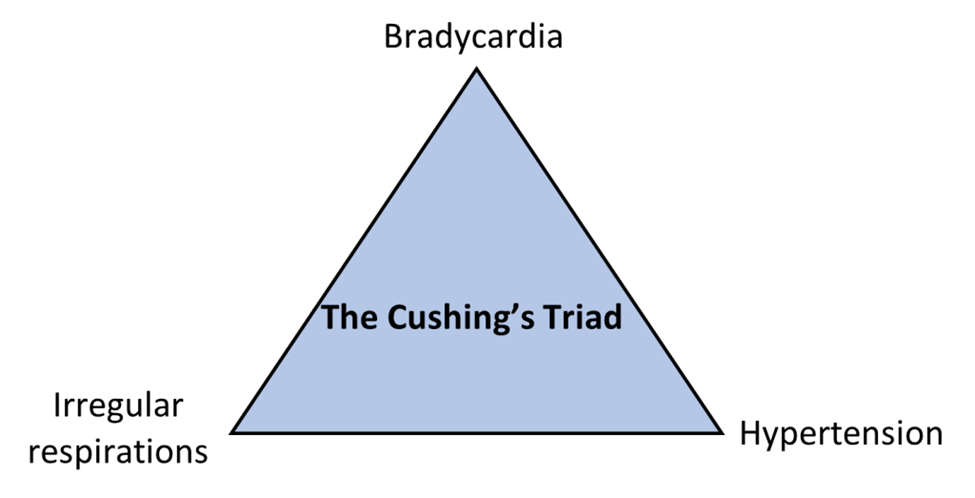
Which three symptoms are characteristic of Cushing triad associated with increased ICP?
A. Bradycardia, hypertension, and widening pulse pressure
Bradycardia, hypertension, and widening pulse pressureThis combination of symptoms is characteristic of Cushing's triad. Bradycardia (slow heart rate), hypertension (elevated blood pressure), and widening pulse pressure (difference between systolic and diastolic blood pressure) are indicative of increased ICP, specifically resulting in the compression of brain structures that regulate vital functions.
B. Widening pulse pressure, headache, and seizure
Widening pulse pressure, headache, and seizureWhile headache and seizure may occur in patients with increased ICP, widening pulse pressure alone is not sufficient to meet the criteria of Cushing's triad. The presence of bradycardia and hypertension, along with widening pulse pressure, is more indicative of Cushing's triad.
C. Hypertension, tachycardia, and headache
Hypertension, tachycardia, and headache Hypertension and headache may occur in patients with increased ICP, but the absence of bradycardia and widening pulse pressure makes this option less characteristic of Cushing's triad.
D. Hypotension, tachycardia, and narrowing pulse pressure
Hypotension, tachycardia, and narrowing pulse pressureHypotension (low blood pressure) and narrowing pulse pressure are not typically associated with Cushing's triad. Tachycardia (rapid heart rate) may occur in response to increased ICP, but it is usually accompanied by bradycardia rather than hypotension.
Full Explanation
A. Bradycardia, hypertension, and widening pulse pressure
This combination of symptoms is characteristic of Cushing's triad. Bradycardia (slow heart rate), hypertension (elevated blood pressure), and widening pulse pressure (difference between systolic and diastolic blood pressure) are indicative of increased ICP, specifically resulting in the compression of brain structures that regulate vital functions.
B. Widening pulse pressure, headache, and seizure
While headache and seizure may occur in patients with increased ICP, widening pulse pressure alone is not sufficient to meet the criteria of Cushing's triad. The presence of bradycardia and hypertension, along with widening pulse pressure, is more indicative of Cushing's triad.
C. Hypertension, tachycardia, and headache
Hypertension and headache may occur in patients with increased ICP, but the absence of bradycardia and widening pulse pressure makes this option less characteristic of Cushing's triad.
D. Hypotension, tachycardia, and narrowing pulse pressure
Hypotension (low blood pressure) and narrowing pulse pressure are not typically associated with Cushing's triad. Tachycardia (rapid heart rate) may occur in response to increased ICP, but it is usually accompanied by bradycardia rather than hypotension.