
Nursing practice questions with comprehensive rationales
NurseDive Free Nursing Practice Question
The nurse is cognizant of which information related to the administration of vitamin K?
A. Vitamin K is not initially synthesized because of a sterile bowel at birth
Vitamin K is a fat-soluble vitamin that is essential for blood clotting. Newborns have low levels of vitamin K because they do not have the intestinal bacteria that produce it. Therefore, they are given an injection of vitamin K shortly after birth to prevent bleeding disorders.
B. Vitamin K is responsible for the breakdown of bilirubin and the prevention of jaundice.
Vitamin K is not crucial for the breakdown of bilirubin.
C. Vitamin K is important in the production of white blood cells
Vitamin K primarily plays a role in blood clotting, not the production of white blood cells.
D. Vitamin K is important in the production of red blood cells
Vitamin K is not directly involved in the production of red blood cells.
This question is an excerpt from Nurse Dive's nursing test bank - Ati Maternal Newborn Proctored Exam 3 Reno 2 2020. Take the full exam now
Full Explanation
A. Vitamin K is a fat-soluble vitamin that is essential for blood clotting. Newborns have low levels of vitamin K because they do not have the intestinal bacteria that produce it. Therefore, they are given an injection of vitamin K shortly after birth to prevent bleeding disorders.
B. Vitamin K is not crucial for the breakdown of bilirubin.
C. Vitamin K primarily plays a role in blood clotting, not the production of white blood cells.
D. Vitamin K is not directly involved in the production of red blood cells.
Similar Questions
Nurses play a critical role in educating parents regarding measures to prevent infant abduction. Which instructions contribute to infant safety and security?
A. The baby should be carried in the parent’s arms from the room to the nursery
Carrying the baby in the parent's arms enhances security but does not directly address the prevention of abduction.
B. The mom should request that a second staff member verify the identity of any questionable person
Verifying the identity of any questionable person by a second staff member is a key measure to prevent infant abduction.
C. Because of infant security systems, the baby can be left unattended in the client’s room
Leaving the baby unattended in the client's room is not a safe practice and does not contribute to preventing abduction.
D. Parents should be told it is safe to posting photographs of their infant on the Internet
Posting photographs of the infant on the Internet can compromise the child's security and is not recommended.
Full Explanation
A. Carrying the baby in the parent's arms enhances security but does not directly address the prevention of abduction.
B. Verifying the identity of any questionable person by a second staff member is a key measure to prevent infant abduction.
C. Leaving the baby unattended in the client's room is not a safe practice and does not contribute to preventing abduction.
D. Posting photographs of the infant on the Internet can compromise the child's security and is not recommended.
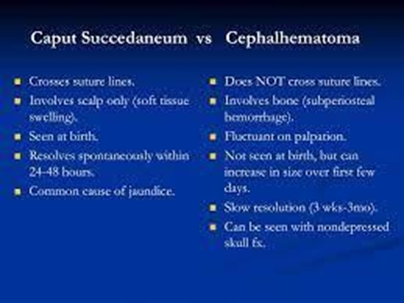
A nurse is caring for a newborn delivered by vaginal birth with a vacuum assist. The newborn’s mother asks about the swollen area on her son’s head. After palpation to identify that the swelling crosses the suture line, which of the following is an appropriate response by the nurse?
A. “This is a cephalhematoma, which can occur spontaneously.”
A cephalhematoma is a collection of blood under the periosteum that does not cross the suture lines and can take weeks to resolve.
B. “Caput succedaneum occurs due to compression of blood vessels.”
Caput succedaneum occurs due to compression of blood vessels during delivery, resulting in edema and bruising of the scalp. It crosses the suture lines and usually resolves within a few days and does not cause any complications.
C. “This is erythema toxicum, which is a transient condition.”
Erythema toxicum is a rash that is unrelated to head swelling.
D. “Mongolian spots can be found on the skin of many newborns.”
Mongolian spots are blue-gray patches on the skin, not associated with head swelling.
Full Explanation
A. A cephalhematoma is a collection of blood under the periosteum that does not cross the suture lines and can take weeks to resolve.
B. Caput succedaneum occurs due to compression of blood vessels during delivery, resulting in edema and bruising of the scalp. It crosses the suture lines and usually resolves within a few days and does not cause any complications.
C. Erythema toxicum is a rash that is unrelated to head swelling.
D. Mongolian spots are blue-gray patches on the skin, not associated with head swelling.
A new mother states that her infant must be cold because the baby’s hands and feet are blue. This common and temporary condition is called what?
A. Vernix caseosa
Vernix caseosa is a white, cheese-like substance covering the baby's skin.
B. Erythema toxicum neonatorum
Erythema toxicum neonatorum is a benign rash that appears in the early days of life.
C. Harlequin sign
Harlequin sign is a transient color change in a newborn, not related to blue hands and feet.
D. Acrocyanosis
Acrocyanosis is a common and temporary condition where the hands and feet may appear blue due to poor peripheral circulation. It is not typically a sign of coldness.
Full Explanation
A. Vernix caseosa is a white, cheese-like substance covering the baby's skin.
B. Erythema toxicum neonatorum is a benign rash that appears in the early days of life.
C. Harlequin sign is a transient color change in a newborn, not related to blue hands and feet.
D. Acrocyanosis is a common and temporary condition where the hands and feet may appear blue due to poor peripheral circulation. It is not typically a sign of coldness.