
Nursing practice questions with comprehensive rationales
NurseDive Free Nursing Practice Question
Twenty-four correctly written as a Roman numeral is
A. XXIIII.
XXIIII: While this form was used in ancient times, it is now considered incorrect by modern Roman numeral standards. Roman numerals should follow subtractive notation, where 4 is written as IV, not IIII.
B. XXIV.
XXIV: This is the correct modern Roman numeral for 24. It combines 20 (XX) and 4 (IV) using the proper subtractive rule for the numeral 4.
C. Xxiiii
Xxiiii: Roman numerals must be written in uppercase to be considered correct. This option also uses an outdated form (IIII for 4) and mixes cases.
D. xixv
xixv: This is not a valid Roman numeral. It incorrectly places symbols and uses lowercase letters, violating both formatting and value rules.
This question is an excerpt from Nurse Dive's nursing test bank - Dosage calculation proctored exam (hellen fluid college). Take the full exam now
Full Explanation
A. XXIIII: While this form was used in ancient times, it is now considered incorrect by modern Roman numeral standards. Roman numerals should follow subtractive notation, where 4 is written as IV, not IIII.
B. XXIV: This is the correct modern Roman numeral for 24. It combines 20 (XX) and 4 (IV) using the proper subtractive rule for the numeral 4.
C. Xxiiii: Roman numerals must be written in uppercase to be considered correct. This option also uses an outdated form (IIII for 4) and mixes cases.
D. xixv: This is not a valid Roman numeral. It incorrectly places symbols and uses lowercase letters, violating both formatting and value rules.
Similar Questions
Mr. Anderson received a total of 45.25 g of a medication over 5 days. He received 4 doses per day. How much medication per dose did he receive? (round to nearest hundredth)
A. 2.30 g
B. 9.20g
C. 9.15 g
D. 2.26 g
Calculation: Calculate the total number of doses the patient received. Total doses = 4 doses/day × 5 days = 20 doses. Total amount of medication received = 45.25 g. Calculate the amount of medication per dose. Amount per dose = Total amount (g) / Total number of doses = 45.25 g / 20 doses = 2.2625 g. Round the answer to the nearest hundredth. = 2.26 g.
Full Explanation
Calculation:
- Calculate the total number of doses the patient received.
Total doses = 4 doses/day × 5 days
= 20 doses.
Total amount of medication received = 45.25 g.
- Calculate the amount of medication per dose.
Amount per dose = Total amount (g) / Total number of doses
= 45.25 g / 20 doses
= 2.2625 g.
- Round the answer to the nearest hundredth.
= 2.26 g.
Of the doses on hand, you would choose___________ to administer the ordered dose
Ordered: Coumadin 7.5 mg PO daily
A. Coumadin 10 mg scored tablets
Coumadin 10 mg scored tablets: A 10 mg tablet exceeds the ordered dose of 7.5 mg. Although it's scored, splitting it in a way that gives exactly 7.5 mg would be imprecise and not ideal for accurate dosing.
B. Coumadin 1 mg scored tables
Coumadin 1 mg scored tablets: While these allow precise dosing, it would require administering multiple tablets (e.g., seven 1 mg tablets and one half), which increases pill burden and potential for error.
C. Coumadin injection 5 mg/via
Coumadin injection 5 mg/vial: The prescribed route is oral (PO), not parenteral. Using an injection would not comply with the prescribed route of administration.
D. Coumadin 5 mg scored tablets
Coumadin 5 mg scored tablets: The 5 mg scored tablet can be used to administer one whole 5 mg tablet and one-half tablet (2.5 mg), totaling 7.5 mg. This provides an accurate and convenient way to deliver the dose.
Full Explanation
A. Coumadin 10 mg scored tablets: A 10 mg tablet exceeds the ordered dose of 7.5 mg. Although it's scored, splitting it in a way that gives exactly 7.5 mg would be imprecise and not ideal for accurate dosing.
B. Coumadin 1 mg scored tablets: While these allow precise dosing, it would require administering multiple tablets (e.g., seven 1 mg tablets and one half), which increases pill burden and potential for error.
C. Coumadin injection 5 mg/vial: The prescribed route is oral (PO), not parenteral. Using an injection would not comply with the prescribed route of administration.
D. Coumadin 5 mg scored tablets: The 5 mg scored tablet can be used to administer one whole 5 mg tablet and one-half tablet (2.5 mg), totaling 7.5 mg. This provides an accurate and convenient way to deliver the dose.
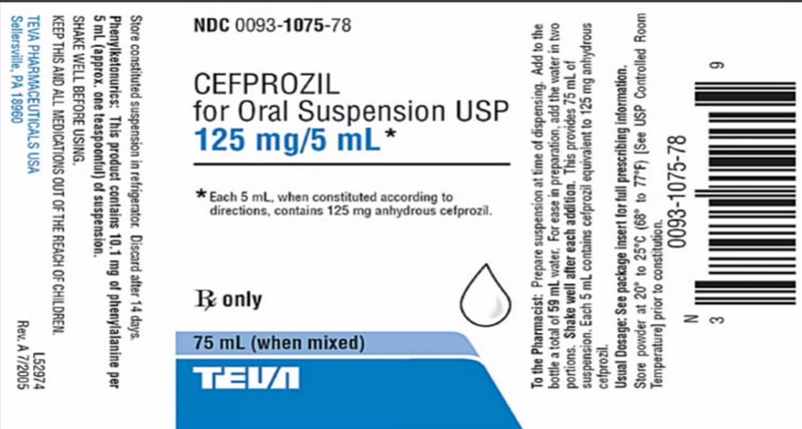
The physician ordered Cefprozil 87.5 mg po q12h for 10 days. What is the amount to administer?
Full Explanation
Ordered dose = 87.5 mg.
- Determine the concentration of the available medication from the label.
The label states that the concentration is 125 mg/5 mL.
Concentration = 125 mg / 5 mL
= 25 mg/mL.
- Calculate the volume to administer per dose using the formula:
Volume (mL) = Desired dose (mg) / Concentration (mg/mL)
= 87.5 mg / 25 mg/mL
= 3.5 mL.