
Nursing practice questions with comprehensive rationales
NurseDive Free Nursing Practice Question
What is a nurse's best protection against negligence or malpractice?
A. Asking permission from the managing nurse prior to performing any duties.
B. Following the standards of practice.
A nurse's best protection against negligence or malpractice is to follow the standards of practice. These standards define the acceptable level of care that a nurse is expected to provide and are based on current evidence and professional consensus. By adhering to these standards, a nurse can demonstrate that they have provided care that meets the expected level of quality and safety.
C. Never be alone with a patient.
D. Recording patient interactions with your phone.
This question is an excerpt from Nurse Dive's nursing test bank - ATI PN Medical Surgical Leadership Proctored Exam. Take the full exam now
Full Explanation
A nurse's best protection against negligence or malpractice is to follow the standards of practice. These standards define the acceptable level of care that a nurse is expected to provide and are based on current evidence and professional consensus. By adhering to these standards, a nurse can demonstrate that they have provided care that meets the expected level of quality and safety.
The other options are not the best protection against negligence or malpractice. Asking permission from the managing nurse prior to performing any duties [a] may be helpful in some situations, but it is not a guarantee against negligence or malpractice. Never being alone with a patient [c] is not practical or necessary for providing safe and effective care. Recording patient interactions with your phone [d] may violate patient privacy and is not an effective way to prevent negligence or malpractice.
Similar Questions
A nurse is delegating tasks to an assistive personnel (AP). Which of the following tasks should the nurse assign to the AP?
A. Assisting the client in selecting a low-residue diet.
B. Performing a complex dressing change.
C. Reviewing the steps of self-blood glucose monitoring with a client.
D. Obtaining vital signs on clients who are stable.
Assistive personnel (AP), also known as unlicensed assistive personnel (UAP), can perform tasks such as recording vital signs ¹. Obtaining vital signs on clients who are stable [d] is a task that can be delegated to an AP.
Full Explanation
Assistive personnel (AP), also known as unlicensed assistive personnel (UAP), can perform tasks such as recording vital signs ¹. Obtaining vital signs on clients who are stable [d] is a task that can be delegated to an AP.
The other options are not tasks that should be delegated to an AP. Assisting the client to select a low-residue diet [a] and reviewing the steps of self-blood glucose monitoring with a client [c] involves patient education and dietary planning, which are typically the responsibility of a licensed nurse. Performing a complex dressing change [b] is a complex task that requires specialized knowledge and skills.
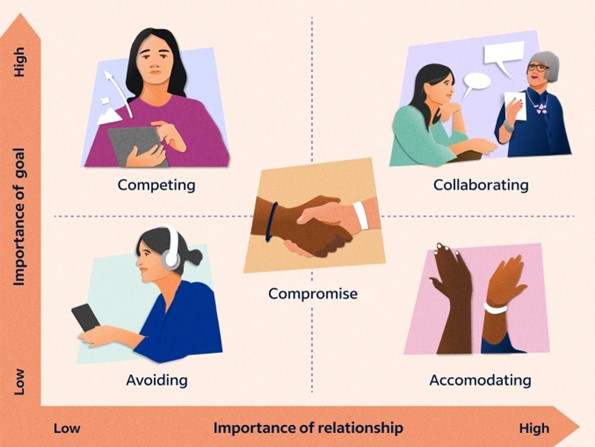
A nurse observes two assistive personnel (AP) arguing over who should go on break first. The nurse interrupts the conversation and states that one AP can take a break now, but the other AP will get to take an early lunch. Which of the following types of conflict management is the nurse demonstrating?
A. Cooperating
involves one party giving in to the demands of the other party in order to maintain harmony.
B. Compromising
In this situation, the nurse is demonstrating the compromising style of conflict management. Compromising involves finding a middle ground where both parties give up something in order to reach a mutually acceptable solution. In this case, the nurse suggests that one AP can take a break now, but the other AP will get to take an early lunch. This solution allows both APs to have some of their needs met while also making concessions.
C. Competing
involves one party trying to win at the expense of the other party.
D. Avoiding
involves avoiding or withdrawing from the conflict altogether.
Full Explanation
In this situation, the nurse is demonstrating the compromising style of conflict management. Compromising involves finding a middle ground where both parties give up something in order to reach a mutually acceptable solution. In this case, the nurse suggests that one AP can take a break now, but the other AP will get to take an early lunch. This solution allows both APs to have some of their needs met while also making concessions.
The other options are not the type of conflict management demonstrated by the nurse in this situation. Cooperating [a] involves one party giving in to the demands of the other party in order to maintain harmony. Competing [c] involves one party trying to win at the expense of the other party. Avoiding [d] involves avoiding or withdrawing from the conflict altogether.
A nurse requests that an assistive personnel (AP) change all the linens and give bed baths to four clients on the unit. The previous day, the AP was not able to complete these same tasks. Which of the following actions should the nurse take in addressing this situation?
A. Offer to help the AP complete the tasks.
Offering to help the AP complete the tasks may seem like a good solution in the short term. However, this approach does not address the underlying issue, which is that the AP was not able to complete these tasks the previous day. The nurse’s role is to delegate tasks appropriately and ensure that all tasks are completed in a timely manner. If the nurse takes over the AP’s tasks, it could lead to an imbalance in the workload and could potentially overburden the nurse. Therefore, while this choice may seem helpful, it is not the most effective solution to the problem.
B. Assign a more qualified staff member to the tasks.
Assigning a more qualified staff member to the tasks could be a potential solution if the AP’s inability to complete the tasks was due to a lack of skills or knowledge. However, without more information, it’s not clear that this is the case. Furthermore, this approach could lead to resentment among staff if it appears that tasks are not being distributed fairly. Therefore, while this choice could be a potential solution, it is not the most effective solution given the information provided.
C. Plan a more reasonable job assignment.
Planning a more reasonable job assignment is the most effective solution to this problem. If the AP was not able to complete the tasks the previous day, it suggests that the workload was too heavy or the tasks were too complex. By reassessing the job assignment and making it more manageable, the nurse can ensure that all tasks are completed in a timely manner. This approach respects the abilities and limitations of the AP, promotes a fair distribution of tasks, and ensures the best care for the clients.
D. Set a time frame for the AP to complete the tasks.
Setting a time frame for the AP to complete the tasks could be a potential solution if the issue was that the tasks were not completed in a timely manner. However, if the AP was not able to complete the tasks at all, simply setting a time frame may not resolve the issue. This approach could also add unnecessary pressure on the AP, which could lead to rushed or substandard work. Therefore, while this choice could be a potential solution, it is not the most effective solution given the information provided.
Full Explanation
The correct answer is Choice C.
Choice A rationale: Offering to help the AP complete the tasks may seem like a good solution in the short term. However, this approach does not address the underlying issue, which is that the AP was not able to complete these tasks the previous day. The nurse’s role is to delegate tasks appropriately and ensure that all tasks are completed in a timely manner. If the nurse takes over the AP’s tasks, it could lead to an imbalance in the workload and could potentially overburden the nurse. Therefore, while this choice may seem helpful, it is not the most effective solution to the problem.
Choice B rationale: Assigning a more qualified staff member to the tasks could be a potential solution if the AP’s inability to complete the tasks was due to a lack of skills or knowledge. However, without more information, it’s not clear that this is the case. Furthermore, this approach could lead to resentment among staff if it appears that tasks are not being distributed fairly. Therefore, while this choice could be a potential solution, it is not the most effective solution given the information provided.
Choice C rationale: Planning a more reasonable job assignment is the most effective solution to this problem. If the AP was not able to complete the tasks the previous day, it suggests that the workload was too heavy or the tasks were too complex. By reassessing the job assignment and making it more manageable, the nurse can ensure that all tasks are completed in a timely manner. This approach respects the abilities and limitations of the AP, promotes a fair distribution of tasks, and ensures the best care for the clients.
Choice D rationale: Setting a time frame for the AP to complete the tasks could be a potential solution if the issue was that the tasks were not completed in a timely manner. However, if the AP was not able to complete the tasks at all, simply setting a time frame may not resolve the issue. This approach could also add unnecessary pressure on the AP, which could lead to rushed or substandard work. Therefore, while this choice could be a potential solution, it is not the most effective solution given the information provided.