
Nursing practice questions with comprehensive rationales
NurseDive Free Nursing Practice Question
Which intervention should be included in the plan of care for an infant with the nursing diagnosis of Excess Fluid Volume related to congestive heart failure?
A. Weigh the infant every day on the same scale at the same time.
This is wrong because weighing the infant every day on the same scale at the same time is a way to monitor fluid balance, not an intervention to treat excess fluid volume.
B. Notify the physician when weight gain exceeds more than 20 g/day.
This is wrong because notifying the physician when weight gain exceeds more than 20 g/day is also a monitoring measure, not an intervention. Moreover, weight gain may not accurately reflect fluid volume status in some patients with heart failure due to poor nutrition and decreased appetite.
C. Put the infant in a car seat to minimize movement.
This is wrong because putting the infant in a car seat to minimize movement may worsen respiratory distress and increase the workload of the heart. The infant should be positioned in a semi-Fowler’s or Fowler’s position to facilitate breathing and reduce venous return.
D. Administer digoxin as ordered by the physician.
Digoxin is a medication that helps improve the pumping function of the heart and reduces fluid retention in the lungs and other tissues. It is commonly used to treat congestive heart failure in infants.
This question is an excerpt from Nurse Dive's nursing test bank - OB Pediatric Cumulative Exam Test 4 V 1 2023 Proctored Exam. Take the full exam now
Full Explanation
Digoxin is a medication that helps improve the pumping function of the heart and reduces fluid retention in the lungs and other tissues. It is commonly used to treat congestive heart failure in infants.
Choice A is wrong because weighing the infant every day on the same scale at the same time is a way to monitor fluid balance, not an intervention to treat excess fluid volume.
Choice B is wrong because notifying the physician when weight gain exceeds more than 20 g/day is also a monitoring measure, not an intervention. Moreover, weight gain may not accurately reflect fluid volume status in some patients with heart failure due to poor nutrition and decreased appetite.
Choice C is wrong because putting the infant in a car seat to minimize movement may worsen the respiratory distress and increase the workload of the heart. The infant should be positioned in a semi-Fowler’s or Fowler’s position to facilitate breathing and reduce venous return.
Similar Questions
The nurse is caring for an infant with suspected pyloric stenosis. Which clinical manifestation would indicate pyloric stenosis?
A. Abdominal rigidity and pain on palpation
This is wrong because abdominal rigidity and pain on palpation are not typical signs of pyloric stenosis. They may indicate other conditions such as appendicitis or bowel obstruction.
B. Rounded abdomen and hypoactive bowel sounds
This is wrong because a rounded abdomen and hypoactive bowel sounds are also not specific for pyloric stenosis. They may be seen in other causes of vomiting or abdominal distension.
C. Visible peristalsis and weight loss
These are symptoms of pyloric stenosis, which is a thickening or narrowing of the pylorus, a muscle in the stomach that blocks food from entering the small intestine. Babies with pyloric stenosis often have forceful vomiting, which may cause dehydration.
D. Distention of lower abdomen and constipation
This is wrong because distention of the lower abdomen and constipation are not related to pyloric stenosis. They may be due to other problems such as Hirschsprung’s disease or intestinal atresia. Normal ranges for weight gain in infants depend on their age, sex, and feeding method. Generally, infants should gain about 25 to 35 grams per day in the first 3 months of life.
Full Explanation
Visible peristalsis and weight loss. These are symptoms of pyloric stenosis, which is a thickening or narrowing of the pylorus, a muscle in the stomach that blocks food from entering the small intestine. Babies with pyloric stenosis often have forceful vomiting, which may cause dehydration.
Choice A is wrong because abdominal rigidity and pain on palpation are not typical signs of pyloric stenosis.
They may indicate other conditions such as appendicitis or bowel obstruction.
Choice B is wrong because a rounded abdomen and hypoactive bowel sounds are also not specific for pyloric stenosis.
They may be seen in other causes of vomiting or abdominal distension.
Choice D is wrong because distention of the lower abdomen and constipation are not related to pyloric stenosis.
They may be due to other problems such as Hirschsprung’s disease or intestinal atresia. Normal ranges for weight gain in infants depend on their age, sex, and feeding method. Generally, infants should gain about 25 to 35 grams per day in the first 3 months of life.
The diagnosis of pregnancy is based on which positive signs of pregnancy? (Select all that apply.).
A. Identification of fetal heartbeat.
B. Palpation of fetal outline.
C. Visualization of the fetus.
D. Verification of fetal movement.
E. Positive hCG test.
Choice E is wrong because a positive hCG test is a probable sign of pregnancy, not a positive one. A probable sign of pregnancy is strongly suggestive of pregnancy but could have other causes. A positive hCG test could be caused by medications, tumors, or other conditions that affect the level of hCG in the blood or urine.
Full Explanation
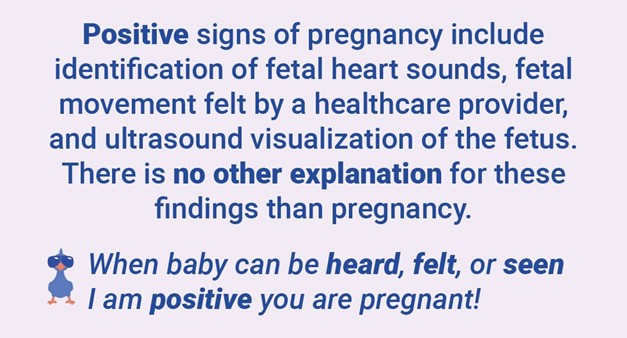
These are all positive signs of pregnancy, which are definitive and can only be explained by the presence of a fetus. A positive sign of pregnancy is fetal movement palpated by the nurse-midwife.
Choice E is wrong because a positive hCG test is a probable sign of pregnancy, not a positive one. A probable sign of pregnancy is strongly suggestive of pregnancy but could have other causes. A positive hCG test could be caused by medications, tumors, or other conditions that affect the level of hCG in the blood or urine.
Some other probable signs of pregnancy are uterine enlargement, Hegar’s sign (softening of the lower uterine segment), Goodell’s sign (softening of the cervix), Chadwick’s sign (bluish discoloration of the cervix), ballottement (rebound of the fetus when tapped by the examiner’s finger), Braxton Hicks contractions (painless, irregular uterine contractions), and positive pregnancy test.
Some other positive signs of pregnancy are identification of fetal heartbeat, visualization of the fetus by ultrasound or x-ray, and verification of fetal movement by an experienced clinician.
Medications used to manage postpartum hemorrhage (PPH) include (Select all that apply.):.
A. Pitocin.
Pitocin is a medicationused to manage postpartum hemorrhage (PPH) by causing the uterus to contract and reduce bleeding. Pitocin is the most effective and preferred medication for PPH prevention and treatment.
B. Methergine.
Methergine is a medication used to manage postpartum hemorrhage (PPH) by causing the uterus to contract and reduce bleeding. Pitocin is the most effective and preferred medication for PPH prevention and treatment.
C. Terbutaline.
Choice C is wrong because Terbutaline is a medication that relaxes the uterus and is used to stop preterm labor, not PPH.
D. Hemabate.
Choice D is wrong because Hemabate is a brand name for carboprost, which is a prostaglandin that can be used for PPH, but it has more side effects and contraindications than Pitocin or Methergine.
E. Magnesium sulfate.
Choice E is wrong because Magnesium sulfate is a medication that prevents seizures in women with preeclampsia or eclampsia, not PPH.
Full Explanation
Pitocin and Methergine are both medications used to manage postpartum hemorrhage (PPH) by causing the uterus to contract and reduce bleeding. Pitocin is the most effective and preferred medication for PPH prevention and treatment.
Choice C is wrong because Terbutaline is a medication that relaxes the uterus and is used to stop preterm labor, not PPH.
Choice D is wrong because Hemabate is a brand name for carboprost, which is a prostaglandin that can be used for PPH, but it has more side effects and contraindications than Pitocin or Methergine.
Choice E is wrong because Magnesium sulfate is a medication that prevents seizures in women with preeclampsia or eclampsia, not PPH.