
Nursing practice questions with comprehensive rationales
NurseDive Free Nursing Practice Question
Which of the following clients is most at risk for traumatic brain injury?
A. A 18 month old child learning how to walk who has a history of febrile seizure.
A 18 month old child learning how to walk who has a history of febrile seizure: This isincorrect because febrile seizures are usually benign and do not increase the risk of traumatic brain injury, unless they cause prolonged loss of consciousness or convulsions.
B. A 35year old female who works at a steel mill and who has absence seizures.
A 35year old female who works at a steel mill and who has absence seizures: This is incorrect because absence seizures are brief and do not impair awareness or motor function, so they do not increase the risk of traumatic brain injury, unless they occur frequently or unpredictably.
C. A 18year old highschool graduate who is enrolling in the Army.
A 18year old highschool graduate who is enrolling in the Army: This is correct becausemilitary personnel are at high risk of traumatic brain injury due to exposure to blasts, projectiles, falls, and assaults.
D. A75 year old female client with osteoporosis and who is on clopidogrel (Plavix) for atrial fibrillation.
A75 year old female client with osteoporosis and who is on clopidogrel (Plavix) for atrial fibrillation: This is incorrect because although this client has several risk factors for bleeding and falls, she is not more likely to sustain a traumatic brain injury than the other choices, unless she has a history of previous head trauma or anticoagulant overdose.
This question is an excerpt from Nurse Dive's nursing test bank - Ati med surg adult care 2 proctored exam. Take the full exam now
Similar Questions
A nurse is performing a neurological assessment for a client with head trauma. Which of the following assessments will give the nurse information about the function of cranial nerve II?
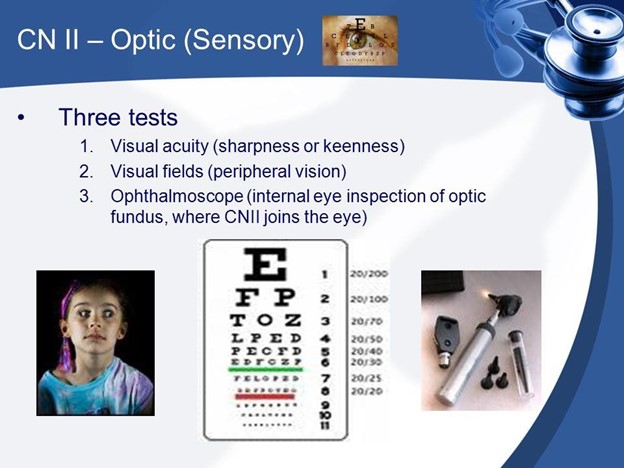
A. Instruct the client to look up and down without moving his head.
This is the correct answer because cranial nerve II is the optic nerve, which is responsible for vision. Testing the client's ability to look up and down without moving his head assesses the function of this nerve.
B. Ask the client to shrug his shoulders against passive resistance.
This is incorrect because cranial nerve XI is the accessory nerve, which innervates thetrapezius and sternocleidomastoid muscles. Asking the client to shrug his shoulders against passive resistance tests this nerve.
C. Observe the client's ability to smile and frown.
This is incorrect because cranial nerve VII is the facial nerve, which controls facial expressions. Observing the client's ability to smile and frown tests this nerve.
D. Have the client stand with eyes his closed and touch his nose.
This is incorrect because cranial nerve VIII is the vestibulocochlear nerve, which is involved in balance and hearing. Having the client stand with eyes his closed and touch his nose tests this nerve.
The nurse caring for a client with a brain tumor will monitor for which of the following early signs of increased intracranial pressure?
A. fixed dilated pupil
This is the correct answer because a fixed dilated pupil indicates compression of cranial nerve III, which is an early sign of increased intracranial pressure.
B. lethargy after administration of pain medication
This is incorrect because lethargy after administration of pain medication may be due to the sedative effect of the medication and not necessarily increased intracranial pressure.
C. lack of emotional response
This is incorrect because lack of emotional response may be related to other factors such as depression, anxiety, or personality changes and not necessarily increased intracranial pressure.
D. CheyneStokes breathing pattern
This is incorrect because CheyneStokes breathing pattern is a late sign of increased intracranial pressure, indicating brainstem dysfunction.
A nurse in the emergency department is caring for a client following an automobile crash in which the client was unrestrained and thrown from the vehicle. When assessing the client, the nurse observes clear fluid draining from the client's nose. Which of the following interventions should the nurse take?
A. Allow the drainage to drip onto a sterile gauze pad.
This is correct because clear fluid draining from the nose could indicate a cerebrospinal fluid (CSF) leak, which is a serious complication of head trauma. Allowing the drainage to drip onto a sterile gauze pad can help confirm the presence of CSF by observing a halo sign (a yellow ring around a blood spot). It also prevents contamination and infection of the CSF.
B. Obtain a culture of the specimen using sterile swabs
This is incorrect because obtaining a culture of the specimen is not a priority intervention for a client with suspected CSF leak. It could also introduce bacteria into the CSF and causemeningitis.
C. Suction the nose gently with a bulb syringe.
This is incorrect because suctioning the nose could increase intracranial pressure and worsen the CSF leak. It could also damage the nasal mucosa and cause bleeding.
D. Insert sterile packing into the nares.
This is incorrect because inserting sterile packing into the nares could obstruct the drainage of CSF and increase intracranial pressure. It could also cause pressure necrosis of the nasal tissue.