
Nursing practice questions with comprehensive rationales
NurseDive Free Nursing Practice Question
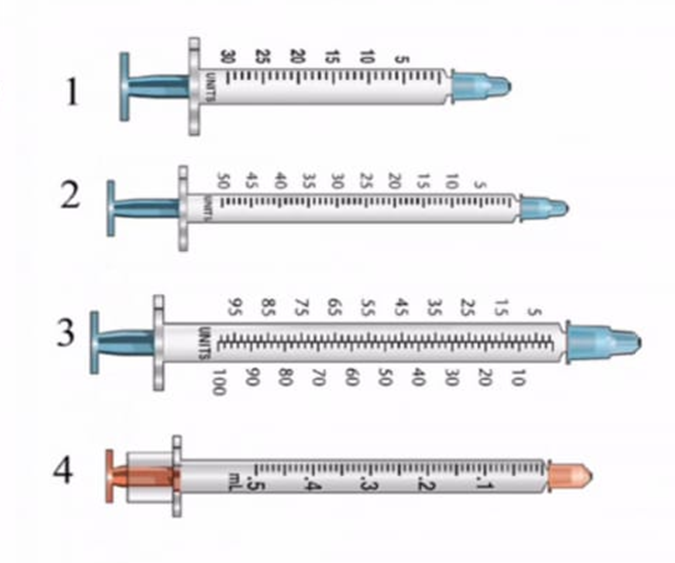
Which of the syringes would be the best choice to administer 10 units of insulin?
This question is an excerpt from Nurse Dive's nursing test bank - Dosage calculation proctored exam (hellen fluid college). Take the full exam now
Full Explanation
A. Syringe 1: This syringe is the best choice because it has a 30-unit capacity and is calibrated in fine, single-unit increments. The 10-unit dose occupies a substantial portion of the syringe's total volume, making the markings clear and easy to read. This ensures the most accurate and precise measurement of the small 10-unit dose, thereby minimizing the risk of a medication error.
B. Syringe 2: This syringe is a U-100 insulin syringe with a 50-unit capacity, which is an acceptable device for insulin administration. However, for a small dose of 10 units, a syringe with a smaller total capacity is preferred.
C. Syringe 3: This syringe is an inappropriate choice for a dose of only 10 units because its capacity is far greater than the required dose. The markings are spaced widely apart, which makes it difficult to accurately and safely measure a small amount of insulin, increasing the risk of a dosing error.
D. Syringe 4: This syringe is not an insulin syringe. It is a tuberculin syringe, which is calibrated in milliliters (mL), not units. Insulin must be measured in units to ensure a safe and accurate dose.
Similar Questions
Which one of the following devices relies on gravity to infuse the solution?
A. PCA device
PCA device: A patient-controlled analgesia (PCA) device uses programmed electronic controls to deliver medication, not gravity, to ensure precise dosing and timing.
B. infusion pump
infusion pump: An infusion pump actively controls and delivers fluids at a set rate using mechanical force, independent of gravity.
C. syringe pump
syringe pump: Syringe pumps use motorized pressure to deliver fluids in small volumes over time and do not depend on gravitational flow.
D. rate controller
rate controller: A rate controller works with gravity by regulating the flow of IV fluid from the bag into the patient using a dial or clamp but does not apply mechanical force itself.
Full Explanation
A. PCA device: A patient-controlled analgesia (PCA) device uses programmed electronic controls to deliver medication, not gravity, to ensure precise dosing and timing.
B. infusion pump: An infusion pump actively controls and delivers fluids at a set rate using mechanical force, independent of gravity.
C. syringe pump: Syringe pumps use motorized pressure to deliver fluids in small volumes over time and do not depend on gravitational flow.
D. rate controller: A rate controller works with gravity by regulating the flow of IV fluid from the bag into the patient using a dial or clamp but does not apply mechanical force itself.
The hospital pharmacy receives a medication order for patient Jolene Smith, DOB 4/23/1986, for Keflex 250 mg qid. The medication order is dated today and is signed electronically by Ms. Smith's physician. What additional information is needed before this medication can be administered?
A. AP's name
AP's name: The physician has already signed the order electronically, which fulfills the requirement for authorized prescriber identification. The specific name may be on record in the electronic health system.
B. Number of refills
Number of refills: Refills are typically necessary for outpatient prescriptions, not for inpatient medication orders where the dosing is managed daily by healthcare staff.
C. Patient's social security number
Patient's social security number: A social security number is not required for medication administration. Patient identification can be verified with full name and date of birth.
D. Route of administration
Route of administration: The route (e.g., oral, IV) is essential for proper medication administration. Without this information, the nurse cannot safely give the drug. Keflex can be administered orally or intravenously, so clarification is necessary.
Full Explanation
A. AP's name: The physician has already signed the order electronically, which fulfills the requirement for authorized prescriber identification. The specific name may be on record in the electronic health system.
B. Number of refills: Refills are typically necessary for outpatient prescriptions, not for inpatient medication orders where the dosing is managed daily by healthcare staff.
C. Patient's social security number: A social security number is not required for medication administration. Patient identification can be verified with full name and date of birth.
D. Route of administration: The route (e.g., oral, IV) is essential for proper medication administration. Without this information, the nurse cannot safely give the drug. Keflex can be administered orally or intravenously, so clarification is necessary.
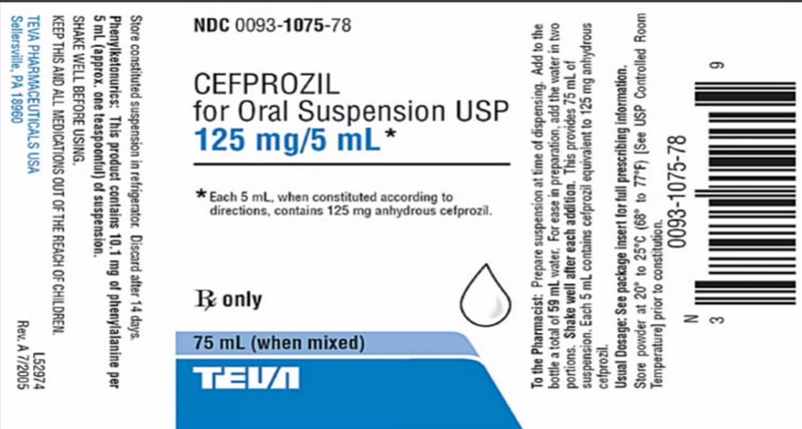
The physician ordered Cefprozil 87.5 mg po q12h for 10 days. What is the amount to administer?
Full Explanation
Ordered dose = 87.5 mg.
- Determine the concentration of the available medication from the label.
The label states that the concentration is 125 mg/5 mL.
Concentration = 125 mg / 5 mL
= 25 mg/mL.
- Calculate the volume to administer per dose using the formula:
Volume (mL) = Desired dose (mg) / Concentration (mg/mL)
= 87.5 mg / 25 mg/mL
= 3.5 mL.