
Nursing practice questions with comprehensive rationales
NurseDive Free Nursing Practice Question
Zinacef 750 mg IV q 8h is ordered. This would be what type of intravenous infusion?
A. KVO
KVO: "Keep vein open" infusions are minimal-rate fluids used to maintain IV line patency, not to deliver active medications like Zinacef. This does not apply to scheduled antibiotic therapy.
B. therapeutic
therapeutic: Zinacef (cefuroxime) is an antibiotic used to treat infections. Since it is being administered on a scheduled basis (750 mg IV q8h), it is used therapeutically to manage a medical condition.
C. replacement
replacement: Replacement fluids are used to restore lost fluids and electrolytes due to vomiting, diarrhea, bleeding, or other losses. They are not used for medication administration.
D. maintenance
maintenance: Maintenance fluids meet basic daily fluid and electrolyte requirements in patients unable to eat or drink. They do not involve scheduled doses of antibiotics or other medications.
This question is an excerpt from Nurse Dive's nursing test bank - Dosage calculation proctored exam (hellen fluid college). Take the full exam now
Full Explanation
A. KVO: "Keep vein open" infusions are minimal-rate fluids used to maintain IV line patency, not to deliver active medications like Zinacef. This does not apply to scheduled antibiotic therapy.
B. therapeutic: Zinacef (cefuroxime) is an antibiotic used to treat infections. Since it is being administered on a scheduled basis (750 mg IV q8h), it is used therapeutically to manage a medical condition.
C. replacement: Replacement fluids are used to restore lost fluids and electrolytes due to vomiting, diarrhea, bleeding, or other losses. They are not used for medication administration.
D. maintenance: Maintenance fluids meet basic daily fluid and electrolyte requirements in patients unable to eat or drink. They do not involve scheduled doses of antibiotics or other medications.
Similar Questions
Which syringe would you select to administer Humulin R U-500 65 units?
Full Explanation
Syringe 1: This U-100 insulin syringe with a 30-unit capacity is inappropriate for this task because the required dose of 65 units exceeds its maximum capacity. This syringe is calibrated for U-100 insulin, and using it for U-500 insulin would lead to a potentially fatal overdose.
Syringe 2: This is a U-100 insulin syringe with a 50-unit capacity. Its capacity is insufficient for the 65-unit dose. Critically, using a U-100 syringe for U-500 insulin would result in a significant medication error and a massive overdose.
Syringe 3: This is a U-100 insulin syringe with a 100-unit capacity. Although the 65-unit dose fits within its capacity, the unit markings are based on U-100 concentration, so drawing to the 65-unit line would actually administer 65 U-100 units, which is a severe overdose of U-500 insulin.
Syringe 4: This is a small-volume syringe calibrated in milliliters, not U-100 units. The proper dose of 65 units of U-500 insulin is calculated as 65 units / 500 units per mL = 0.13 mL. This syringe can accurately and safely measure this specific volume, making it the appropriate choice to prevent a dosing error.
Calculate the amount to administer_________.
Ordered: Filgrastim 120 mcg subcut daily
See label for available medication
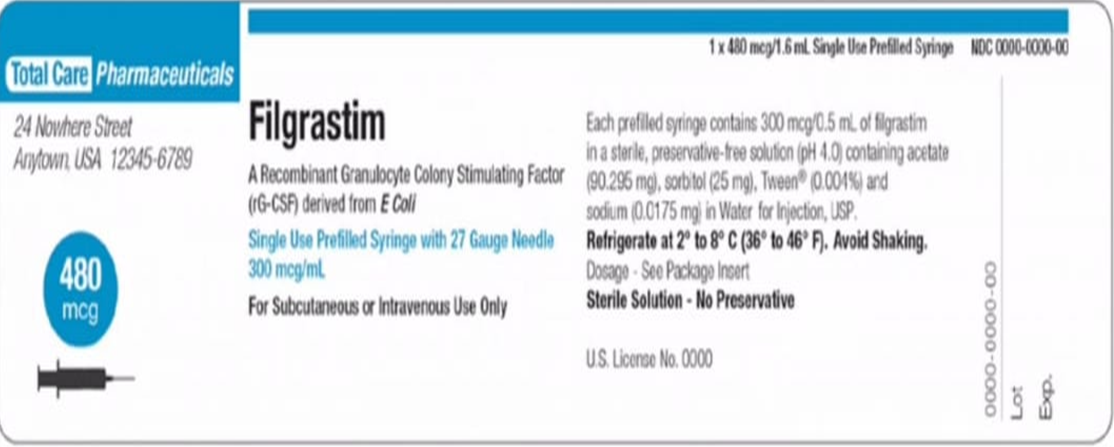
Full Explanation
Calculation:
Ordered dose: 120 mcg
- Identify the medication concentration:
The label states the concentration is 300 mcg/mL.
- Calculate the volume to administer.
Volume (mL) = Desired Dose / Available Concentration
= 120 mcg / 300 mcg/mL
= 0.4 mL
Ordered: Amoxicillin 250 mg tid for 7 days
On hand: See label
Note: Partial bottles are not dispensed.
How much amoxicillin should be dispensed?
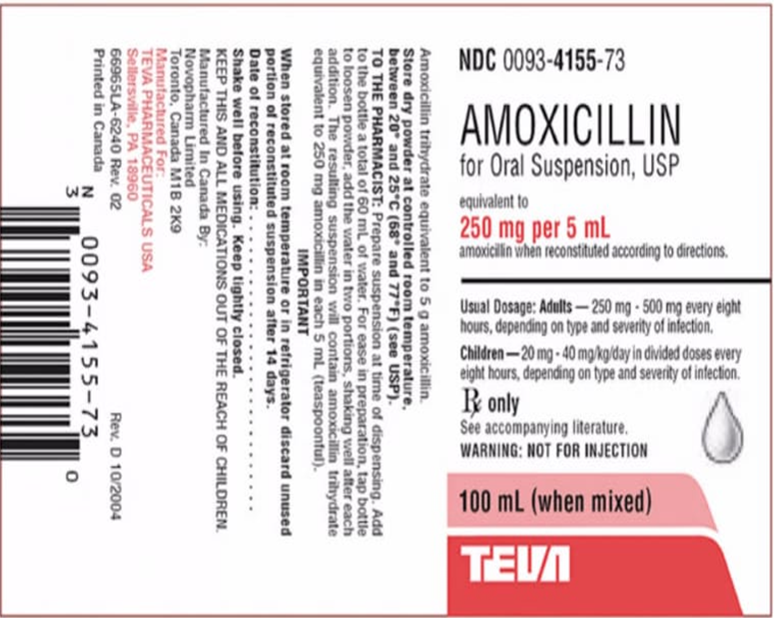
Full Explanation
Rationale:
- Calculate the total milligrams of amoxicillin needed for the entire prescription.
Given:
Ordered dose is 250 mg.
Frequency is three times a day (tid).
Duration is 7 days.
Total milligrams needed = 250 mg/dose × 3 doses/day × 7 days
= 5250 mg.
- Determine the concentration of the medication from the label.
The label states the concentration is 250 mg per 5 mL.
Concentration = 250 mg / 5 mL
= 50 mg/mL.
- Calculate the total volume in milliliters (mL) required for the prescription.
Total volume needed = Total milligrams needed / Concentration
= 5250 mg / 50 mg/mL
= 105 mL.
- Determine the amount to dispense based on the bottle size and dispensing instructions.
The label indicates that each reconstituted bottle contains 100 mL.
The total volume needed is 105 mL, which is more than what one 100 mL bottle contains.
The note states, "Partial bottles are not dispensed." Therefore, two bottles must be dispensed to provide the client with a full course of medication.
Amount to dispense = 2 bottles × 100 mL/bottle
= 200 mL.