Nursing practice questions with comprehensive rationales
NurseDive Free Nursing Practice Question
A charge nurse is making client care assignments. Which of the following tasks should the nurse delegate to assistive personnel (AP)? (Select all that apply.)
A. Assist a client to ambulate using a gait belt.
This is a correct choice because assisting a client to ambulate using a gait belt is a task that can be delegated to AP, as it does not require clinical judgment or assessment skills.
B. Review a low-sodium diet for a client who has hypertension.
This is an incorrect choice because reviewing a low-sodium diet for a client who has hypertension is a task that requires teaching and evaluation, which are within the scope of practice of the registered nurse (RN) and cannot be delegated to AP.
C. Feed a client who had a stroke 3 months ago.
This is a correct choice because feeding a client who had a stroke 3 months ago is a task that can be delegated to AP, as long as the client does not have dysphagia or other complications that require close monitoring by the RN.
D. Bathe a client who had an amputation 2 days ago.
This is an incorrect choice because bathing a client who had an amputation 2 days ago is a task that requires assessment and intervention by the RN, as the client may have pain, bleeding, infection, or psychological issues related to the amputation.
E. Expllain oral hygiene to a client receiving chemotherapy.
This is an incorrect choice because explaining oral hygiene to a client receiving chemotherapy is a task that requires teaching and evaluation, which are within the scope of practice of the RN and cannot be delegated to AP.
This question is an excerpt from Nurse Dive's nursing test bank - RN Ati fundamental of nursing proctored exam. Take the full exam now
Full Explanation
Rationale A: Assisting a client to ambulate using a gait belt is a task within the scope of practice for assistive personnel. It involves physical support and monitoring, which do not require the advanced training of a registered nurse. This task ensures the client's safety while promoting mobility.
Rationale B: Reviewing a low-sodium diet is not within the scope of practice for assistive personnel as it requires nutritional knowledge and the ability to teach, which are responsibilities of a registered nurse or a dietitian.
Rationale C: Feeding a client who had a stroke 3 months ago can be delegated to assistive personnel. This task does not require the clinical judgment of a nurse and can be performed following a predefined plan of care.
Rationale D: Bathing a client who had an amputation 2 days ago can be delegated to assistive personnel. They are trained to assist with activities of daily living, including bathing, while ensuring the client's safety and comfort.
Rationale E: Explaining oral hygiene to a client receiving chemotherapy involves patient education and understanding of the specific needs related to the client's condition, which are beyond the role of assistive personnel. This task requires the expertise of a nurse or other healthcare professional.
Similar Questions
A nurse is assessing a client's bowel sounds. At which of the following points in the assessment should the nurse auscultate the client's abdomen?
A. After palpating the abdomen
After palpating the abdomen is not the ideal time to auscultate bowel sounds.Palpation may stimulate bowel sounds and potentially give a false impression of their presence or absence.
B. Prior to percussing the abdomen
Prior to percussing the abdomen is the correct sequence. Auscultation of bowel sounds should be done before any other abdominal assessment techniques, including percussion or palpation. This allows the nurse to accurately hear any existing bowel sounds without interference.
C. Prior to inspecting the abdomen
Prior to inspecting the abdomen is not the ideal time for auscultation. Inspection focuses on visual examination and assessment, which does not involve listening for bowel sounds.
D. After assessing for kidney tenderness
After assessing for kidney tenderness is not the correct timing for auscultating bowel sounds. Assessing for kidney tenderness involves a different aspect of the physical examination and does not influence bowel sound assessment.
Full Explanation
A. After palpating the abdomen is not the ideal time to auscultate bowel sounds.
Palpation may stimulate bowel sounds and potentially give a false impression of their presence or absence.
B. Prior to percussing the abdomen is the correct sequence. Auscultation of bowel sounds should be done before any other abdominal assessment techniques, including percussion or palpation. This allows the nurse to accurately hear any existing bowel sounds without interference.
C. Prior to inspecting the abdomen is not the ideal time for auscultation. Inspection focuses on visual examination and assessment, which does not involve listening for bowel sounds.
D. After assessing for kidney tenderness is not the correct timing for auscultating bowel sounds. Assessing for kidney tenderness involves a different aspect of the physical examination and does not influence bowel sound assessment.
A nurse is assessing for cyanosis in a client who has dark skin. Which of the following sites should the nurse examine to identify cyanosis in this client?
A. Dorsal surface of the foot
The dorsal surface of the foot may not be the best site for assessing cyanosis in a client with dark skin. Cyanosis can be more challenging to detect in individuals with darker skin tones due to the presence of melanin, which can mask the bluish color associated with cyanosis.
B. Dorsal surface of the hand
The dorsal surface of the hand is also not the most reliable site for assessing cyanosis in a client with dark skin. Again, the presence of melanin can make it more challenging to identify cyanosis in this area.
C. Pinnae of the ears
The pinnae of the ears is considered one of the more reliable sites for assessing cyanosis in individuals with dark skin. The skin in this area is thinner, and it is less affected by the presence of melanin. Therefore, any bluish discoloration may be more noticeable.
D. Conjunctivae
Examining the conjunctivae is a valid way to assess for cyanosis in individuals with all skin tones, including those with dark skin. However, this option does not specifically address the challenge of assessing cyanosis in a client with dark skin.
Full Explanation
A) The dorsal surface of the foot is not the most reliable site to assess for cyanosis in individuals with dark skin because the skin pigmentation can mask the bluish tint that indicates reduced oxygenation.
B) Similarly, the dorsal surface of the hand may not clearly show cyanosis due to the thickness and pigmentation of the skin, which can obscure the color change.
C) The pinnae of the ears may also not be the best indicator of cyanosis in dark-skinned individuals because peripheral areas like the ears can be affected by environmental temperatures, leading to misleading color changes.
D) The conjunctivae, however, are a mucous membrane where the skin pigmentation does not affect visibility. Therefore, it is an appropriate site for assessing cyanosis as it allows for the observation of subtle changes in color that indicate hypoxia. This is why the conjunctivae are the correct site to examine for cyanosis in a client with dark skin.
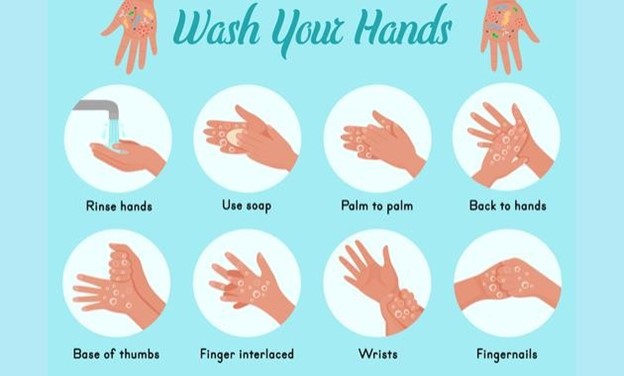
A nurse is preparing to perform hand hygiene. Which of the following actions should the nurse take?
A. Rub hands and arms to dry.
Rubbing hands and arms to dry is not the correct action for hand hygiene. After applying soap, hands should be rinsed thoroughly with water and then dried using a clean towel or air dryer.
B. Adjust the water temperature to feel hot.
Adjusting the water temperature to feel hot is not recommended for hand hygiene.Water that is too hot can be uncomfortable and may even cause skin irritation. The water should be comfortably warm.
C. Apply 4 to 5 mL of liquid soap to the hands.
Applying 4 to 5 mL of liquid soap to the hands is the correct action. This provides an adequate amount of soap to create a good lather for effective handwashing.
D. Hold the hands higher than the elbows.
Holding the hands higher than the elbows is not a necessary step for hand hygiene.The focus should be on thoroughly cleaning the hands, not on the position of the hands in relation to the elbows.
Full Explanation
A. Rubbing hands and arms to dry is not the correct action for hand hygiene. After applying soap, hands should be rinsed thoroughly with water and then dried using a clean towel or air dryer.
B. Adjusting the water temperature to feel hot is not recommended for hand hygiene.
Water that is too hot can be uncomfortable and may even cause skin irritation. The water should be comfortably warm.
C. Applying 4 to 5 mL of liquid soap to the hands is the correct action. This provides an adequate amount of soap to create a good lather for effective handwashing.
D. Holding the hands higher than the elbows is not a necessary step for hand hygiene.
The focus should be on thoroughly cleaning the hands, not on the position of the hands in relation to the elbows.