
Nursing practice questions with comprehensive rationales
NurseDive Free Nursing Practice Question
A client suspected of having a stroke is scheduled to have an angiogram. Which of the following is a priority action for the nurse?
A. Review renal function labs
Correct. Reviewing renal function labs is a priority action for the nurse because angiography involves the injection of contrast dye, which can cause nephrotoxicity in clients with impaired renal function. The nurse should ensure that the client's creatinine and blood urea nitrogen levels are within normal range before proceeding with the procedure.
B. Prep the client for surgery
Incorrect. Prepping the client for surgery is not a priority action for the nurse because angiography is not a surgical procedure, but a diagnostic one. The nurse should explain theprocedure to the client and obtain informed consent, but this is not as urgent as reviewing renal function labs.
C. Hold all fluids and food for 24 hours
Incorrect. Holding all fluids and food for 24 hours is not a priority action for the nurse because it can cause dehydration and electrolyte imbalance in the client, which can worsen their condition. The nurse should follow the facility's protocol for fasting before angiography, which is usually 4 to 6 hours.
D. Assess the gag reflex
Incorrect. Assessing the gag reflex is not a priority action for the nurse because it is not related to angiography, but to dysphagia, which is a common complication of stroke. The nurse should assess the client's swallowing ability and provide appropriate interventions, such asthickened liquids or speech therapy, but this is not as urgent as reviewing renal function labs.
This question is an excerpt from Nurse Dive's nursing test bank - Ati med surg adult care 2 proctored exam. Take the full exam now
Similar Questions
A nurse is assessing a client who has a traumatic head injury to determine motor function response. Which of the following client responses to painful stimulus is expected?
A. Flexes the upper and extends the lower extremities in response to the painful stimulus
Incorrect. Flexing the upper and extending the lower extremities in response to the painful stimulus is an abnormal response that indicates decorticate posturing, which is a sign of severe brain damage affecting the cerebral hemispheres.
B. Pushes the painful stimulus away
Correct. Pushing the painful stimulus away is a normal response that indicates intact motor function and voluntary movement.
C. Shows no reaction to the painful stimulus
Incorrect. Showing no reaction to the painful stimulus is an abnormal response that indicates no motor function or deep coma.
D. Extends her body toward the painful stimulus
Incorrect. Extending her body toward the painful stimulus is an abnormal response thatindicates decerebrate posturing, which is a sign of severe brain damage affecting the brainstem.
A physician tells the family of a client involved in a motorvehicle accident that the client sustained a coupcontrecoup injury. Which of the following statements by the nurse indicates an understanding of this type of traumatic brain injury?
A. This type of injury is never fatal
Incorrect. This type of injury can be fatal depending on the severity and location of the damage.
B. There are two points of impact with this type of injury
Correct. A coupcontrecoup injury occurs when the brain hits the skull at the site of impact (coup) and then rebounds and hits the opposite side of the skull (contrecoup).
C. The client has an open head injury
Incorrect. This type of injury is a closed head injury, meaning that the skull and dura mater are intact.
D. A large portion of the brain has a generalized injury
Incorrect. This type of injury causes focal damage to specific areas of the brain, not a generalized injury.
A nurse is caring for a client who has an epidural hematoma. Which of the following manifestations should the nurse expect?
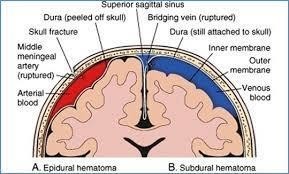
A. Cognitive perception that decreases over several months postinjury
Incorrect. Cognitive perception that decreases over several months postinjury is more characteristic of a subdural hematoma.
B. A change in the level of consciousness that develops over 48 hr
Incorrect. A change in the level of consciousness that develops over 48 hr is more characteristic of an intracerebral hemorrhage.
C. Neurologic deficits that increase up to 2 weeks postinjury
Incorrect. Neurologic deficits that increase up to 2 weeks postinjury is more characteristic of a subacute subdural hematoma.
D. A lucid period followed by decreasing level of consciousness
Correct. An epidural hematoma is caused by bleeding between the dura mater and the skull, usually from a ruptured artery. The bleeding can cause increased intracranial pressure, which can compress the brain and lead to a loss of consciousness. However, there may be a lucid periodbetween the initial injury and the onset of symptoms, when the client appears alert and oriented.