
Nursing practice questions with comprehensive rationales
NurseDive Free Nursing Practice Question
A client who recently suffered a stroke suffers from right-sided homonymous hemianopsia. What is the best action for the nurse to take when caring for the client during mealtime?
A. Place food trays on the left side of the client.
reason: This is the correct answer because right-sided homonymous hemianopsia means that the client has lost vision in the right half of both eyes, so placing food trays on the left side of the client will help them see and access their food better.
B. Place food trays on the right side of the client.
reason: This is incorrect because placing food trays on the right side of the client will make it harder for them to see and reach their food, as they have no vision on that side.
C. Perform a focused visual exam.
reason: This is incorrect because performing a focused visual exam is not an appropriate action for the nurse to take during meal time. The nurse should assess the client's vision before or after meals, but not interfere with their eating.
D. Have the assistive personnel feed all meals to the client.
reason: This is incorrect because having the assistive personnel feed all meals to the client will decrease their independence and dignity, as well as their ability to practice using their unaffected side. The nurse should encourage and assist the client to feed themselves as much as possible, and only provide assistance when needed.
This question is an excerpt from Nurse Dive's nursing test bank - ATI Med Surg Proctored Exam 4. Take the full exam now
Full Explanation
Choice A reason: This is the correct answer because right-sided homonymous hemianopsia means that the client has lost vision in the right half of both eyes, so placing food trays on the left side of the client will help them see and access their food better.
Choice B reason: This is incorrect because placing food trays on the right side of the client will make it harder for them to see and reach their food, as they have no vision on that side.
Choice C reason: This is incorrect because performing a focused visual exam is not an appropriate action for the nurse to take during meal time. The nurse should assess the client's vision before or after meals, but not interfere with their eating.
Choice D reason: This is incorrect because having the assistive personnel feed all meals to the client will decrease their independence and dignity, as well as their ability to practice using their unaffected side. The nurse should encourage and assist the client to feed themselves as much as possible, and only provide assistance when needed.
Similar Questions
A client returns to the clinic for follow-up treatment after a skin biopsy of a suspicious lesion performed 1 week ago. The biopsy report indicates that the lesion is a melanoma. The nurse understands that melanoma has which characteristics?
A. The lesion is asymmetrical and dark brown or black
Choice A Reason: This is correct because melanoma is a type of skin cancer that arises from melanocytes, which are cells that produce pigment. Melanoma lesions are often irregular in shape and color, and may have different shades of brown or black.
B. The lesion has a high risk for metastasis
Choice B Reason: This is correct because melanoma is a very aggressive and invasive type of skin cancer that can spread quickly to other parts of the body through the blood or lymphatic system. Melanoma has a high mortality rate if not detected and treated early.
C. The skin around the lesion is warm and red
Choice C Reason: This is incorrect because warm and red skin around a lesion may indicate inflammation or infection, but not necessarily melanoma. Melanoma lesions may have other signs, such as bleeding, itching, or ulceration.
D. The lesion is in an area that is frequently exposed to sunlight
Choice D Reason: This is correct because melanoma is associated with exposure to ultraviolet (UV) radiation from sunlight or artificial sources, such as tanning beds. UV radiation can damage the DNA of melanocytes and cause them to grow abnormally.
E. The lesion is painful
Choice E Reason: This is incorrect because melanoma lesions are usually not painful unless they are ulcerated or infected. Pain may be a sign of other types of skin conditions, such as burns, blisters, or cuts.
Full Explanation
Choice A Reason: This is correct because melanoma is a type of skin cancer that arises from melanocytes, which are cells that produce pigment. Melanoma lesions are often irregular in shape and color, and may have different shades of brown or black.
Choice B Reason: This is correct because melanoma is a very aggressive and invasive type of skin cancer that can spread quickly to other parts of the body through the blood or lymphatic system. Melanoma has a high mortality rate if not detected and treated early.
Choice C Reason: This is incorrect because warm and red skin around a lesion may indicate inflammation or infection, but not necessarily melanoma. Melanoma lesions may have other signs, such as bleeding, itching, or ulceration.
Choice D Reason: This is correct because melanoma is associated with exposure to ultraviolet (UV) radiation from sunlight or artificial sources, such as tanning beds. UV radiation can damage the DNA of melanocytes and cause them to grow abnormally.
Choice E Reason: This is incorrect because melanoma lesions are usually not painful unless they are ulcerated or infected. Pain may be a sign of other types of skin conditions, such as burns, blisters, or cuts.
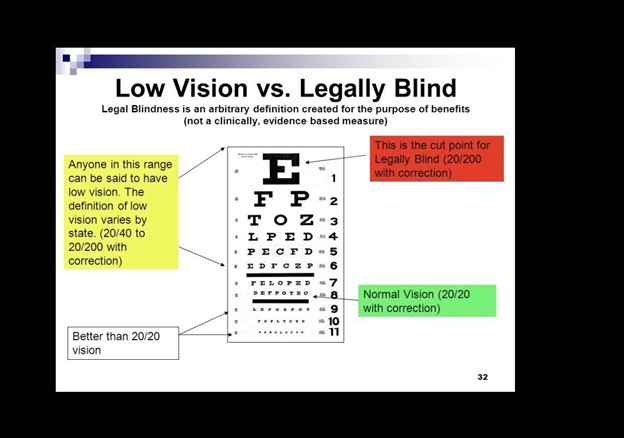
A client's chart indicates that they are legally blind. Which of the following is the definition of legally blind?
A. Full vision loss in at least one eye
Reason: This is incorrect because full vision loss in one eye does not necessarily mean that the person is legally blind. Legal blindness depends on the visual acuity and visual field of both eyes.
B. The best-corrected vision in the better eye of 20/200 or less
Reason: This is correct because legal blindness is defined by the World Health Organization (WHO) as having a visual acuity of 20/200 or worse in the better eye with the best possible correction, such as glasses or contact lenses. This means that the person can see at 20 feet what a normal person can see at 200 feet.
C. Inability to see clearly from 200 feet away without corrective lenses
Reason: This is incorrect because inability to see clearly from 200 feet away without corrective lenses may indicate nearsightedness or myopia, but not legal blindness. Nearsightedness can be corrected with lenses or surgery.
D. Bilateral visual impairment of 20/60 or greater
Reason: This is incorrect because bilateral visual impairment of 20/60 or greater does not meet the criteria for legal blindness. Visual impairment is defined by WHO as having a visual acuity of less than 20/60 but better than 20/200 in the better eye with the best possible correction.
Full Explanation
Choice A Reason: This is incorrect because full vision loss in one eye does not necessarily mean that the person is legally blind. Legal blindness depends on the visual acuity and visual field of both eyes.
Choice B Reason: This is correct because legal blindness is defined by the World Health Organization (WHO) as having a visual acuity of 20/200 or worse in the better eye with the best possible correction, such as glasses or contact lenses. This means that the person can see at 20 feet what a normal person can see at 200 feet.
Choice C Reason: This is incorrect because inability to see clearly from 200 feet away without corrective lenses may indicate nearsightedness or myopia, but not legal blindness. Nearsightedness can be corrected with lenses or surgery.
Choice D Reason: This is incorrect because bilateral visual impairment of 20/60 or greater does not meet the criteria for legal blindness. Visual impairment is defined by WHO as having a visual acuity of less than 20/60 but better than 20/200 in the better eye with the best possible correction.
A client arrives to the clinic after spending the day at the beach. She reports extreme pain and the nurse observes red skin on her face and upper body. There are no blisters present. What degree of burn has the client suffered?
A. First degree
Reason: This is correct because first degree burns are superficial burns that affect only the outer layer of the skin, called the epidermis. First degree burns cause redness, pain, and mild swelling, but no blisters or scarring. They usually heal within a week.
B. Second degree
Reason: This is incorrect because second degree burns are partial thickness burns that affect both the epidermis and the underlying layer of the skin, called the dermis. Second degree burns cause blisters, severe pain, and possible infection. They may take several weeks to heal and may leave scars.
C. Third degree
Reason: This is incorrect because third degree burns are full thickness burns that destroy all layers of the skin and may damage the underlying tissues, such as muscles, nerves, or bones. Third degree burns cause charred or white skin, numbness, and shock. They require skin grafting and may cause permanent disability or death.
D. This burn cannot be classified
Reason: This is incorrect because this burn can be classified according to the depth and extent of the skin damage. The classification of burns helps to determine the appropriate treatment and prognosis for the client.
Full Explanation
Choice A Reason: This is correct because first degree burns are superficial burns that affect only the outer layer of the skin, called the epidermis. First degree burns cause redness, pain, and mild swelling, but no blisters or scarring. They usually heal within a week.
Choice B Reason: This is incorrect because second degree burns are partial thickness burns that affect both the epidermis and the underlying layer of the skin, called the dermis. Second degree burns cause blisters, severe pain, and possible infection. They may take several weeks to heal and may leave scars.
Choice C Reason: This is incorrect because third degree burns are full thickness burns that destroy all layers of the skin and may damage the underlying tissues, such as muscles, nerves, or bones. Third degree burns cause charred or white skin, numbness, and shock. They require skin grafting and may cause permanent disability or death.
Choice D Reason: This is incorrect because this burn can be classified according to the depth and extent of the skin damage. The classification of burns helps to determine the appropriate treatment and prognosis for the client.