
Nursing practice questions with comprehensive rationales
NurseDive Free Nursing Practice Question
A client with a history of COPD is being assessed. When the nurse percusses the client's chest, which characteristic sound is expected?
A. Tympany
Tympany is a drum-like, resonant sound that is typically heard over air-filled structures, such as the gastric bubble, not the chest. It is not a sound associated with the lungs, especially in the context of COPD.
B. Hyperresonance
Hyperresonance is an abnormally loud, lower-pitched sound than normal resonance heard over hyperinflated areas of the lung, such as in cases of COPD. This is due to the increased air content within the lungs, often because of overdistension or destruction of alveolar tissue, as seen in emphysema, a common type of COPD.
C. Resonance
Resonance is the normal sound heard over healthy lung tissue when percussed. However, in the case of COPD, particularly emphysema, the destruction of lung tissue leads to hyperinflation and thus a hyperresonant sound rather than the normal resonance.
D. Dullness
Dullness is heard when fluid or solid tissue replaces air in the lung or occupies the pleural space, as in the case of pneumonia or pleural effusion. This is not characteristic of COPD, where there is an increase in air due to the breakdown of alveolar walls.
This question is an excerpt from Nurse Dive's nursing test bank - Ati Fundamentals Assessment Proctored Exam Midterm. Take the full exam now
Full Explanation
Choice a reason:
Tympany is a drum-like, resonant sound that is typically heard over air-filled structures, such as the gastric bubble, not the chest. It is not a sound associated with the lungs, especially in the context of COPD.
Choice b reason:
Hyperresonance is an abnormally loud, lower-pitched sound than normal resonance heard over hyperinflated areas of the lung, such as in cases of COPD. This is due to the increased air content within the lungs, often because of overdistension or destruction of alveolar tissue, as seen in emphysema, a common type of COPD.
Choice c reason:
Resonance is the normal sound heard over healthy lung tissue when percussed. However, in the case of COPD, particularly emphysema, the destruction of lung tissue leads to hyperinflation and thus a hyperresonant sound rather than the normal resonance.
Choice d reason:
Dullness is heard when fluid or solid tissue replaces air in the lung or occupies the pleural space, as in the case of pneumonia or pleural effusion. This is not characteristic of COPD, where there is an increase in air due to the breakdown of alveolar walls.
Similar Questions
A nurse educator is presenting at a continuing education seminar for nurses. As part of his presentation, he is emphasizing the prevention of skin breakdown in immobile patients who have suffered from a stroke. The level of prevention being discussed by the nurse educator is:
A. Educational Prevention
Educational Prevention is not a recognized level of prevention in healthcare. While education is a key component in all levels of prevention, it is not a standalone category. Education is typically included in primary prevention as it involves informing the public about health practices to prevent the onset of disease.
B. Tertiary Prevention
Tertiary Prevention is the level of prevention that aims to manage and treat an existing disease to prevent further complications or deterioration. In the case of immobile stroke patients, tertiary prevention would involve measures to prevent skin breakdown and other complications associated with immobility and the stroke's long-term effects.
C. Secondary Prevention
Secondary Prevention involves early detection and prompt intervention to prevent the progression of a disease. For stroke patients, secondary prevention might include monitoring for signs of skin breakdown so that early treatment can be initiated. However, the scenario described focuses on managing an existing condition rather than early detection.
D. Primary Prevention
Primary Prevention aims to prevent the disease or injury before it occurs. This would involve strategies to prevent strokes in the first place, such as controlling high blood pressure or encouraging healthy lifestyle changes. It does not directly relate to the prevention of skin breakdown in patients who have already had a stroke.
Full Explanation
Choice a reason:
Educational Prevention is not a recognized level of prevention in healthcare. While education is a key component in all levels of prevention, it is not a standalone category. Education is typically included in primary prevention as it involves informing the public about health practices to prevent the onset of disease.
Choice b reason:
Tertiary Prevention is the level of prevention that aims to manage and treat an existing disease to prevent further complications or deterioration. In the case of immobile stroke patients, tertiary prevention would involve measures to prevent skin breakdown and other complications associated with immobility and the stroke's long-term effects.
Choice c reason:
Secondary Prevention involves early detection and prompt intervention to prevent the progression of a disease. For stroke patients, secondary prevention might include monitoring for signs of skin breakdown so that early treatment can be initiated. However, the scenario described focuses on managing an existing condition rather than early detection.
Choice d reason:
Primary Prevention aims to prevent the disease or injury before it occurs. This would involve strategies to prevent strokes in the first place, such as controlling high blood pressure or encouraging healthy lifestyle changes. It does not directly relate to the prevention of skin breakdown in patients who have already had a stroke.
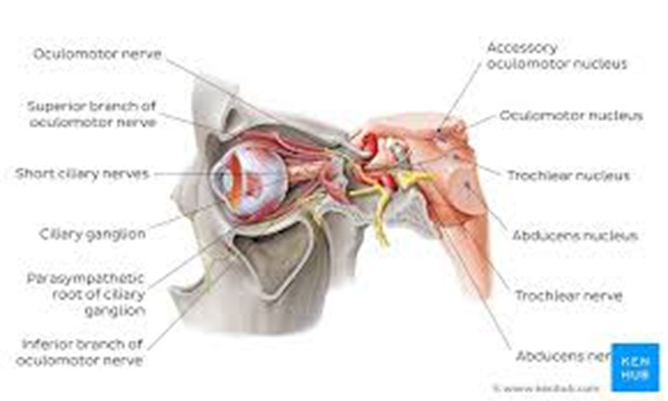
The nurse read the patient's health history and noted cranial nerve III oculomotor paralysis. Which of the following would the nurse expect?
A. The eye cannot look to the outside.
The inability of the eye to look outward, known as lateral rectus palsy, is associated with cranial nerve VI, the abducens nerve, not the oculomotor nerve. The oculomotor nerve does not control the lateral rectus muscle which governs this movement.
B. Myopia.
Myopia, or nearsightedness, is a refractive error of the eye where distant objects appear blurry while close objects can be seen clearly. It is not related to oculomotor nerve paralysis, which affects eye movements and pupil response, not the shape of the eyeball or the refractive properties of the lens.
C. Ptosis will be evident and no pupillary constriction.
Ptosis, or drooping of the upper eyelid, and an absence of pupillary constriction are classic signs of oculomotor nerve paralysis. The oculomotor nerve controls most of the eye's movements, including lifting the eyelid via the levator palpebrae superioris muscle and constricting the pupil through the circular muscles of the iris.
D. Normal eye movement.
Normal eye movement would not be expected in a patient with oculomotor nerve paralysis. This nerve controls the majority of the eye's movements, so paralysis would lead to abnormal eye movement, such as the inability to move the eye upward, downward, or inward.
Full Explanation
Choice a reason:
The inability of the eye to look outward, known as lateral rectus palsy, is associated with cranial nerve VI, the abducens nerve, not the oculomotor nerve. The oculomotor nerve does not control the lateral rectus muscle which governs this movement.
Choice b reason:
Myopia, or nearsightedness, is a refractive error of the eye where distant objects appear blurry while close objects can be seen clearly. It is not related to oculomotor nerve paralysis, which affects eye movements and pupil response, not the shape of the eyeball or the refractive properties of the lens.
Choice c reason:
Ptosis, or drooping of the upper eyelid, and an absence of pupillary constriction are classic signs of oculomotor nerve paralysis. The oculomotor nerve controls most of the eye's movements, including lifting the eyelid via the levator palpebrae superioris muscle and constricting the pupil through the circular muscles of the iris.
Choice d reason:
Normal eye movement would not be expected in a patient with oculomotor nerve paralysis. This nerve controls the majority of the eye's movements, so paralysis would lead to abnormal eye movement, such as the inability to move the eye upward, downward, or inward.
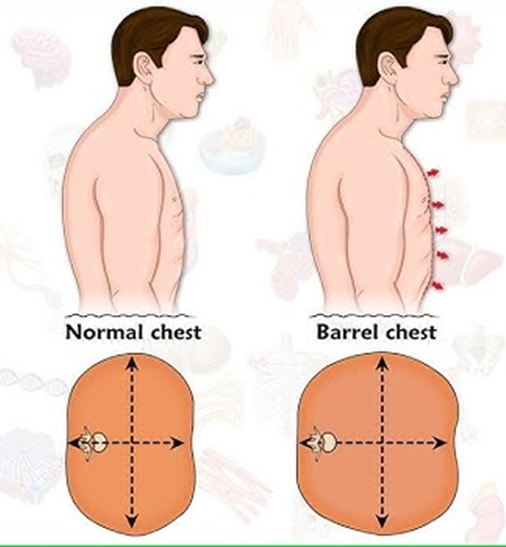
While examining a client, the nurse observes the client's chest to be barrel-shaped. The nurse would interpret this as indicating which of the following?
A. Pigeon Chest
Pigeon Chest, or pectus carinatum, is a condition where the breastbone is pushed outward, and the chest appears to protrude. It is not typically associated with a barrel-shaped chest, which is characterized by a rounded and bulging appearance.
B. Pneumonia
Pneumonia is an infection that inflames the air sacs in one or both lungs, which may fill with fluid or pus. While it can cause chest expansion, it does not lead to a barrel-shaped chest. The barrel-shaped chest is more indicative of a chronic condition rather than an acute infection like pneumonia.
C. Funnel Chest
Funnel Chest, or pectus excavatum, is a condition where the breastbone is sunken into the chest. Unlike a barrel-shaped chest, funnel chest gives the chest a depressed appearance.
D. COPD
COPD, or Chronic Obstructive Pulmonary Disease, is commonly associated with a barrel-shaped chest. This shape results from the chronic hyperinflation of the lungs due to obstructive lung disease, which causes the rib cage to remain expanded.
Full Explanation
Choice a reason:
Pigeon Chest, or pectus carinatum, is a condition where the breastbone is pushed outward, and the chest appears to protrude. It is not typically associated with a barrel-shaped chest, which is characterized by a rounded and bulging appearance.
Choice b reason:
Pneumonia is an infection that inflames the air sacs in one or both lungs, which may fill with fluid or pus. While it can cause chest expansion, it does not lead to a barrel-shaped chest. The barrel-shaped chest is more indicative of a chronic condition rather than an acute infection like pneumonia.
Choice c reason:
Funnel Chest, or pectus excavatum, is a condition where the breastbone is sunken into the chest. Unlike a barrel-shaped chest, funnel chest gives the chest a depressed appearance.
Choice d reason:
COPD, or Chronic Obstructive Pulmonary Disease, is commonly associated with a barrel-shaped chest. This shape results from the chronic hyperinflation of the lungs due to obstructive lung disease, which causes the rib cage to remain expanded.