
Nursing practice questions with comprehensive rationales
NurseDive Free Nursing Practice Question
A nurse in a burn treatment center is caring for a client who is admitted with severe burns to both lower extremities and is scheduled for an escharotomy. The client's spouse asks the nurse what the procedure entails. Which of the following nursing statements is appropriate?
A. "This procedure involves placing the client into a shower and removing the dead tissue."
B. "Dead tissue will be non-surgically removed."
C. "Large incisions will be made in the eschar to improve circulation."
An escharotomy is a surgical procedure that involves making incisions in the eschar, which is the hard, blackened tissue that forms over a severe burn wound. The eschar can restrict blood flow and cause compartment syndrome, which can lead to tissue necrosis and nerve damage. By cutting through the eschar, the pressure is relieved and circulation is restored. This procedure does not involve removing the dead tissue, which is done by debridement or hydrotherapy. A skin graft is a different procedure that involves transplanting healthy skin from another site to cover a burn wound.
D. "A piece of healthy skin will be removed from an unburned area and grafted over the burned area."
This question is an excerpt from Nurse Dive's nursing test bank - ATI SP 250 Exam 3 Med Surg Proctored Exam. Take the full exam now
Full Explanation
An escharotomy is a surgical procedure that involves making incisions in the eschar, which is the hard, blackened tissue that forms over a severe burn wound. The eschar can restrict blood flow and cause compartment syndrome, which can lead to tissue necrosis and nerve damage. By cutting through the eschar, the pressure is relieved and circulation is restored. This procedure does not involve removing the dead tissue, which is done by debridement or hydrotherapy. A skin graft is a different procedure that involves transplanting healthy skin from another site to cover a burn wound.
Similar Questions
A nurse is teaching a client who has emphysema about self-management strategies. Which of the following statements by the client indicates an understanding of the teaching?
A. "I will inhale slowly through pursed lips to help me breathe better."
Inhaling slowly through pursed lips is incorrect. The correct technique is to exhale slowly through pursed lips, which helps to keep the airways open longer, allowing for better air exchange and reducing shortness of breath.
B. "I will lie on my stomach to practice abdominal breathing every day."
Lying on the stomach to practice abdominal breathing is not a recommended strategy for managing emphysema. Abdominal or diaphragmatic breathing can be beneficial, but it is typically practiced in a comfortable, upright position.
C. "I will follow a daily diet high in calories and protein."
Clients with emphysema often have an increased caloric demand due to the effort required to breathe. A diet high in calories and protein can help maintain energy levels and prevent muscle wasting.
D. "I will avoid getting a flu shot."
Avoiding a flu shot is incorrect. Patients with emphysema are at higher risk for respiratory infections, and getting an annual flu shot is crucial to prevent complications.
Full Explanation
The correct answer is choice C. “I will follow a daily diet high in calories and protein.”
Choice A rationale:
Inhaling slowly through pursed lips is incorrect. The correct technique is to exhale slowly through pursed lips, which helps to keep the airways open longer, allowing for better air exchange and reducing shortness of breath.
Choice B rationale:
Lying on the stomach to practice abdominal breathing is not a recommended strategy for managing emphysema. Abdominal or diaphragmatic breathing can be beneficial, but it is typically practiced in a comfortable, upright position.
Choice C rationale:
Clients with emphysema often have an increased caloric demand due to the effort required to breathe. A diet high in calories and protein can help maintain energy levels and prevent muscle wasting.
Choice D rationale:
Avoiding a flu shot is incorrect. Patients with emphysema are at higher risk for respiratory infections, and getting an annual flu shot is crucial to prevent complications.
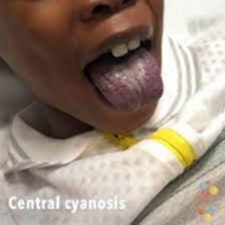
A nurse is assessing a client who has asthma. Which of the following areas should the nurse evaluate as the most reliable indicator of central cyanosis?
A. Soles of the feet
B. Ear lobes
C. Oral mucosa
This is because central cyanosis reflects a decrease in arterial oxygen saturation and is best seen in areas where blood vessels are close to the surface, such as the oral mucosa, tongue, and lips. Peripheral cyanosis, which may be caused by vasoconstriction or poor circulation, can be seen in the soles of the feet, ear lobes, and nail beds, but it does not necessarily indicate hypoxemia.
D. Conjunctivae
Full Explanation
This is because central cyanosis reflects a decrease in arterial oxygen saturation and is best seen in areas where blood vessels are close to the surface, such as the oral mucosa, tongue, and lips. Peripheral cyanosis, which may be caused by vasoconstriction or poor circulation, can be seen in the soles of the feet, ear lobes, and nail beds, but it does not necessarily indicate hypoxemia.
A nurse is talking with a client who has to come to the clinic for HIV testing. The nurse should explain that, after the laboratory has the enzyme- linked immunosorbent assay (ELISA) results, it will use which of the following tests to confirm the diagnosis?
A. CD4+ T-cell count
B. Western blot analysis
This is because Western blot analysis detects specific antibodies to HIV antigens and has a high specificity and sensitivity for HIV infection. CD4+ T-cell count measures the number of helper T cells in the blood and indicates the degree of immunosuppression in clients with HIV infection, but it does not confirm the diagnosis. Quantitative RNA assay and viral load test measure the amount of HIV RNA in the blood and indicate the level of viral replication and response to antiretroviral therapy, but they do not confirm the diagnosis.
C. Quantitative RNA assay
D. Viral load test
Full Explanation
This is because Western blot analysis detects specific antibodies to HIV antigens and has a high specificity and sensitivity for HIV infection. CD4+ T-cell count measures the number of helper T cells in the blood and indicates the degree of immunosuppression in clients with HIV infection, but it does not confirm the diagnosis. Quantitative RNA assay and viral load test measure the amount of HIV RNA in the blood and indicate the level of viral replication and response to antiretroviral therapy, but they do not confirm the diagnosis.